
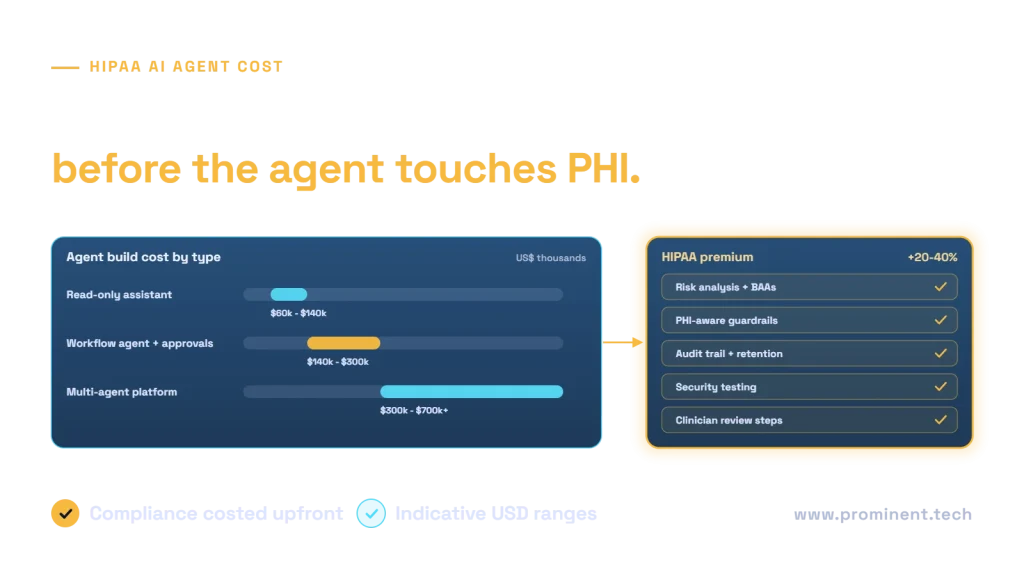
A HIPAA-compliant AI agent typically costs US$60,000 to US$140,000 to build as a read-only assistant over protected health information (PHI), US$140,000 to US$300,000 as a workflow agent that prepares or updates records in clinical or administrative systems with human approval, and US$300,000 to US$700,000 or more as a multi-agent platform. Compared with an equivalent agent that does not handle PHI, HIPAA safeguards usually add 20 to 40 percent to the build: risk analysis, business associate agreements (BAAs), PHI-aware guardrails, audit trails, security testing and clinician review steps. Running costs are also higher because of log retention, monitoring and compliance reviews. These are indicative planning ranges, not a quote.
Key takeaways
- Budget the HIPAA safeguards as explicit line items, not hidden contingency.
- Read-only agents are the cheapest and fastest way to deliver value with PHI.
- Write actions into EHR or claims systems add integration, approval and testing cost.
- Every vendor touching PHI needs a BAA; this can limit service choices and affect pricing tiers.
- Use de-identified data for most development and testing to reduce cost and risk.
HIPAA-compliant AI agent cost by agent type
| Agent type | Example | Indicative build cost (USD) | Typical timeline |
|---|---|---|---|
| Read-only assistant | Answers staff questions over policies and a patient’s chart, with citations | $60,000 – $140,000 | 3 – 5 months |
| Workflow agent with approvals | Prepares prior authorisation packets or referral letters for staff to approve | $140,000 – $300,000 | 5 – 8 months |
| Multi-agent platform | Several agents across intake, coding and care coordination with shared governance | $300,000 – $700,000+ | 9 – 15 months |
For general agent pricing without PHI, see AI agent development cost in 2027. For the safeguards themselves, see HIPAA-compliant AI applications.
What the HIPAA premium pays for
- Risk analysis and documentation. Updating the Security Rule risk analysis to include prompts, tools, indexes, logs and vendors.
- BAA-covered services. Selecting and configuring model, hosting and logging services under BAAs, sometimes at higher service tiers.
- PHI-aware guardrails. Minimum necessary filtering, output checks and blocking of unsafe requests.
- Audit trails. Recording who asked what, which records the agent accessed and what it did, with secure retention.
- Security testing. Threat modelling and red-teaming, including prompt injection from clinical documents.
- Clinician review. Approval queues and interfaces so qualified staff stay accountable.
The HHS Security Rule guidance sets out the administrative, physical and technical safeguards these activities implement.
Cost drivers specific to healthcare AI agents
- EHR integration. Read access through FHIR APIs is common; write access is more restricted and often requires vendor approval. See FHIR API integration.
- Clinical content. Notes, scanned documents and codes need careful extraction and validation.
- Evaluation with clinicians. Clinical experts must review test cases and outputs.
- Approval design. Each action needs a defined reviewer and audit trail. See human-in-the-loop AI agents.
- Organisational review. Privacy, security and clinical governance committees add calendar time.
Running costs for HIPAA-compliant agents
| Cost line | Indicative monthly range (USD) |
|---|---|
| Model usage under BAA | $500 – $15,000 |
| Protected hosting, indexes and storage | $800 – $6,000 |
| Audit log retention and monitoring | $300 – $3,000 |
| Ongoing compliance reviews and security testing | Typically 10 – 15% of build per year |
| Clinician review time | Measured in staff hours per approved task |
A worked HIPAA AI agent cost estimate
Illustrative, fictional example: a specialty clinic group builds an agent that gathers chart evidence and drafts prior authorisation requests for staff approval.
| Line | Assumption | Amount (USD) |
|---|---|---|
| Agent build | FHIR read access, document extraction, payer rules, drafting, approval queue | $150,000 |
| HIPAA safeguards | 30% for risk analysis, guardrails, audit, security testing | $45,000 |
| Running cost | $4,500 a month including protected hosting and logging | $54,000 |
| Ongoing compliance and support | 12% of build | $18,000 |
| First-year total | $267,000 |
Compare with measured benefits during a pilot, such as staff hours saved per request and faster approvals.
Controlling cost without cutting safeguards
- Start read-only. Deliver value with drafting and retrieval before adding write actions.
- Use de-identified data for development and most testing. See the HHS de-identification guidance.
- Reuse a governed AI layer across agents for guardrails, audit and access control.
- Engage compliance early so reviews run in parallel with the build.
- Measure cost per task and route routine steps to smaller models.
Common questions
How much does a HIPAA-compliant AI agent cost?
Indicatively, US$60,000 to US$140,000 for a read-only assistant, US$140,000 to US$300,000 for a workflow agent with approvals, and US$300,000 to US$700,000 or more for a multi-agent platform, plus running and compliance costs.
How much does HIPAA compliance add to AI agent cost?
Typically 20 to 40 percent of the build compared with an equivalent agent that does not handle PHI, plus higher running costs for protected hosting, logging and reviews.
Can we reduce cost by using de-identified data?
Yes, for development, testing and some analytics use cases. De-identified data under HIPAA’s methods is not PHI, which simplifies safeguards.
Do AI agents in healthcare need human approval?
For clinical and coverage decisions, yes. Agents can draft and prepare, but qualified staff should review and remain accountable.
How long does a HIPAA-compliant AI agent take to build?
Three to five months for a read-only assistant and five to eight months for a workflow agent, including security and compliance reviews.
Get a realistic estimate for your healthcare AI agent
Share the workflow, the systems involved and who must approve the agent’s work. Our healthcare and generative AI development teams will scope the agent and its safeguards, with HIPAA requirements planned with your compliance team.