
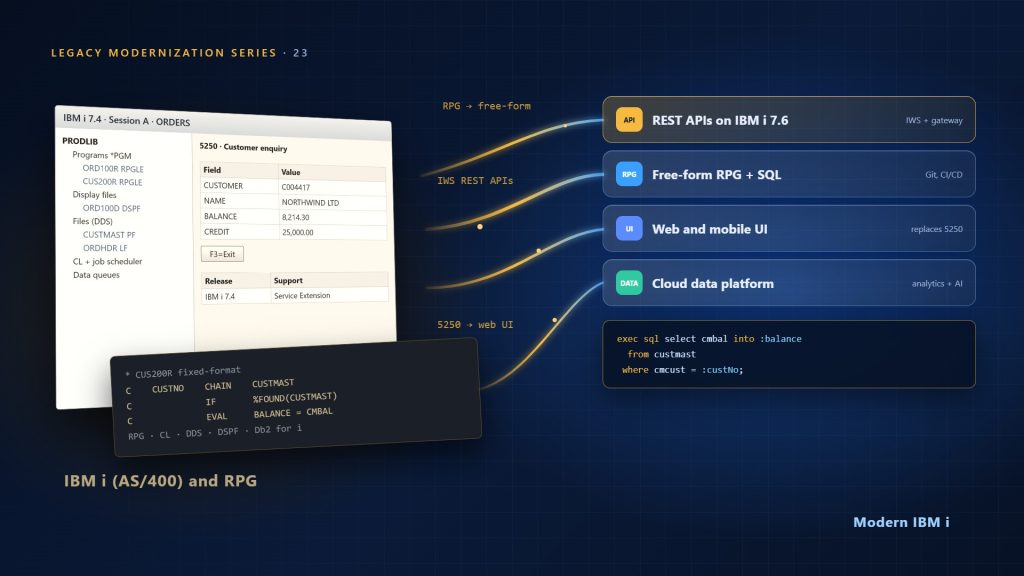
IBM i RPG modernization connects business systems running on IBM i (formerly AS/400 and iSeries) to modern applications through APIs, modern RPG and SQL, while keeping the reliable core that many distributors, manufacturers, retailers and insurers still run on. IBM i is a current IBM platform: version 7.6 became generally available in April 2025. Version 7.4 moved off standard support on 30 September 2026. The real pressures are green-screen user interfaces, fixed-format RPG that few developers can read, and data locked away from analytics and cloud services. This guide covers the support status, integration options, code patterns and a phased plan.
Technically reviewed by Harshita Pipaliya.
This is the twenty-third article in our Legacy Modernization Series. It follows COBOL/CICS Mainframe Modernization, which uses the same API-first approach on IBM Z.
Executive summary
- The platform is current: IBM i 7.6 became generally available on 18 April 2025 and 7.5 on 10 May 2022. IBM will announce their end of standard support with at least 12 months’ notice (IBM release life cycle).
- 7.4 is on paid extension: standard support for IBM i 7.4 changed on 30 September 2026. IBM’s Service Extension for 7.4 runs from 1 October 2026 to 30 September 2029.
- APIs are built in: the Integrated Web Services (IWS) server exposes ILE programs as REST or SOAP services, and Db2 for i SQL HTTP functions let RPG and SQL call external REST APIs.
- Modernize the code, not just the screen: converting fixed-format RPG to free-form RPG with embedded SQL makes the logic readable and testable for a wider pool of developers.
- Our recommendation: move to IBM i 7.5 or 7.6, expose key business functions as APIs, give users a web front end over those APIs, modernize RPG and the database step by step, and decide on any platform exit per capability, not as one big rewrite.
IBM i support status
| Release | Generally available | Standard support | Notes |
|---|---|---|---|
| IBM i 7.6 | 18 April 2025 | Current | End date to be announced with 12 months’ notice |
| IBM i 7.5 | 10 May 2022 | Current | End date to be announced with 12 months’ notice |
| IBM i 7.4 | 21 June 2019 | Changed 30 September 2026 | Service Extension 1 October 2026 to 30 September 2029 |
| IBM i 7.3 | 15 April 2016 | Changed 30 September 2023 | Extended Service Extension to 30 September 2028 |
Source: IBM release life cycle page (modified March 2026). Hardware also matters: a server that cannot run 7.5 or 7.6 limits your options, so check your Power model.
What this means: IBM i is not end of life, but releases are. Plan upgrades to 7.5 or 7.6 alongside modernization, and treat paid service extensions as a bridge.
Why IBM i applications need modernizing
- User experience: 5250 green screens are fast for experts but hard for new staff, customers and mobile users.
- Skills: fixed-format RPG, data description specifications (DDS) and CL are unfamiliar to most developers.
- Integration: partners, e-commerce and cloud services expect APIs and events, not file transfers.
- Data access: analytics and AI teams need data in modern platforms, with clear models.
- Change speed: large monolithic programs without automated tests slow every change.
Modernization paths compared
| Path | What it means | Best for | Watch-outs |
|---|---|---|---|
| Upgrade and refactor on IBM i | Free-form RPG, SQL, modular ILE, Git and CI/CD | Systems that fit the business well | Needs RPG skills and investment |
| API enablement | REST APIs over RPG programs and Db2 for i | New channels and partners | Design coarse-grained, secure APIs |
| New web front end | Browser UI over APIs, replacing 5250 screens | User experience and onboarding | Avoid pure screen-scraping where possible |
| Data replication | Change data capture to a cloud data platform | Analytics, AI, reporting | Data latency and mapping |
| Rebuild or replace by capability | Move selected functions to .NET, Java or SaaS behind the same APIs | Clear business case per capability | Integration and data sync during transition |
Most programmes combine the first four, and use the fifth selectively.
IBM i to API concept mapping
| IBM i | Modern equivalent | Notes |
|---|---|---|
| RPG program or service program (ILE) | REST API operation via IWS | Expose business functions, not screens |
| 5250 display files (DSPF) | Web or mobile UI over APIs | |
| DDS physical and logical files | SQL tables, views and indexes in Db2 for i | Convert gradually; keep record formats compatible |
Native I/O (CHAIN, READ, WRITE) | Embedded SQL | Set-based where possible |
| Data queues, data areas | Message queues, events, configuration | |
| CL programs and job scheduler | Scheduled jobs, pipelines, events | |
| User profiles and object authority | OAuth at the gateway, mapped service profiles, row and column access control | |
| Save files and FTP interfaces | APIs and managed file transfer |
Code patterns: before and after
The examples below are illustrative and simplified.
1. Fixed-format RPG with native I/O (before):
     FCUSTMAST  IF   E           K DISK
     C     CUSTNO        CHAIN     CUSTMAST
     C                   IF        %FOUND(CUSTMAST)
     C                   EVAL      BALANCE = CMBAL
     C                   ENDIF
2. Fully free-form RPG with embedded SQL (after): a procedure ready to expose as an API.
**free
dcl-proc getBalance export;
  dcl-pi *n packed(13:2);
    custNo char(10) const;
  end-pi;
  dcl-s balance packed(13:2) inz(0);

  exec sql
    select cmbal into :balance
      from custmast
     where cmcust = :custNo;

  return balance;
end-proc;
3. Calling an external REST API from Db2 for i SQL:
SELECT r.currency, r.rate
FROM JSON_TABLE(
       QSYS2.HTTP_GET('https://api.example.com/fx-rates?base=USD'),
       '$.rates[*]'
       COLUMNS (currency CHAR(3) PATH '$.code',
                rate DECIMAL(15,6) PATH '$.value')) AS r;
4. A .NET client using the IWS-hosted API through a gateway:
public record CustomerBalance(string CustomerNo, decimal Balance);

public class CustomerClient(HttpClient http)
{
    public Task<CustomerBalance?> GetAsync(string customerNo, CancellationToken ct) =>
        http.GetFromJsonAsync<CustomerBalance>($"customers/{Uri.EscapeDataString(customerNo)}/balance", ct);
}
Recommended target architecture
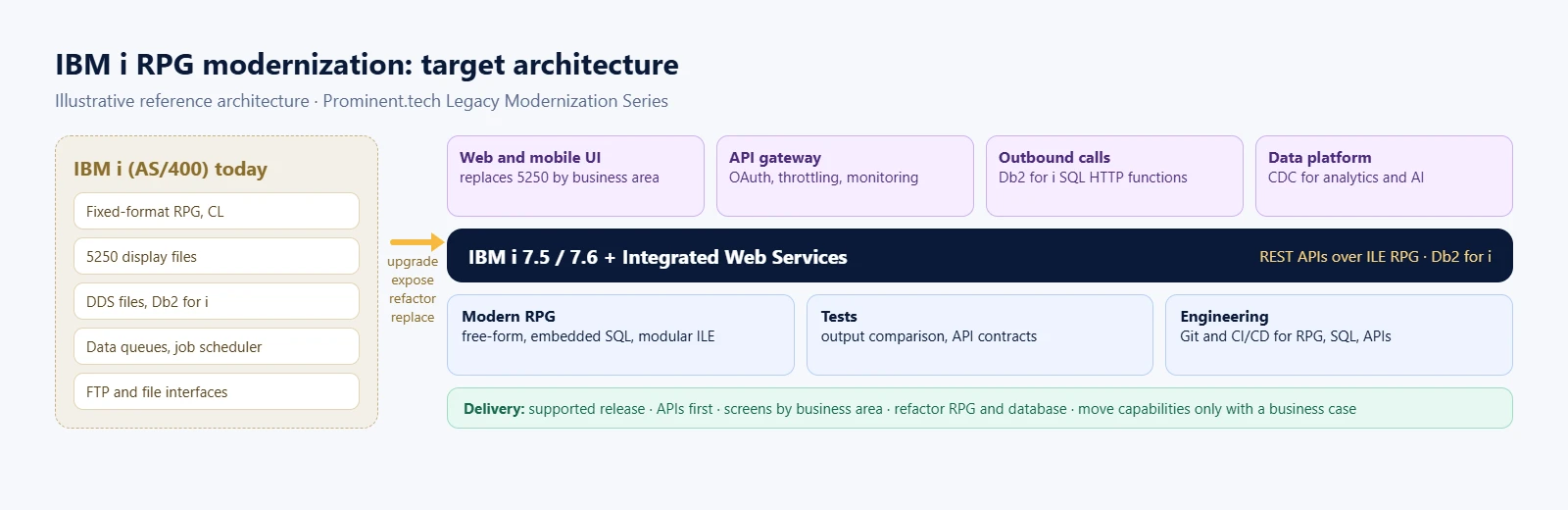
- Core: IBM i 7.5 or 7.6 with Db2 for i, running modernized ILE RPG and SQL.
- API layer: Integrated Web Services exposing business functions as REST APIs; SQL HTTP functions for outbound calls.
- Gateway and identity: an API gateway for OAuth, throttling and monitoring, with mapped service profiles on IBM i.
- User interface: web and mobile front ends over the APIs, replacing 5250 screens by business area.
- Data: change data capture into a cloud data platform for analytics, reporting and AI.
- Engineering: Git, CI/CD and automated tests for RPG, SQL and APIs.
Running core operations on IBM i? Talk to our modernization team about an API-first plan that keeps what works and opens it to new channels.
IBM i modernization steps
- Inventory: programs, service programs, files, display files, CL, jobs, interfaces and their usage.
- Upgrade to IBM i 7.5 or 7.6 if you are on 7.4 or earlier, and bring Technology Refresh and PTF levels current.
- Set up engineering: source in Git, a modern editor, builds and automated tests.
- Expose APIs for the most valuable business functions through IWS and a gateway.
- Refactor RPG to free-form with embedded SQL, module by module, starting with code you change most.
- Modernize the database: define DDS files as SQL tables and views where it helps, add constraints.
- Replace screens with web and mobile UIs over the APIs, by business area.
- Replicate data to a cloud platform for analytics and AI.
- Move capabilities off IBM i only where there is a clear business case, behind the same APIs.
Security considerations
- Gateway first: expose APIs only through a gateway with TLS, OAuth and rate limiting.
- Service profiles: run APIs under dedicated user profiles with the minimum object authority.
- Row and column access control: use Db2 for i permissions and masks for sensitive data.
- Retire insecure interfaces: replace plain FTP and Telnet with secure alternatives.
- Audit: use the IBM i audit journal and correlate with gateway logs.
Testing, deployment and support
Testing
- Capture current program outputs and compare them after RPG refactoring.
- Contract tests for every API; end-to-end tests for each new UI flow.
- Performance tests at peak, especially for interactive and batch overlap.
Deployment
- Deploy RPG, SQL and API changes through a pipeline with promotion between environments.
- Keep 5250 screens available while new UIs are adopted, then retire them.
Support
- Track IBM i release support dates and apply Technology Refreshes and PTFs.
- Document APIs, owners and runbooks for both IBM i and cloud teams.
Request an estimate
Cost and timeline depend on your application, data and integrations, so we estimate each project individually rather than publish price ranges. Hardware, IBM i licences and service extensions are extra. Cost drivers: program count and complexity, DDS usage, number of screens, integrations and test coverage.
Request an estimate for your application, or read legacy application modernization cost and ROI to build the business case.
FAQs
Is IBM i (AS/400) still supported?
Yes. IBM i 7.6 became available in April 2025 and 7.5 in May 2022, both under standard support. IBM i 7.4 moved to a paid Service Extension on 1 October 2026.
Do we have to leave IBM i to modernize?
No. Many organizations modernize on IBM i with APIs, web front ends, free-form RPG and SQL, and move only selected capabilities elsewhere.
How do we expose RPG programs as APIs?
Use the Integrated Web Services server on IBM i to expose ILE programs as REST or SOAP services, and publish them through an API gateway.
Can RPG call external REST APIs?
Yes. Db2 for i SQL HTTP functions such as HTTP_GET and HTTP_POST call REST services from SQL, which RPG can use through embedded SQL. The IWS client can also generate stubs for RPG.
Should we convert fixed-format RPG to free-form?
For code you change often, yes. Free-form RPG with embedded SQL is easier to read, test and staff.
What about green screens?
Replace them with web or mobile UIs over APIs, business area by business area. Screen-wrapping tools can help short term but do not fix the underlying design.
How long does IBM i modernization take?
A pilot with a few APIs and one UI area often takes two to four months. Enterprise programmes take a year or more, in phases.
Conclusion
IBM i remains a supported, current platform, but 7.4 is now on paid extension and green screens and fixed-format RPG hold businesses back. Upgrade to 7.5 or 7.6, expose business functions as secure APIs, replace screens with modern UIs, modernize RPG and the database step by step, and move capabilities elsewhere only where it pays.
Previous in this series: COBOL/CICS Mainframe Modernization. Next: AI-Powered Legacy Code Discovery.
Related services: Legacy Software Modernization · .NET Development · Microsoft Azure · AWS · Data and API Integration
Sources
- IBM, Release life cycle (IBM i releases)
- RPGPGM.COM, EoS for 7.4 announced (September 2025)
- IBM, Integrated Web Services for IBM i
- IBM Docs, HTTP functions overview (Db2 for i 7.5)
Plan your IBM i modernization
Prominent.tech helps teams modernize IBM i applications step by step: secure APIs over RPG programs, web front ends to replace green screens, free-form RPG and SQL, and data replication for analytics and AI. Talk to our modernization team or explore our legacy software modernization services.