
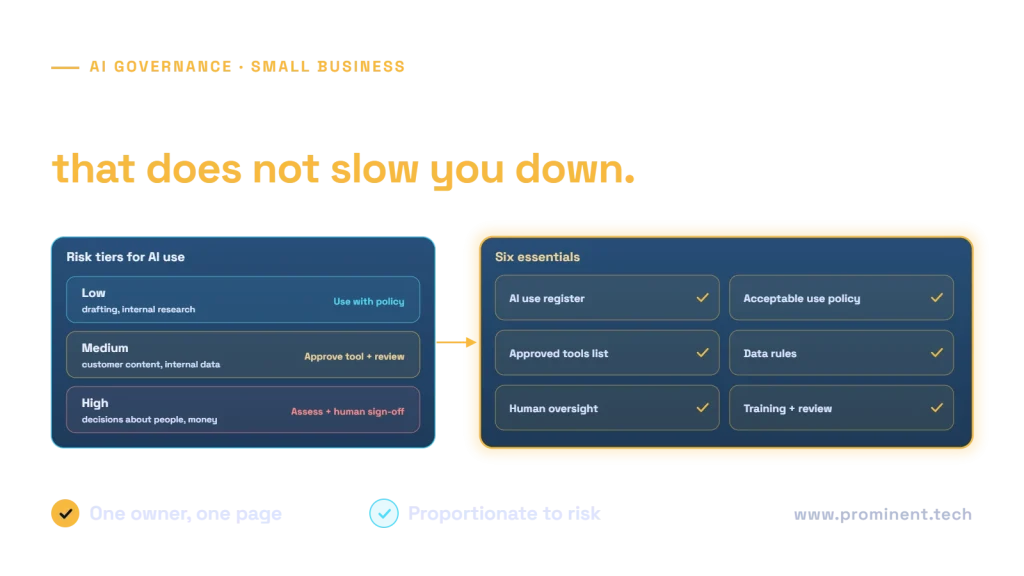
AI governance for startups and small businesses is a lightweight set of rules and habits that let the team use AI productively while controlling the real risks: confidential data leaking into public tools, inaccurate output reaching customers, unfair or unlawful decisions about people, and breaking customer contracts or regulations. It does not need a committee. A right-sized framework has one accountable owner, an inventory of where AI is used, a one-page acceptable use policy, an approved tools list, clear data rules, human review for high-impact uses, basic training and a quarterly review. Most small businesses can put it in place within 90 days.
Key takeaways
- Govern by risk: most everyday AI use needs a policy, not an approval process.
- Know where AI is used. An AI register is the foundation of everything else.
- Set clear data rules: what may and may not be entered into which tools.
- Require human review before AI output affects customers, money or people.
- Keep it to a few pages and one owner, and review it every quarter.
Why small businesses need AI governance
- Shadow AI. Staff already use AI tools, often personal accounts, with company data.
- Confidentiality. Customer data or code pasted into the wrong tool can breach contracts and data protection law.
- Accuracy. AI output can be wrong but convincing; see the real cost of LLM hallucinations.
- Customer trust. Enterprise customers increasingly ask suppliers how they govern AI.
- Regulation. Rules such as the EU AI Act apply by use case, not company size, and include obligations such as AI literacy for staff.
A right-sized AI governance framework
| Essential | What it looks like in a small business |
|---|---|
| Accountable owner | One named person, often the CTO, COO or a founder |
| AI use register | A simple list of tools and use cases, owners, data used and risk tier |
| Acceptable use policy | One or two pages staff actually read |
| Approved tools list | Business accounts with appropriate data terms; personal accounts not used for company data |
| Data rules | Which data classes may go into which tools |
| Human oversight | Named reviewers for medium- and high-risk uses |
| Vendor checks | Short questionnaire on data use, retention and security |
| Training | Short session on safe use, plus onboarding for new staff |
| Incident handling | How to report and fix AI mistakes or data exposure |
| Quarterly review | Update the register, tools list and policy |
The NIST AI Risk Management Framework offers a fuller structure you can grow into.
Risk tiers: proportionate controls
Tiering keeps governance light where risk is low. Customer-facing assistants and AI agents that take actions usually sit in the medium or high tier; see AI agent security threats and LLM guardrails for technical controls.
What to put in an AI acceptable use policy
- Which tools are approved, and that company data stays in approved tools.
- Data that must never be entered, such as customer personal data, credentials and confidential contracts, unless a tool is approved for it.
- That people remain responsible for anything they publish or send.
- When AI use must be disclosed to customers.
- How to request a new tool or use case.
- How to report a mistake or data exposure.
A 90-day implementation plan
- Weeks 1–2: appoint the owner and build the AI register by asking each team what they use.
- Weeks 3–4: agree risk tiers, data rules and the approved tools list; move staff to business accounts.
- Weeks 5–6: publish the one-page policy and run a short training session.
- Weeks 7–10: review medium- and high-risk uses, add human oversight and vendor checks.
- Weeks 11–12: set up incident reporting and schedule the quarterly review.
Regulation and customer expectations
Requirements depend on where you operate and what the AI does. Data protection law applies to personal data in any AI tool; the UK ICO publishes guidance on AI and data protection. Higher-risk uses, such as recruitment or credit decisions, carry more obligations. As you grow and build your own models, extend this framework with ML governance and model risk management.
Common questions
Does a small business need AI governance?
Yes, but proportionate to its risks. A few pages of policy, a register of AI use, clear data rules and human review for high-impact uses cover most needs.
Who should own AI governance in a startup?
One accountable person, typically the CTO, COO or a founder, with input from whoever handles legal, security and data protection.
Should we ban public AI tools?
Usually not. Approve business versions with suitable data terms, set clear data rules and move staff away from personal accounts for company work.
Does the EU AI Act apply to small businesses?
It applies based on the AI use and market, not company size, though some obligations are lighter for smaller firms. Check which of your uses fall into regulated categories.
How often should we review AI governance?
Quarterly is a good rhythm for a small business, plus whenever you adopt a new tool or launch a customer-facing AI feature.
Put proportionate AI governance in place
Our AI integration and business analysis teams can help you build your AI register, policy and controls in weeks, sized to your business.