


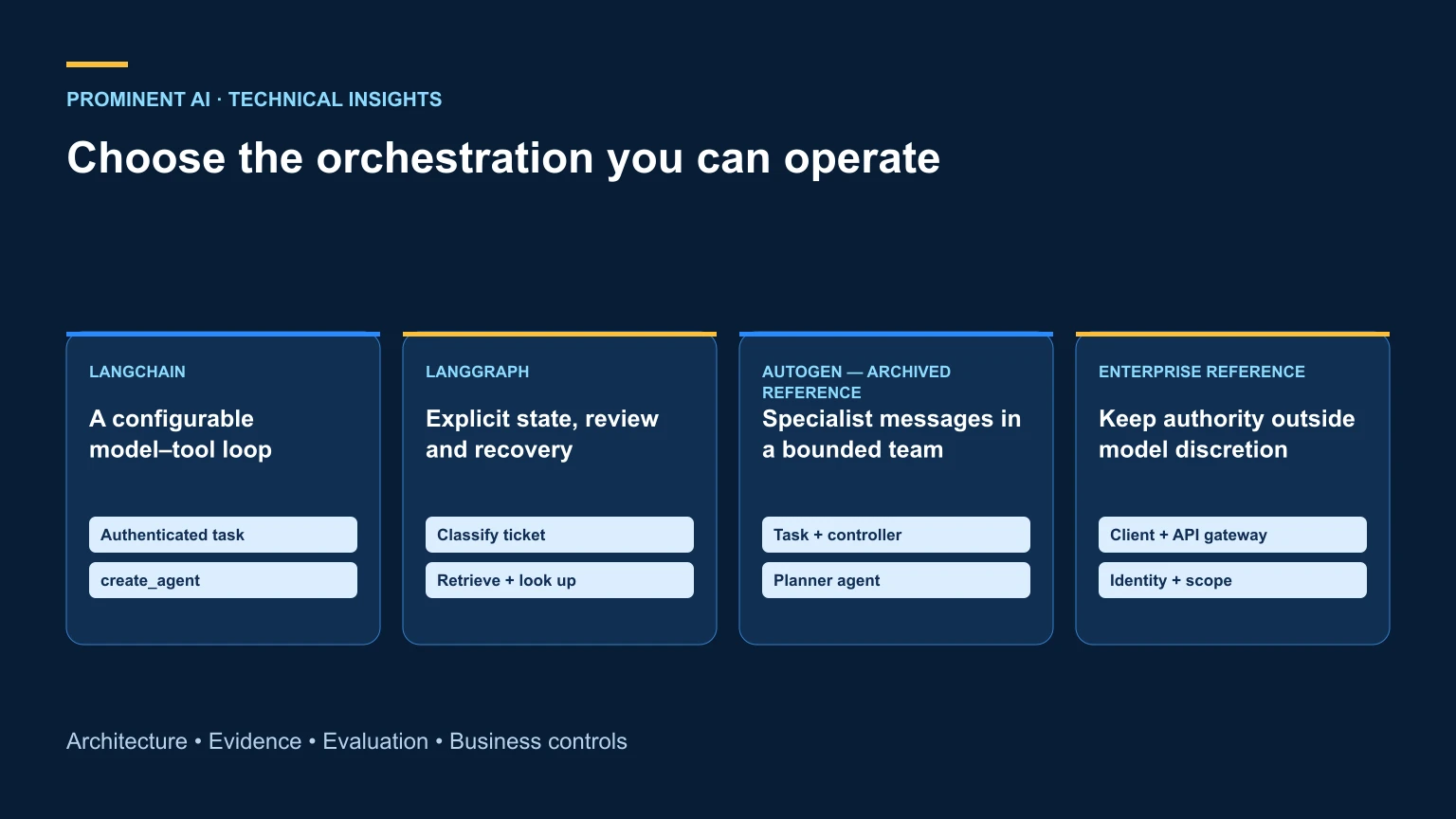
LangChain provides higher-level building blocks for model-powered agents; LangGraph provides lower-level control over stateful orchestration, checkpoints and workflow routing. They are complementary: LangChain agents use LangGraph primitives, and LangGraph can also be used independently. AutoGen popularised conversational multi-agent patterns, but its repository now carries an archived/no-maintenance warning. For new Microsoft-centric projects, evaluate Microsoft Agent Framework instead. Choose from your required control, recovery, integration and support model—not a universal framework ranking or a demonstration’s apparent intelligence.
Key takeaways
- LangChain vs LangGraph is usually a question about abstraction and control.
- Multiple agents do not automatically outperform one well-designed agent.
- Durable state does not make external side effects exactly-once.
- Framework features do not replace application authorisation and tenant isolation.
- Treat AutoGen examples as legacy reference material and assess migration risk.
Contents
What are AI agent frameworks?
AI agent frameworks organise model calls, tool execution and the state needed to complete a task. Orchestration decides which component runs next. Planning proposes steps, while application policy determines which steps are permitted. A tool is an application function, not an unrestricted entitlement to use a business system.
State records the current task; memory may refer to previous messages or a separate persistent store. Human-in-the-loop operation introduces a controlled pause for review, correction or approval. A multi-agent system divides responsibilities across agents, which creates additional communication and failure boundaries.
Frameworks are useful when their abstractions reduce repeated integration work and make execution easier to inspect. They also introduce dependencies, release changes and framework-specific operating knowledge. A linear pipeline with one model call may need no agent framework. A conventional workflow engine may be a better owner of long waits, deterministic approvals and transactional business steps.
AWS’s framework guidance helps separate frameworks from managed platforms. Our AI-agent automation article explains the business opportunities; this guide focuses on defensible implementation choices.
What is LangChain?
LangChain supplies model integrations, tool abstractions and a configurable agent creation interface. Its current Python entry point is create_agent. Model-provider packages connect the agent to a supported model; tools expose typed functions. Retrieval can be supplied as a tool or placed in an explicit surrounding pipeline.
LangChain’s overview documents the higher-level agent approach. Middleware can customise execution around model and tool calls, including logging, limits and intervention. A LangChain agent can sit inside a larger LangGraph graph when the surrounding workflow needs explicit routing.
The advantage is a practical starting point for a standard tool-using loop. The limitation is that business-specific behaviour still needs explicit design. Middleware is not a substitute for a backend’s access checks. Provider integrations differ in supported features, and upgrading an abstraction does not guarantee identical behaviour across models.
Use it first when the task fits a bounded loop with a small tool set. Keep deterministic checks outside that loop. Document the expected tool-call contract so developers can diagnose a failure without depending on a prompt transcript alone.
What is LangGraph?
LangGraph models execution as nodes, edges and shared state. Nodes perform work; edges determine the next step. Conditional routes can branch, loop, stop or send a case for review. Checkpoints allow execution state to be stored and later resumed.
Its overview describes low-level orchestration for stateful applications. It does not require using LangChain for every node: a node can call ordinary Python, an API or another supported component. That flexibility is useful when deterministic and model-driven operations must coexist.
An interrupt pauses execution and surfaces a payload. Resuming requires the correct thread and checkpoint context. In production, use durable storage and authenticate the person or service issuing the resume request. An in-memory demonstration cannot survive a process restart.
Recovery requires careful side-effect design. A resumed node may re-execute code before the interrupt, and retries can repeat a tool call. Put irreversible effects behind idempotent services and reconcile uncertain outcomes. Observability should connect graph steps to actual integration outcomes rather than reporting only that a node completed.
Choose explicit graphs where state transitions and exception routes are central requirements. Their cost is additional design and testing: graph complexity can become difficult to reason about if every possible exception creates another poorly owned branch.
What is Microsoft AutoGen?
AutoGen’s historical design supports agents communicating through messages, using tools and coordinating in teams. AgentChat offers higher-level agents and team patterns; Core provides lower-level event-driven building blocks. Conversational coordination is useful for exploring specialist roles, but it also needs termination rules and careful tool boundaries. The AgentChat documentation remains a reference for existing implementations.
Lifecycle checked 27 October 2026: the official repository explicitly warns that it is archived, no longer actively maintained by Microsoft, and without Microsoft bug or security fixes or support. Older contribution wording on the same page still refers to maintenance mode. Use the explicit caution for risk decisions; do not infer a patch commitment from the older wording. The repository directs new projects towards Microsoft Agent Framework.
This makes lifecycle a selection criterion, not a footnote. Do not launch a new sensitive production workload on AutoGen merely because a legacy tutorial is convenient. Existing owners need dependency review, containment, an accountable risk decision and a migration plan.
LangChain vs LangGraph vs AutoGen: detailed comparison
The capabilities below are documented patterns. Learning effort and recommended fit are editorial judgements, not measured rankings. AutoGen capabilities describe the archived implementation, not an assurance of ongoing support.
| Criterion | LangChain | LangGraph | AutoGen legacy |
|---|---|---|---|
| Core purpose | Higher-level model and agent construction | Controlled stateful orchestration | Conversational agent teams |
| Architectural model | Configurable model–tool loop | Nodes, edges and shared state | Messages, agents and teams |
| Learning curve | Simpler for a standard loop | More explicit workflow concepts | Conversation and termination design |
| Model providers | Integration packages | Any suitable callable or integration | Model-client components |
| Tools | Typed functions and integrations | Explicit nodes or agent tools | Agent tools and extensions |
| MCP | Adapter/integration dependent | Through selected tools/adapters | Legacy extension support |
| Single agent | Primary starting pattern | Supported as a graph | Supported through AgentChat |
| Multi-agent | Compose supported patterns | Explicit coordination topology | Team/conversation patterns |
| State | Agent state and underlying runtime | Explicit state contract | Agent/team state |
| Persistence | Configure suitable runtime store | Checkpointer and store choices | Save/load and application storage |
| Human review | Middleware/runtime pattern | Interrupt/resume | User interaction/team pattern |
| Error handling | Middleware and application logic | Routes, retries and recovery design | Team/application handling |
| Observability | Instrumentation; optional LangSmith | Graph traces; optional LangSmith | Logging/tracing hooks |
| Testing | Model, tools and middleware | Nodes, paths and recovery | Roles, conversations and termination |
| Security | Application enforcement required | Application enforcement required | Application enforcement plus lifecycle risk |
| Deployment | Application or supported hosted option | Application or supported hosted option | Existing self-operated application |
| Scalability | Depends on services and workload | Depends on state and worker design | Depends on runtime and team workload |
| Operational complexity | Grows with tools and middleware | Grows with state, paths and recovery | Grows with conversations and legacy upkeep |
| Cost drivers | Calls, tools, hosting, tracing | Calls, checkpoints, workers, review | Calls, messages, tools and migration |
| Ecosystem/lifecycle | Active documentation; pin releases | Active documentation; pin releases | Archived warning; evaluate replacement |
Do not interpret “supported pattern” as feature parity across all model providers or releases. Verify transport, async behaviour, streaming, persistence and cancellation in the exact dependency set you deploy.
Discuss Your AI Agent Architecture — compare orchestration choices against your workflow and operating constraints.
Four architecture views
LangChain agent architecture

The application supplies an authenticated task, configured model, tools and middleware. The agent loops until completion or a limit is reached. Backend policy validates every integration operation. Keep the model-to-tool proposal distinct from the tool’s permission to execute.
LangGraph stateful workflow architecture

The graph separates classification, evidence gathering, decision, approval and execution. A checkpoint records progress. Conditional edges route missing evidence to clarification and rejected actions to a safe terminal state. Recovery uses the stored state and integration reconciliation rather than asking the model to reconstruct what happened.
AutoGen conversational team architecture

A team coordinates specialist messages and tool use under a termination policy. A planner and reviewer are roles, not independent security authorities. The executor must still pass the same policy gateway as any other integration. This diagram explains legacy architecture; it is not a new-deployment recommendation.
Enterprise reference architecture

An API gateway and identity service establish the caller. Orchestration executes in the application boundary; tools cross into business systems through an authorisation gateway. State, evidence and logs each have their own retention and access policies. Approval is an authenticated external event bound to a proposed action. Monitoring spans every boundary.
An agent cannot grant itself additional permissions by changing a prompt or asking another agent. This is an architectural invariant that should hold whichever framework is used.
Practical comparison: the same support workflow
Use one task contract: classify a ticket, retrieve authorised knowledge, look up the customer, validate policy, request any required approval, update the CRM, generate a response and record an audit event. Fix that contract before comparing frameworks.
With LangChain, use a bounded agent for classification, retrieval and read-only lookups; place consequential writes behind a separate reviewed application operation. With LangGraph, express the steps and exception routes as nodes and edges, pausing before the write. In an existing AutoGen application, specialist agents may gather evidence and draft a recommendation, while an external controller owns approval and writes.
The following examples show small architectural slices, not three complete support products. Imports are checked against the linked documentation and package listings; syntax is checked locally. They have not been executed against model APIs, a CRM or a production identity system.
LangChain: read-only tool selection
import os
from langchain.agents import create_agent

def ticket_status(ticket_id: str) -> str:
    """Return synthetic demonstration ticket status; no customer data."""
    return {"DEMO-1": "awaiting review"}.get(ticket_id, "not found")

agent = create_agent(
    model=os.environ["LANGCHAIN_MODEL"],
    tools=[ticket_status],
    system_prompt="Use the read-only tool. Never claim a record was changed.",
)
result = agent.invoke({
    "messages": [{"role": "user", "content": "Status of DEMO-1?"}]
})
Configure a provider-qualified supported model and its integration package. This example cannot make CRM changes. A production lookup must derive user and tenant scope from the server; a model-supplied ticket ID alone does not establish access.
LangGraph: explicit pause and resume
from typing import TypedDict
from langgraph.graph import StateGraph, START, END
from langgraph.checkpoint.memory import InMemorySaver
from langgraph.types import interrupt, Command

class State(TypedDict):
    proposal: str
    approved: bool

def review(state: State):
    answer = interrupt({"proposal": state["proposal"]})
    return {"approved": answer is True}

builder = StateGraph(State)
builder.add_node("review", review)
builder.add_edge(START, "review")
builder.add_edge("review", END)
graph = builder.compile(checkpointer=InMemorySaver())
config = {"configurable": {"thread_id": "synthetic-demo-1"}}
paused = graph.invoke({"proposal": "Draft response only", "approved": False}, config)
# Demonstrates rejection. Authenticate/authorise a real resume in the backend.
rejected = graph.invoke(Command(resume=False), config)
The in-memory checkpointer is for illustration. Approval is not proven by a boolean arriving from an unauthenticated browser. Bind the task, approver, proposal hash, expiry and record version before any write; use durable persistence and tenant-scoped thread identifiers.
AutoGen: archived read-only team example
import asyncio
import os
from autogen_agentchat.agents import AssistantAgent
from autogen_agentchat.teams import RoundRobinGroupChat
from autogen_ext.models.openai import OpenAIChatCompletionClient

async def main():
    client = OpenAIChatCompletionClient(model=os.environ["AUTOGEN_MODEL"])
    try:
        drafter = AssistantAgent(
            "drafter", model_client=client,
            system_message="Draft from supplied synthetic facts only. No actions.",
        )
        reviewer = AssistantAgent(
            "reviewer", model_client=client,
            system_message="Identify unsupported statements. Do not approve writes.",
        )
        team = RoundRobinGroupChat([drafter, reviewer], max_turns=2)
        await team.run(task="DEMO-1 is awaiting review. Draft a status response.")
    finally:
        await client.close()

if __name__ == "__main__":
    asyncio.run(main())
The team API reference documents this coordination pattern. Model support must be checked for the selected client; this is not a recommendation to add an archived dependency to a new production system.
Version and licence evidence
On 27 October 2026, PyPI displayed LangChain 1.4.7, LangGraph 1.2.18, autogen-agentchat 0.7.5 and autogen-ext 0.7.5. These are research snapshots, not an integration-tested lockfile. Resolve a compatible environment and lock hashes before testing; do not combine arbitrary “latest” packages.
The core projects use MIT-licensed code; inspect the exact release licences and transitive dependencies, including the LangChain licence and LangGraph licence. Hosted tracing, deployment, model inference and enterprise support have separate terms. LangSmith is an optional platform, not a requirement to buy a service merely to run open-source LangGraph.
Which framework performs better?
There is no defensible universal performance winner. A framework with fewer calls may be faster on one task, while explicit recovery may be more important on another. Measure the complete workload, including waiting and retries.
Build a held-out ticket set with identical evidence, tool responses, model version, temperature settings where applicable, token budgets and infrastructure. Run repeated trials because model behaviour varies. Include cold starts, concurrency, slow tools, rate limits and process termination. Separate active compute time from time waiting for human review.
Record p50 and p95 end-to-end latency, calls per task, input/output tokens, tool attempts, accepted resolution rate, incorrect actions, successful recovery and cost per accepted resolution. Report sample counts, failure definitions and uncertainty. Do not hide failed runs from latency or cost denominators.
Compare two designs as well as two libraries. If one uses a single bounded agent and another uses five conversing agents, the result measures architecture and configuration, not the intrinsic speed of their frameworks. Retain traces so an architect can explain why a result changed.
Enterprise applications and orchestration fit
| Scenario | Reasonable starting approach | Why and what to validate |
|---|---|---|
| Customer support | LangChain for reads; LangGraph for reviewed writes | Controlled account access and recovery |
| Knowledge assistant | Explicit RAG pipeline; optional LangChain | Retrieval quality before extra autonomy |
| Document processing | Deterministic pipeline plus model steps | Schema, provenance and exception queues |
| Insurance claims administration | Explicit graph/workflow | Evidence and adjuster-owned decisions |
| Financial operations | Workflow engine with bounded model nodes | Reconciliation and separation of duties |
| Healthcare administration | Reviewed stateful workflow | Privacy, missing evidence and escalation |
| Software agents | Isolated execution and scoped tools | Repository permissions and change review |
| Supply-chain exceptions | Stateful integration workflow | Stale events and uncertain write outcomes |
| Research and analysis | Evaluate specialist coordination | Evidence coverage; correlated model errors |
These are editorial starting points, not industry compliance assessments. A team already operating another suitable framework may rationally retain it. Migration must earn its cost through reduced risk, better support or measured capability improvements.
Is AutoGen still the right choice in 2026?
For a new Microsoft-centric implementation, evaluate Microsoft Agent Framework rather than starting from AutoGen. Its documentation covers agent and workflow development for Python and .NET. Check the exact SDK package, release status, provider and feature: availability in an overview does not mean every connector or experimental capability has the same support status.
Microsoft positions the newer framework as a path bringing together lessons from AutoGen and Semantic Kernel. This is not evidence that an AutoGen application can be migrated by changing an import. Inventory tools, message contracts, state, approvals, telemetry, deployment and tests before estimating the work. The framework repository is the place to check code, releases and licence terms.
Retaining an existing AutoGen system temporarily can be a risk-managed transition decision where isolation, dependency controls and business continuity justify it. It is not a statement that archived code is safe. Define an owner and exit criteria; test migration on one workflow behind an adapter rather than replacing every integration at once.
Azure hosting does not remove application responsibilities. Validate identity propagation, regional data processing, secrets, model access and failover for your deployment. Our Azure technology page describes a relevant service context without implying that every framework feature is supported everywhere.
Security and governance checklist
Framework security features are building blocks. The application remains responsible for authority and consequences.
- Test indirect prompt injection in retrieved knowledge and tool results.
- Use least-privilege identities and narrow tool operations.
- Reauthorise writes server-side, including resumed or retried work.
- Keep secrets out of prompts, code, checkpoints and ordinary traces.
- Enforce tenant scope across retrieval, caches, state and logs.
- Bind human decisions to the exact proposed payload and its expiry.
- Sandbox executable code with restricted network and filesystem access.
- Validate output schema, business rules and evidence separately.
- Make writes idempotent and reconcile uncertain outcomes.
- Retain protected audit evidence with appropriate deletion controls.
- Evaluate model, tool, prompt and dependency changes before rollout.
OWASP’s excessive-agency guidance provides a useful threat lens. Our AI security article adds organisational context. A second model reviewing a first model’s proposal is not equivalent to independent authorisation.
Implementation cost and total cost of ownership
Use a configurable cost sheet rather than a framework price comparison. Let N be monthly tasks, k calls per task, Ti/To average input/output tokens per call, and Pi/Po contracted prices per million tokens. Inference is N×k×(Ti×Pi + To×Po)/1,000,000.
Add tool charges, hosting, checkpoint/storage operations, tracing, evaluation runs, review labour, support, security operations and deployment. Allocate one-time development and migration over a stated planning horizon. Separate open-source licence cost from operating cost and optional hosted subscriptions.
A hypothetical 20,000 tasks with four calls each creates 80,000 calls before retries. Increasing the average to six calls raises call volume by half, but cost also depends on context growth and output length. Use measured token distributions rather than assuming every call is identical. A team conversation can repeatedly carry history unless context is managed.
Evaluate cost per accepted task and total correction effort. Calculate sensitivity to retries, review rates and traffic peaks. Development effort estimates should follow a scoped integration inventory; no reliable project price follows solely from choosing LangChain or LangGraph.
Decision matrix: which AI agent framework should you choose?
| Requirement | Evaluate first | Decision condition |
|---|---|---|
| Small prototype | LangChain or a direct SDK | Keep dependencies and tool scope small |
| Simple tool-using agent | LangChain | Standard loop fits the task |
| Stateful enterprise workflow | LangGraph or conventional engine | Explicit transitions and recovery matter |
| Complex multi-agent work | LangGraph or Microsoft Agent Framework | Specialist split beats single-agent baseline |
| Microsoft-centric environment | Microsoft Agent Framework | Required SDK, integrations and support verified |
| Document-heavy application | Deterministic ingestion/RAG with optional framework | Evidence and access dominate orchestration |
| Regulated or sensitive workflow | Explicit reviewed process | Application controls and obligations assessed |
| Long-running task | Durable workflow/graph | Restart, expiry and cancellation tested |
| Existing AutoGen system | Containment and migration assessment | Archived dependency risk explicitly owned |
Other frameworks, including CrewAI or Google ADK, may merit evaluation for a specific requirement. This article does not rank untested alternatives. Prefer conventional software where every route is stable and no model-driven decision adds value.
Discuss Your AI Agent Architecture — turn the selection criteria into a pilot and acceptance plan.
Production deployment checklist
Agree requirements and excluded actions; document the architecture and data boundaries. Select durable state with backup, deletion and schema migration. Test integrations, tool schemas, approvals, cancellation, duplicate messages and recovery after a crash. Build representative agent evaluations and adversarial cases.
Monitor quality, actions, tail latency and budgets. Configure bounded retries, spending limits and escalation ownership. Release through CI/CD with dependency scanning, versioned prompts and rollback. Use a limited pilot before increasing traffic or permissions. An on-call team must be able to pause work and reconcile partially completed tasks.
Our MLOps guide explains release discipline. Cloud scalability and model selection remain separate decisions. Do not use a framework selection as a substitute for either.
How Prominent AI Services LLP can help
Prominent’s published LangChain and LangGraph capability includes a LangGraph section. Relevant services include generative AI development, enterprise AI integration, business process automation and API integration.
Discuss architecture, implementation boundaries, integration and evaluation rather than purchasing a framework name. For opportunities beyond agents, see our generative AI use-case guide. No client results or certifications are implied by these illustrative designs.
Frequently asked questions
What is the difference between LangChain and LangGraph?
LangChain offers higher-level agent and model abstractions. LangGraph offers explicit stateful orchestration. Choose the abstraction level needed for your workflow.
Is LangGraph part of LangChain?
It belongs to the same ecosystem and underpins LangChain agents, but it can also be used independently with ordinary code and other integrations.
Is LangGraph better than LangChain?
Neither is universally better. LangGraph provides control at the cost of more explicit design; LangChain is convenient for a standard agent loop.
What is AutoGen used for?
Historically, it has been used for conversational agents, specialist teams and tool coordination. Its archived lifecycle changes its suitability for new deployments.
Is AutoGen still maintained in 2026?
The repository’s explicit warning says it is archived and no longer maintained by Microsoft. Do not rely on older maintenance-mode language as a support promise.
What is Microsoft Agent Framework?
It is Microsoft’s framework for building agents and workflows, including Python and .NET paths. Verify the release and feature status required for your implementation.
Which framework is best for multi-agent systems?
Choose by topology, state, termination, integrations and operating support. First demonstrate that multiple agents improve the same workload over a simpler baseline.
Can LangGraph be used with Azure OpenAI?
Yes, through suitable model integrations or an explicit API-calling node. Verify the deployment, authentication and model capabilities in your Azure environment.
Which framework is easiest for beginners?
For a small standard tool-using agent, LangChain is a reasonable editorial starting point. A direct SDK may be simpler for a single model call.
Which framework is best for production AI agents?
Production suitability depends on the entire system: security, persistence, recovery, tests and support. A framework alone cannot establish readiness.
How much does it cost to build AI agents?
Estimate integration and development effort plus inference, tools, infrastructure, review, testing and maintenance. Compare cost per accepted task, not only token spend.
Can LangChain and LangGraph be used together?
Yes. LangChain agents use LangGraph primitives, and an agent can be embedded in a broader graph with deterministic steps.
What are alternatives to AutoGen?
Evaluate Microsoft Agent Framework, LangGraph or another actively supported framework against the required workflow. Migration effort and existing controls matter.
How do you secure enterprise AI agents?
Enforce narrow permissions, backend action checks, tenant isolation, protected secrets, review, logging and recovery. Test prompt injection and integration failures.
Should a business use AI agents or traditional automation?
Use deterministic automation for stable rules. Consider bounded agents where unstructured inputs or variable decisions justify the additional uncertainty and controls.
Discuss Your AI Agent Architecture — define the workflow before selecting its orchestration framework.