


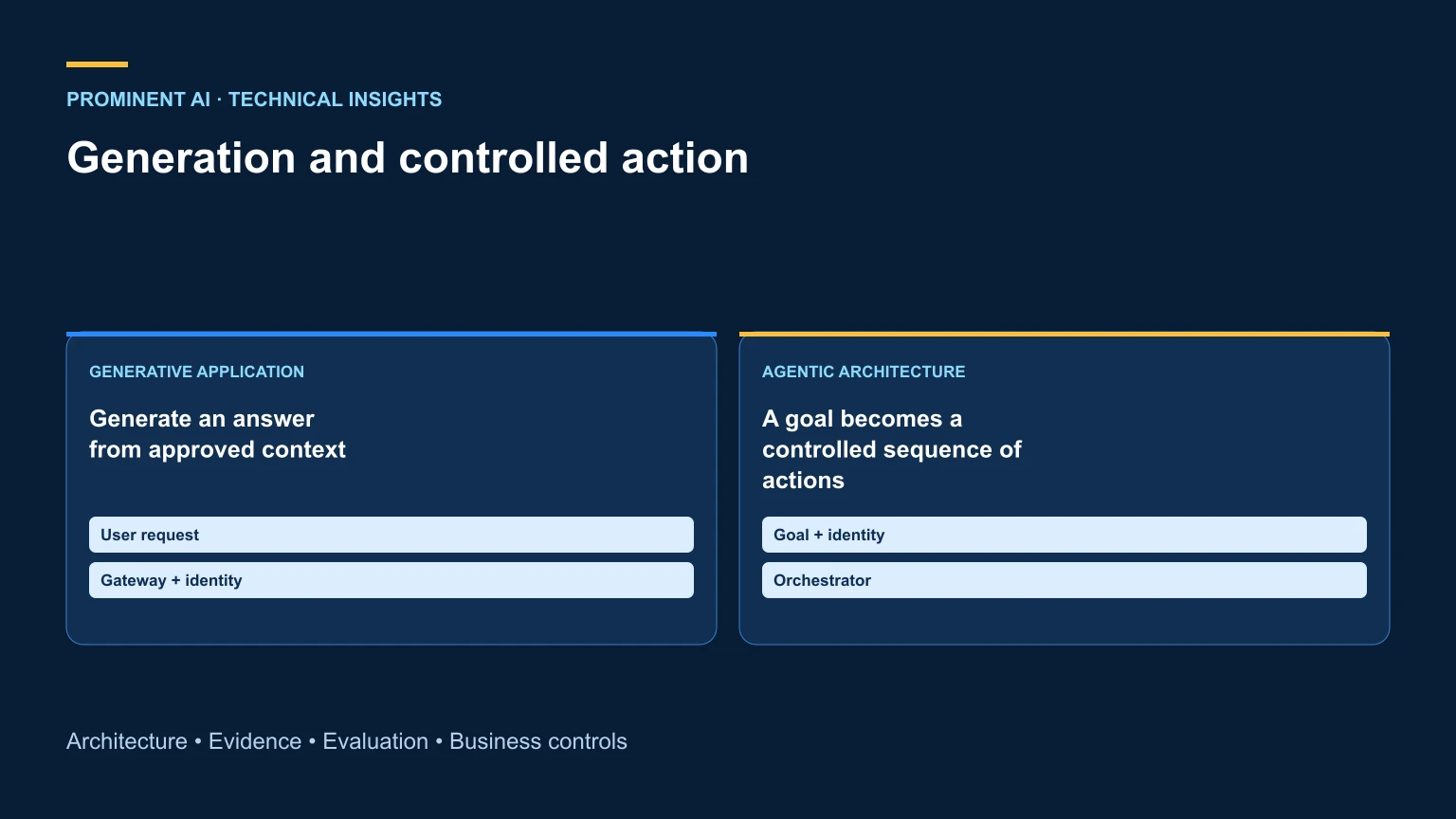
Generative AI creates content such as text, images or code; agentic AI coordinates actions towards a goal, choosing steps and using tools within defined limits. They overlap: an agent often uses a generative model to interpret requests, propose actions and explain results. The practical difference is the surrounding application architecture, especially state, permissions, feedback and approval. Choose generation when a useful output completes the task; consider an agent when completing the task requires controlled interaction with business systems.
Key takeaways
- A model that can call tools is not automatically a dependable business process.
- Begin with the least autonomous architecture that meets the requirement.
- Keep authorisation, financial limits and irreversible actions outside model discretion.
- Measure successful outcomes, recovery and review effort alongside token costs.
- Add multiple agents only when separate responsibilities improve measured results.
Contents
What is generative AI?
Generative AI produces new outputs from supplied instructions, context and learned patterns. A business application might draft a proposal, summarise a meeting, transform a document into JSON or explain an approved policy. The output still needs validation appropriate to its use.
The model does not automatically have access to company systems. The application decides what information to supply, which tools to expose and whether any proposed action can execute. A generative application can maintain conversation history, retrieve documents and call functions; describing all generative AI as stateless or incapable of tool use is misleading.
An email drafting assistant may complete its task by returning a reviewed draft. Connecting the same model to a mail API changes the risk: sending a message needs recipient validation, access checks and a clear policy about approval. The model has not become a different category of intelligence merely because an integration was added.
Our generative AI business use cases article explores the broader opportunity. This comparison concentrates on the architecture needed when content becomes action.
What is agentic AI? AI agents explained
An AI agent observes information, selects a next step, uses permitted tools and evaluates progress towards a goal. In contemporary enterprise applications, a language model often helps select those steps. The application supplies state, execution controls and stopping conditions.
Planning is a proposed sequence, not proof that the sequence is safe. Reasoning is inferred through decisions and outcomes, not a requirement to expose private model reasoning. Memory can mean temporary task state, a conversation record or an explicitly governed long-term store; these have different retention and access needs.
Feedback lets the system respond to a failed lookup, changed record or missing approval. Autonomy is bounded by which decisions the application delegates. A support agent may autonomously retrieve an order but need a supervisor before offering an exception refund. These boundaries come from organisational policy and applicable obligations, not a universal rule that every agent action needs a person.
Distinguish agents from workflows. A workflow follows predefined routes; an agent dynamically selects some steps. Many effective systems combine both. Anthropic’s engineering guidance makes this distinction and recommends starting with simpler solutions. A deterministic rules engine remains preferable when inputs and decisions are well specified.
Agentic AI vs generative AI: detailed comparison
The comparison below describes typical application designs, not mutually exclusive model types. A product may contain both patterns.
| Dimension | Generative application | Agentic application |
|---|---|---|
| Primary purpose | Produce a useful output | Complete a bounded goal through actions |
| Architecture | Input, context, model, validation, output | Orchestration, model, state, tools, policy and feedback |
| Autonomy | Often limited to producing a draft | Delegated decisions within explicit permissions |
| Planning | Can suggest a plan | Can select and execute permitted steps |
| Reasoning | Supports interpretation and synthesis | Also supports routing and action selection |
| Memory | Optional conversation or application state | Task state usually needed; long-term memory optional |
| Tool use | Optional | Common, but tools remain application-controlled |
| External access | Only through supplied context or integrations | Through scoped connectors and approved APIs |
| Workflow | Often request–response | May loop, pause, resume or escalate |
| Oversight | Review generated output as required | Review consequential actions and exception routes |
| Error handling | Retry, abstain or request clarification | Also reconcile partial actions and resume safely |
| Security | Protect inputs, evidence and outputs | Also prevent excessive permissions and unsafe actions |
| Cost | Model calls plus application operations | Also orchestration, tools, state and review |
| Latency | Often one or a few calls | Variable; loops and approvals can dominate |
| Testing | Output quality and grounding | Also action correctness and failure recovery |
| Deployment | Serving application and dependencies | Also workers, durable state and operational controls |
| Business fit | Drafting, transformation, explanation | Multi-step work with meaningful variable decisions |
An agent is not inherently more accurate. It has more opportunities to collect evidence, but also more opportunities to choose an incorrect action. Compare the complete process against the current baseline.
Generative AI application architecture

The gateway authenticates the user and applies request limits. The application validates the request, selects a versioned prompt and optionally retrieves authorised evidence. The model returns a candidate output, which passes through schema, citation or business validation before presentation.
Keep the trust boundary visible. A document used as evidence can contain malicious instructions. It should not acquire authority over the application merely because its text reaches the model. A schema-valid answer can still contain a false value, and a citation can point to irrelevant evidence.
Monitoring records enough information to investigate failures without unnecessarily retaining confidential prompts. Version the model configuration, prompt, retrieval settings and validation rules together. That allows a regression to be traced to a release rather than attributed vaguely to “AI.”
For the ingestion and retrieval details, use our enterprise RAG architecture guide. Retrieval is a knowledge-supply mechanism; it is not itself permission to take an action.
Agentic AI architecture: controlled action loops

The agentic loop adds a goal contract, orchestration, durable task state and a controlled tool registry. Each proposed tool call crosses an enforcement point before the integration runs. The registry describes available operations; a separate policy service decides whether this user, tenant and task may perform the requested operation now.
Read tools and write tools should have different scopes. A customer lookup can return an approved view of a record. A CRM update should require validated arguments, an expected record version and an idempotency key. Tool output returns as untrusted data for the next decision; it is not a new system instruction.
Human approval must bind to the specific action and payload. If an amount or recipient changes after approval, the earlier approval should not silently authorise the new operation. Store the approver, decision, policy version and action fingerprint without treating an agent-generated “approved” field as evidence.
Feedback can lead to another lookup, a safe retry, an escalation or completion. Cap iterations, elapsed time, tool calls and spending. Use a terminal failure state when the goal cannot be completed within those limits. A system that keeps trying indefinitely is not demonstrating useful autonomy.
MCP can standardise connections to tools and resources. Its HTTP authorisation specification describes transport-level access; it does not replace business authorisation for a particular refund or record change. Keep server-side action checks even when the connection is authenticated.
Discuss Your Enterprise AI Project — bring one workflow, its systems and the actions that require review.
Single agents, multiple agents or deterministic workflows?
A single agent is a sensible first experiment when one context and a small set of tools can complete the task. It reduces handoffs and makes traces easier to follow. Give it a narrow goal rather than an unrestricted mandate to improve the business.
Multiple agents can help where responsibilities genuinely differ: a research component gathers evidence while another drafts a response under a different tool scope. However, two agents agreeing is not independent validation if they share the same model, evidence and failure modes. Additional conversations increase cost and coordination complexity.
Use deterministic software for calculations, access decisions, payment limits, deduplication and stable approval routes. A workflow engine can coordinate retries and long waits while model calls handle unstructured interpretation inside individual steps. Google’s agentic design-pattern guidance is a useful primary reference for evaluating architecture patterns.
The engineering question is which decisions need adaptation. If the next step can be written as a clear rule and tested, delegating it to a model may add uncertainty without useful flexibility.
Example: resolving a customer support ticket
Consider an illustrative request about an incorrect subscription charge. A generative assistant summarises the ticket and drafts a response from the supplied policy. An agentic application can coordinate the following controlled process:
- Classify the request and identify missing information.
- Retrieve the authenticated customer’s account and current subscription details.
- Retrieve the applicable policy with effective dates and source references.
- Calculate eligibility using deterministic rules; do not ask a model to invent a refund limit.
- Prepare the proposed action and route it for approval where policy requires it.
- Update the CRM through an authorised API using an idempotency key.
- Generate a response from the confirmed result, not the intended result.
- Record the evidence, decision, approval and integration outcome in an audit trail.
If the CRM times out, first establish whether the update committed. Blindly retrying can create duplicate adjustments. If the account record changes during review, revalidate before execution. If the policy is ambiguous, escalate with the supporting evidence rather than generating a confident exception.
This extends the business scenarios in our AI agents and process automation guide. It is an illustrative architecture, not a claim about a completed client project.
Enterprise use cases across eight industries
Each example below describes a potential workflow and value measure. It does not promise automation suitability or regulatory compliance.
| Industry and problem | Generative approach | Agentic approach and systems | Value to assess; oversight |
|---|---|---|---|
| Financial services: fragmented servicing requests | Summarise correspondence | Retrieve approved account data, assemble a case and route through CRM | Handling time and completeness; authorised staff retain consequential decisions |
| Insurance: incomplete claims packs | Extract and explain missing documents | Check policy and document status, request permitted evidence, update claims queue | Rework and queue age; adjuster reviews coverage and settlement |
| Healthcare and life sciences: administrative evidence scattered | Draft an administrative summary | Assemble authorised scheduling or research records and route for specialist review | Search effort and completeness; no autonomous clinical decision |
| Manufacturing: maintenance exceptions | Summarise a work order and manual | Retrieve asset history, suggest a task and prepare a CMMS request | Triage time; engineer approves safety-critical intervention |
| Retail and e-commerce: order exceptions | Draft a customer response | Check OMS and inventory, apply approved return rules, prepare an action | Resolution quality and repeat contacts; exceptions reviewed |
| Logistics: shipment disruption | Explain tracking events | Compare carrier updates, prepare alternatives and route a TMS task | Exception response time; dispatcher approves commitments |
| Real estate: incomplete transaction information | Summarise supplied documents | Collect permitted CRM and property records, flag gaps and assign follow-up | Administrative completeness; qualified staff verify legal or valuation matters |
| SaaS: account support spread across systems | Draft a knowledge-based answer | Inspect scoped telemetry and account status, create a reviewed support action | Task success and escalation quality; tenant isolation and change approval |
Start with the department that owns the outcome. “Automate insurance” is too broad; “assemble missing-document checklists for a claims handler” is a testable boundary. Agree which records count as authoritative and which decisions remain with a person.
Selecting the technology stack
Separate a framework, a managed platform and a protocol. A framework helps structure code; a platform supplies hosting or managed services; a protocol defines communication. None automatically supplies your organisation’s complete governance model.
| Option | State and tools | Observability and complexity | Governance consideration |
|---|---|---|---|
| LangChain | Higher-level agent loop and integrations | Quick starting point; trace actual calls | Application still owns data and action permissions |
| LangGraph | Explicit stateful graphs and checkpoints | Useful for controlled routing and recovery; more design effort | Protect checkpoints and resume endpoints |
| Microsoft Copilot Studio | Managed agent and connector patterns | Fits supported low-code scenarios; validate capacity and connector limits | Check environment, identity and action policies |
| Microsoft Foundry | Model and agent development services | Fits supported Azure architectures | Verify region, model, feature status and access controls |
| OpenAI agent tooling | Model, tool and orchestration options depend on selected API/SDK | Evaluate current supported runtime and tracing | Confirm retention, scopes and deployment constraints |
| MCP | Standardised tool/resource connection | Reduces connector inconsistency; adds server trust decisions | Transport authentication does not authorise every action |
| Conventional workflow engine | Durable predefined process and integrations | Often simpler for stable rules | Keep explicit ownership, retry and approval rules |
| Azure or AWS infrastructure | Queues, storage, identity and hosting | Operational fit depends on existing estate | Validate service availability and data boundaries |
These are selection criteria, not performance rankings. AWS’s framework guidance distinguishes orchestration foundations from platform services. The team’s ability to operate the result matters as much as a demonstration’s elegance.
For platform scope, consult the current Copilot Studio agent overview, Microsoft Foundry overview and OpenAI agent-tooling comparison. Select a supported feature set rather than assuming that an SDK and a managed agent service have identical execution or retention behaviour.
Security checklist for agentic applications
The main additional risk is excessive agency: an incorrect or manipulated decision reaches a tool with too much power. OWASP’s excessive-agency guidance supports limiting functionality, permissions and autonomy.
- Treat user input, retrieved documents, tool responses and other agents as untrusted content.
- Derive identity and tenant scope on the server, not from model-generated parameters.
- Permit narrow typed operations rather than general shell, SQL or unrestricted HTTP tools.
- Authorise every action, including retries and resumed tasks.
- Keep secrets in managed stores; never include credentials in prompts or traces.
- Separate tenants in retrieval, state, caches, logs and integration scopes.
- Require policy-defined approval and make cancellation and expiry explicit.
- Use bounded retries, idempotency keys, reconciliation and compensating actions.
- Log action outcomes with access-controlled retention and sensitive-field redaction.
- Red-team malicious documents, forged approvals, cross-tenant references and tool failures.
Sandboxing helps contain code execution but does not decide whether a business action is appropriate. Output validation helps enforce structure but cannot establish that every fact is true. Design several independent controls rather than expecting one prompt to provide security.
Implementation cost and a transparent ROI model
Use your measured workload and contracted prices. A planning model can begin with 10,000 monthly tasks, three model calls per task, 2,000 input and 400 output tokens per call, and 15% routed for five-minute review. These are hypothetical assumptions, not observed performance or vendor quotes.
At those assumptions, model usage is 60 million input and 12 million output tokens. Review is 125 hours. If input and output prices per million tokens are Pi and Po, inference costs 60×Pi + 12×Po. Add tool charges, hosting, state storage, observability, testing, support and reviewer labour at your actual loaded hourly rate.
Monthly operating cost is:
C = inference + tools + infrastructure + review + maintenance + security/quality operations.
Compare against an equivalent baseline, including residual manual work and error correction. Net benefit is baseline avoidable cost − C; simple payback is one-time implementation / positive monthly net benefit. If net benefit is zero or negative, there is no positive payback under that scenario. Freed staff time is capacity, not automatically cash savings.
Test sensitivity to calls per task, context growth, retry rate, review percentage and successful completion rate. Calculate cost per accepted task = total operating cost / accepted tasks, counting escalations and failures consistently. A lower token bill with more human correction may be worse overall.
Decision matrix: which architecture should you choose?
| Situation | Starting recommendation | Evidence needed before expansion |
|---|---|---|
| Limited budget; output-only task | Prompted generative application | Output quality and review burden |
| Current private knowledge required | Generation with permission-aware RAG | Retrieval coverage and grounded answers |
| Stable rules and predictable integrations | Deterministic workflow | Rule coverage and failure recovery |
| Variable steps across business systems | Bounded single-agent pilot | Correct actions and safe escalation |
| Distinct specialist responsibilities | Evaluate multi-agent coordination | Improvement over single-agent baseline |
| Sensitive actions; low operational maturity | Assisted workflow with explicit review | Authorisation, audit and support ownership |
| Tight latency; simple objective | Minimise model calls and dynamic planning | Measured tail latency at expected load |
Risk, integration readiness, operating skills and time to value should constrain autonomy. More sophisticated orchestration cannot repair inaccessible data or an undefined business process.
Seven phases from discovery to controlled rollout
- Discover: document users, existing steps, systems and excluded decisions. Acceptance: an agreed task boundary and baseline measurement plan.
- Prioritise: compare frequency, impact, data readiness and risk. Acceptance: a process owner approves the pilot and success criteria.
- Design architecture and security: define tools, identity, state and recovery. Acceptance: threat model and action permissions reviewed.
- Build a proof of concept: use synthetic or approved data and read-only integrations first. Acceptance: representative scenarios execute with traceable evidence.
- Evaluate a pilot: test held-out cases, injection, unavailable systems and approval failures. Acceptance: business-defined quality and risk thresholds met.
- Roll out gradually: canary users, feature flags, bounded volume and rollback. Acceptance: support staff can pause, recover and reconcile work.
- Monitor and improve: track success, corrections, incidents, cost and drift. Acceptance: accountable owners review changes before release.
Set numerical thresholds with the business owner before testing; this article does not invent a universal acceptable error rate. Treat prompt, model and tool changes as releases. Our MLOps and DevOps comparison explains the wider release discipline, while cloud AI guidance covers infrastructure choices.
Discuss Your Enterprise AI Project — define a pilot with explicit acceptance criteria and operating responsibilities.
How Prominent AI Services LLP can help
Prominent’s published services include generative AI development, enterprise AI integration, business process automation with AI and API and system integration. These provide relevant starting points for discussing an architecture, integration scope and evaluation plan.
Choose a model using task-specific tests and review our AI security guide alongside the proposed design. A useful initial discussion identifies the process, required systems, permitted actions and evidence needed to justify production use.
Frequently asked questions
What is the main difference between agentic AI and generative AI?
Generative AI produces content. Agentic applications coordinate actions towards goals. An agent frequently contains a generative model, so the categories overlap rather than representing competing technologies.
Is ChatGPT generative AI or agentic AI?
ChatGPT is a generative AI product. A particular feature can exhibit agentic behaviour when it coordinates tools and actions. Assess the enabled feature, permissions and workflow rather than assigning every interaction the same autonomy.
What is agentic AI architecture?
It combines a goal, orchestration, model, task state, scoped tools, policy enforcement, feedback and monitoring. Production designs also need recovery, review routes and limits on actions and spending.
What are AI agents in simple terms?
Agents are software components that choose steps towards a goal and use permitted tools. Their reliability depends on the application controls and evidence available, not only the underlying model.
Can generative AI work without agents?
Yes. Summarisation, drafting and structured transformation can use a fixed request–response pipeline. Add orchestration only when the task requires it.
Does agentic AI require an LLM?
No. Agents are a broader software and AI concept. Many current business agents use LLMs, but goal-directed systems can use rules, planning algorithms or other models.
What are practical agentic AI examples?
Examples include assembling support cases, coordinating document requests and preparing maintenance tasks. These are illustrative applications; important actions still require the authorisation and oversight defined for that process.
How much does an agentic AI system cost?
Cost depends on integrations, model calls, state, review, testing and operations. Estimate from representative tasks and report cost per accepted outcome; token price alone is insufficient.
Is agentic AI secure?
It can be designed with controls, but no architecture is automatically secure. Restrict permissions, validate tools, protect tenant boundaries and test manipulation and recovery before rollout.
Which framework is best for agentic AI?
There is no universal winner. Match required state, workflow control, integrations, lifecycle and operating skills to a measured pilot. Consider conventional software before adding a framework.
Will agentic AI replace RPA?
Not necessarily. RPA and deterministic integrations can execute predictable steps while models interpret variable information. API-based integration is often preferable where reliable APIs exist.
How should a business adopt agentic AI?
Start with one measurable, bounded task, a current baseline and clear owners. Prove output quality, action safety, recovery and operating cost before expanding permissions or volume.
Discuss Your Enterprise AI Project — turn a specific operational problem into an architecture you can evaluate.