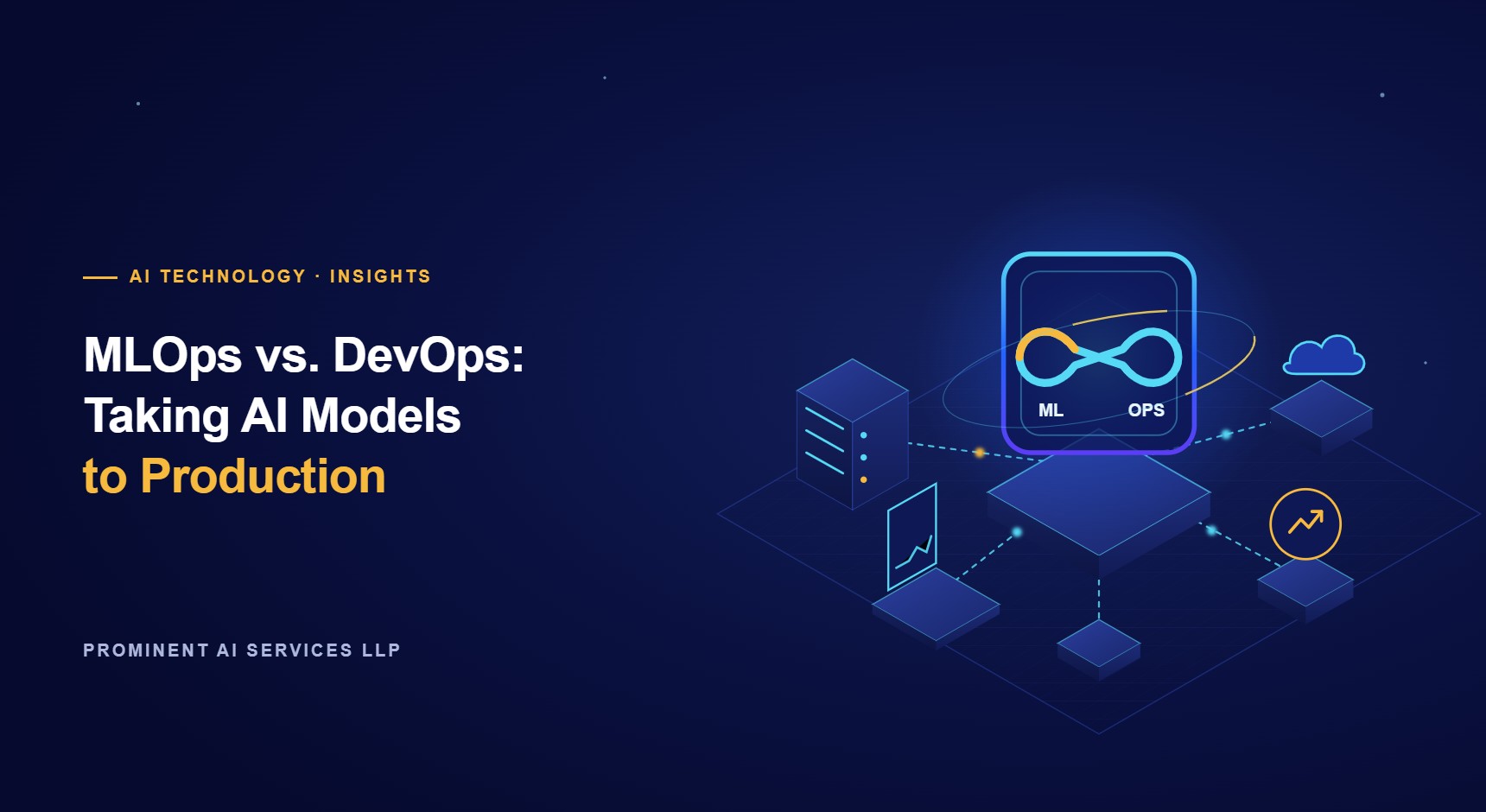
MLOps (machine learning operations) applies DevOps practices such as version control, automated testing and continuous delivery to machine learning, and adds what models specifically need: data and model versioning, experiment tracking, monitoring for data drift and regular retraining. DevOps keeps software running; MLOps keeps models accurate as the world they learned from changes.
Key takeaways
- A machine learning system is code plus data plus a trained model, and all three must be versioned.
- Software usually fails loudly; models fail quietly, by becoming less accurate over time.
- Monitoring must cover prediction quality and input data, not just uptime.
- Retraining needs to be automated, tested and approved like any other release.
MLOps vs. DevOps at a glance
| Area | DevOps | MLOps |
|---|
| What is versioned | Source code and configuration | Code, training data, features and model artefacts |
| Testing | Unit, integration and performance tests | Also data validation, model accuracy and bias checks |
| Releases | Triggered by code changes | Triggered by code changes, new data or falling accuracy |
| Monitoring | Uptime, errors, latency | Also data drift, prediction quality and cost per prediction |
| Typical failure | Crash or error | Silent decline in accuracy |
Why traditional DevOps is not enough for AI
A web application behaves the same way until someone changes its code. A model’s behaviour depends on the data it was trained on. When customer behaviour, prices, suppliers or language change, the data moves away from what the model learned, a problem known as data drift. The application still runs and returns answers, but the answers get worse. Without MLOps, teams often discover this months later through business results rather than alerts.
Reproducibility is the second gap. To audit or fix a model, you need to know exactly which data, code and settings produced it. Ordinary source control does not capture datasets or trained model files.
The building blocks of MLOps
- Experiment tracking: recording parameters, metrics and results for every training run, for example with MLflow.
- Model registry: a catalogue of approved model versions with their lineage and status.
- Automated pipelines: CI/CD that retrains, tests and deploys models in a repeatable way.
- Serving: deploying models as APIs or batch jobs, often in containers on Kubernetes or managed endpoints.
- Monitoring: tracking drift, accuracy against real outcomes, latency and cost, with alerts.
- Governance: approval steps, access control and documentation for audit and compliance.
What about large language models?
Applications built on large language models need the same discipline, sometimes called LLMOps: versioning prompts and model choices, evaluation sets of real questions with expected answers, monitoring of answer quality and safety, and close tracking of token costs. A prompt change is a release and should be tested like one.
How to introduce MLOps step by step
- Start tracking experiments and storing models in a registry, even before full automation.
- Put data validation checks at the start of every training pipeline.
- Automate deployment for your most important model, with a simple rollback.
- Add monitoring for drift and accuracy, then automate retraining with an approval step.
- Reuse the same pipeline for every new model.
We implement MLOps on Azure Machine Learning, AWS SageMaker and Databricks. See our MLOps and model lifecycle management service and DevOps services, or hire ML developers and DevOps engineers.
Have models that are hard to keep accurate in production? Tell us about your set-up, and we will suggest an MLOps roadmap sized to your team. Start your AI journey.
Last updated: October 2026 · Prominent AI Services LLP engineering team