
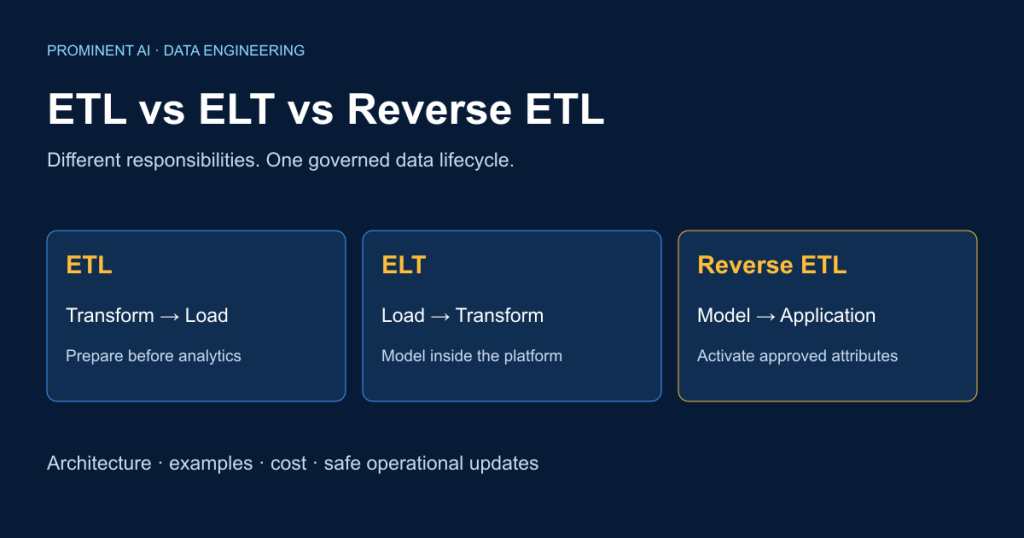
ETL transforms source data before loading it into its final analytical destination. ELT loads data into an analytical platform before transforming it there. Reverse ETL sends curated analytical data back to operational applications. An enterprise can use all three: prepare financial records before reporting, model product activity inside a lakehouse, then send approved account scores to a CRM.
The right choice depends on the destination, privacy boundaries, freshness requirements and who owns the resulting data. Neither transformation order nor a product label guarantees speed, security or lower cost.
Key takeaways
- Choose ETL when data needs an agreed transformation or restriction before the final analytical load.
- Choose ELT when the analytical platform should perform transformations and support reuse of permitted landed data.
- Add reverse ETL when an operational team needs curated attributes in its existing application.
- Batch, incremental processing and streaming are separate design decisions; none belongs exclusively to one pattern.
- Treat operational writes as controlled changes: stable identity, field ownership, permissions, retries and reconciliation matter.
Contents
- Definitions and architecture
- Technical comparison
- Three enterprise examples
- Tools and platforms
- Cost and performance
- Governance and security
- Failure modes
- Selection matrix
- Modernization roadmap
- Production checklist
- Frequently asked questions
Definitions and architecture
ETL: transform before the analytical load
Extract, transform, load moves data through validation and transformation before publishing it to its final analytical destination. An integration service, processing engine or staging environment can perform that work. ETL does not require a dedicated physical transformation server, and temporary staging storage does not automatically make a pipeline ELT.
The relevant boundary is the intended analytical destination. A pipeline might temporarily land encrypted files, standardise currencies, remove disallowed fields and then load curated warehouse tables. Its consumer-facing pattern is ETL. Microsoft’s data integration architecture guidance provides the underlying distinction between ETL and ELT.

Text equivalent: SQL, ERP and files → restricted staging and transformations → quality approval → curated analytical destination. Failed records go to quarantine; successful progress is checkpointed.
ELT: transform inside the analytical platform
Extract, load, transform first brings data into an analytical platform, then uses its SQL, Spark or other processing capabilities to create useful datasets. Loading does not mean making raw data available to everyone. Restrict the landing area, define retention and publish governed consumer models separately.
Keeping permitted source detail can support new transformations and replay. It also creates storage, access and lifecycle responsibilities. A sensitive attribute that has no justified analytical purpose should not be retained simply because storage is available.

Text equivalent: approved sources → restricted analytical landing → platform transformations → curated models and reports. Transformation quality gates separate raw landing from business consumption.
Reverse ETL: return useful data to operational systems
Reverse ETL moves selected, modelled data from a warehouse or lakehouse into applications such as CRM, support or marketing systems. For example, a reconciled account health score can appear alongside a customer record. It is not normally a complete warehouse export or a substitute for transactional application integration.
Before enabling writes, specify the destination object, stable matching key, permitted fields and owner of each attribute. A dashboard can display a bad score; a sync can distribute that score into workflows that act on it. Fivetran’s reverse ETL overview describes the operational direction of this movement.

Text equivalent: accepted analytical model → identity, permission and field checks → destination-aware insert/update/upsert → record-level acknowledgement and reconciliation. Invalid or ambiguous records are held for review.
A complete lifecycle can combine all three
ETL can prepare restricted finance feeds; ELT can combine permitted sales and product data; reverse ETL can activate approved account attributes. Operational responses may return through ingestion, but origin markers and attribute ownership must prevent an update from endlessly triggering itself.

Text equivalent: sources → approved preparation and landing → analytical modelling → activation approval → operational updates → separately identified feedback. Reconciliation, access controls and monitoring span the lifecycle.
Technical comparison
These are typical architecture choices, not restrictions imposed on every implementation.
| Criterion | ETL | ELT | Reverse ETL |
|---|---|---|---|
| Primary purpose | Prepare analytical data before final load | Model landed analytical data | Put curated attributes into operational work |
| Data direction | Sources to analytical destination | Sources to analytical platform | Analytical platform to business applications |
| Transformation location | Before final analytical load | Within analytical platform | Usually upstream model; mapping at export |
| Common sources | Databases, APIs, ERP, files | Databases, APIs, events, files | Accepted tables, views or models |
| Common destinations | Warehouse or curated analytical store | Warehouse, lakehouse, analytical storage | CRM, support, marketing or operational apps |
| Data format | Validated target contract | Restricted source detail, then models | Destination-compatible objects and fields |
| Compute | Integration or processing engine | Analytical platform processing | Model query plus sync/API workers |
| Raw retention | Optional controlled staging | Often retained selectively | Export minimum attributes; retain evidence |
| Scalability | Depends on engine and design | Depends on engine and workload | Also constrained by destination APIs |
| Latency | Extraction plus transformation and load | Landing plus transformation and serving | Model freshness plus sync and acknowledgement |
| Batch | Supported | Supported | Commonly scheduled |
| Incremental processing | Watermarks or change-based inputs | Incremental landing and modelling | Changed-record comparison where supported |
| Streaming | Possible with suitable design | Possible with suitable platform | Connector-specific; not inherently real time |
| Data quality | Gate before curated load | Gate before curated publication | Gate before operational write |
| Governance | Source-to-target ownership | Landing-to-model ownership | Model-to-destination ownership |
| Security | Protect processing and target | Protect raw, processing and serving | Protect export and destination permissions |
| Cost drivers | Movement, processing, operations | Storage, queries, processing, operations | Queries, licence, API usage, reconciliation |
| Complexity | Pre-load dependencies and recovery | Model dependencies and platform operations | Identity, mappings and write recovery |
| Example tools | ADF, Glue, integration runtimes | Fabric, Databricks, Snowflake, BigQuery | Hightouch, Fivetran Activations, custom APIs |
| Typical users | Integration and data engineers | Data and analytics engineers | Data engineers with operational owners |
| Use cases | Curated financial reporting | Reusable product and sales models | Account scores and approved segments |
| Limitations | Upstream changes can delay publication | Uncontrolled raw access or compute growth | Wrong writes can affect business workflows |
Need Help Designing Your Enterprise Data Pipelines?
Start with source contracts, destination responsibilities and measurable acceptance criteria. Discuss Your Data Engineering Architecture with Prominent AI Services LLP.
Three enterprise examples
These are illustrative designs using synthetic data, not descriptions of completed client projects.
1. Finance ETL: reconciled reporting records
A finance team receives SQL Server transactions, ERP extracts and CSV adjustments. Dates, currency codes and account identifiers differ. Loading inconsistent records directly into reporting tables makes period totals difficult to reconcile.
Extract a bounded accounting window and preserve source delivery IDs. Standardise formats, resolve approved account mappings and convert amounts using the explicitly selected exchange-rate date and source. Validate required keys and balanced totals before loading curated reporting tables. Keep original currency and conversion evidence so reviewers can explain the result.
Output: a reconciled reporting dataset, exception queue and run evidence. A late adjustment reopens the relevant period under an agreed policy; it does not silently overwrite an approved close. The rate table and accounting rules require finance ownership. A technical validation pass alone cannot establish accounting correctness.
2. Microsoft Fabric ELT: reusable sales analysis
An organisation combines SQL Server orders, Salesforce account references, ERP fulfilment records and CSV product mappings. Fabric Data Factory coordinates approved ingestion into OneLake and a Lakehouse. Bronze preserves permitted source detail; Silver applies types, deterministic deduplication and reference checks; Gold publishes accepted sales measures. Spark or supported SQL transformations implement the selected path. An optional Warehouse serves justified relational needs, while Power BI uses a deliberately chosen semantic-model connection.
These are logical responsibilities, not a requirement to copy every dataset three times. Fabric Data Factory supports integration and orchestration; design and verify the particular activities, connections and execution context.
For a deliberately small synthetic example, an existing Spark temporary view named `bronze_orders_demo` contains order ID, amount, status, event timestamp and event sequence. This Spark SQL query selects the latest accepted order record and aggregates paid revenue:
WITH ranked AS (
  SELECT *, ROW_NUMBER() OVER (
    PARTITION BY order_id
    ORDER BY event_ts DESC, event_sequence DESC
  ) AS rn
  FROM bronze_orders_demo
), accepted AS (
  SELECT order_id, CAST(amount AS DECIMAL(18,2)) AS amount
  FROM ranked
  WHERE rn = 1 AND status = 'paid' AND amount >= 0
)
SELECT COUNT(*) AS paid_orders, SUM(amount) AS revenue
FROM accepted;
The companion fixture produces two paid orders and revenue of 150.00 in a single assumed currency. This is a teaching query, not a complete production quality pipeline: quarantine invalid casts, handle cancellations and deletes, establish deterministic event ordering, and reconcile currency and tax rules. A partition filter that ignores older corrections can understate revenue even when the query succeeds.
Output: reusable sales models with documented definitions and freshness. See Prominent’s Microsoft Fabric services for the relevant implementation context.
3. SaaS reverse ETL: reviewed account health
A customer-success team needs a consistent account signal derived from billing, product usage, support issues, renewal dates and engagement. The analytical model produces `account_id`, `health_score`, `renewal_risk`, `as_of_utc`, `model_version` and `activation_allowed`. Use a stable account identifier mapped to an approved destination key, rather than assuming email uniquely identifies an account.
A synthetic rule starts at 100 and subtracts 35 for low usage, 20 for unresolved priority support, 10 for an approaching renewal and 20 for late billing. This is an illustrative triage rule, not a validated predictive model. A human owner must approve thresholds and how teams act on the result.
The following is a generic integration contract, not a Salesforce, Dynamics 365 or HubSpot API request:
{
  "operation": "upsert",
  "external_key": {"account_id": "ACCT_DEMO_001"},
  "fields": {"health_score": 35, "renewal_risk": "review"},
  "model_version": "health_v1",
  "as_of_utc": "2026-10-01T09:00:00Z",
  "change_id": "demo-change-001"
}
Resolve identities, enforce the permitted processing purpose, reject stale models and allow only approved fields. Never overwrite an account owner’s notes or sales stage simply because they appear in the source model. Start with a reviewable daily cadence if that meets the business need; increase frequency only after measuring freshness and API headroom.
Confirm each destination’s insert/update/upsert behaviour. Dataverse upsert documentation illustrates why identifiers and alternate keys need deliberate design. Reconcile attempted, accepted, failed and skipped rows; an HTTP success for a batch is not proof that every record was applied.
Output: approved account attributes in the operational workspace, with a sync ledger and unresolved exceptions. Withdrawal or suppression requires an explicit field-clear or suppression policy; disappearance from a query must not automatically delete the customer account.
Tools and platforms
Select capabilities against actual source, transformation and destination requirements. A product may support several patterns.
| Platform | Relevant role | What to verify |
|---|---|---|
| Microsoft Fabric | Integrated ingestion, OneLake and analytical processing | Activities, capacity, access and serving path |
| Azure Data Factory | Managed integration and orchestration for ETL/ELT | Connectors, execution runtime, data movement charges |
| Azure Databricks | Lakehouse ingestion and Spark/SQL processing | Lakeflow Connect coverage, processing and operational ownership |
| Snowflake | Analytical storage and SQL data pipelines | Appropriate tasks, streams or dynamic-table design |
| BigQuery | Managed analytical loading and transformations | Processing model, bytes/slots, location and permissions |
| AWS Glue | Serverless data integration | Jobs, connectors, streaming needs and runtime costs |
| dbt | Transformation models, dependencies and tests | Adapter support and incremental model correctness |
| Ingestion platforms | Source extraction, replication and change delivery | Deletes, schema changes, connector limits and recovery |
ADF, Databricks ingestion, Snowflake pipelines, BigQuery data movement and AWS Glue document different execution choices. None establishes a universal price or performance winner.
dbt models primarily describe transformations and modelling. Do not assume dbt replaces every extractor or operational sync service. Incremental models still require a correct filter, key strategy and backfill plan.
Reverse ETL and activation options
| Option | Appropriate evaluation | Commercial and operational caution |
|---|---|---|
| Hightouch | Curated models to supported operational destinations | Self-serve documentation uses active syncs; verify current plan and enterprise quote |
| Fivetran Activations | Warehouse-to-application syncs within supported coverage | Formerly Census; migration and contract terms matter; usage uses monthly active rows |
| Customer data platforms | Identity, audiences and activation when those are required | Broader scope than reverse ETL; connector, event, profile and consent features vary |
| Custom destination API | Narrow, controlled integration with owned requirements | Team owns authentication, retries, mappings, monitoring and maintenance |
Verify Hightouch sync semantics and current pricing for the actual package. For Census-era comparisons, use the current Fivetran Activations migration FAQ and usage-based pricing definition. Do not carry old Census plan assumptions into a new estimate.
For Fabric reverse ETL, validate the supported access route, source type, authentication and destination mapping before selecting a tool. A vendor’s warehouse support does not by itself prove a native Fabric connector. A custom approved export can be evaluated where no suitable supported connection exists.
Industry applications
| Industry | Analytical preparation | Operational use, if justified |
|---|---|---|
| Banking and finance | Reconciled transactions and account models | Approved relationship-service signals |
| Insurance | Policy, claims and renewal models | Review queues with accountable decisions |
| Healthcare and life sciences | Restricted operational datasets | Authorised administrative follow-up; no autonomous clinical claim |
| Manufacturing | Production, quality and asset history | Maintenance review priorities |
| Retail and ecommerce | Sales, returns and inventory models | Permitted segments or replenishment work |
| Logistics and supply chain | Shipment and supplier history | Exception routing with freshness limits |
| Real estate | Property, lease and service records | Approved renewal and maintenance reminders |
| SaaS and technology | Billing, usage and support models | Reviewed account-health attributes |
| Professional services | Project, capacity and billing models | Delivery-capacity review tasks |
Each example needs its own data owner, permitted purpose and acceptance criteria. Sensitive data and consequential decisions warrant narrower exports and stronger review. These possibilities are not evidence of a delivered integration or a guaranteed business result.
Cost and performance
Build a comparable cost model
Monthly total = ingestion and movement + transformation compute + retained storage + analytical serving + activation licence/usage + network/API charges + engineering/support + failure recovery. Avoid counting the same platform capacity twice. Separate shared baseline allocation from workload-specific marginal cost.
Three configurable synthetic scenarios make assumptions visible:
| Input | Small | Mid-size | Large |
|---|---|---|---|
| Records per day | 100,000 | 5,000,000 | 100,000,000 |
| Average record size | 1 KB | 2 KB | 2 KB |
| Planned cadence | Daily | Hourly | 15 minutes |
| Monthly compute-unit hours | 40 | 400 | 4,000 |
| Average retained storage | 10 GB | 600 GB | 12,000 GB |
| Additional recovery compute | 2% | 5% | 10% |
| Monthly support hours | 4 | 20 | 80 |
These are planning inputs, not benchmarks, vendor recommendations or derived storage promises. Raw decimal input volume for 30 days is records/day × KB/record × 30 ÷ 1,000,000 GB. Compression, versions, retained months and curated copies change actual storage. Supply quoted compute, storage, support and other monthly charges in the companion calculator; rates intentionally start blank. Activation pricing requires its own billable-unit calculation: source records per day are not automatically monthly active rows.
Benchmark the accepted result
Use the same input snapshot, quality rules, concurrency, region and destination contract. Test initial load, steady-state increments, late corrections, backfills and recovery separately. Record extraction time, queue delay, transformation time, time until the consumer can use accepted data, p50/p95 latency, rejected records, throughput and total billable consumption.
Repeat under warm and cold conditions and include operational API throttling. A faster landing step is not a faster usable dataset. Publish workload configuration and measured results only after execution; this article contains no measured speed comparison. For subsecond operational commands, evaluate event-driven integration rather than assuming a scheduled reverse ETL connector meets the deadline.
Governance and security
Agree the permitted processing purpose before exporting personal information. Apply minimisation, retention and access rules across source, staging, analytical and destination copies. The European Commission’s GDPR principles support purpose limitation and minimisation; selecting a tool or region does not itself demonstrate compliance. Applicable obligations and lawful basis require organisation-specific assessment.
- Use workload identities and least privilege; separate read, transform, publish and activation permissions.
- Keep secrets in managed connections or an approved secret store, with rotation and audit.
- Document residency and cross-border movement, including connector processing and support access.
- Restrict raw data and apply row/column boundaries at every actual access surface.
- Export an allowlist of fields and destination API scopes; source permissions do not automatically travel with a copied record.
- Record model version, purpose, mappings, approvals and destination acknowledgements without leaking sensitive payloads into logs.
- Define retention, withdrawal, suppression and deletion propagation for each copy, including backups where applicable.
Failure modes
| Risk | Practical control |
|---|---|
| Schema drift | Version contracts; quarantine incompatible changes before publication |
| Duplicate or replayed changes | Stable business/event keys and deterministic deduplication |
| Late arrivals and backfills | Explicit correction window and replayable source evidence |
| Partial analytical load | Staged publication and checkpoint only after acceptance |
| Missing CDC deletes | Test tombstones and define analytical deletion semantics |
| Wrong operational identity | Reject missing or ambiguous matches; review mapping exceptions |
| Destination throttling or outage | Bounded retries, backoff and observable exception queues |
| Unauthorised field overwrite | Field ownership, allowlists and dry-run diffs |
| Stale score or model | Freshness threshold and version checks before export |
| Feedback loop | Origin metadata, ownership and exclusion of self-generated updates |
For reverse ETL, distinguish retryable throttling or transient failure from validation and permission failures. Honour destination guidance, cap retry time and preserve unresolved records. Hightouch’s retry documentation illustrates destination-sensitive behaviour. After an ambiguous timeout, a write might already have succeeded. Use supported idempotency features or stable-key upsert plus a durable ledger and reconciliation; do not claim universal exactly-once delivery.
Selection matrix
| Decision input | ETL/ELT implication | Activation implication |
|---|---|---|
| Business objective | Identify the accepted analytical product | Identify an operational action and owner |
| Freshness | Budget ingestion and transformation latency | Include sync and destination delay |
| Volume | Size processing and storage experimentally | Check API and connector headroom |
| Transformation complexity | Choose suitable engine and dependency model | Keep business logic in an owned model |
| Privacy | Restrict before landing where required | Minimise destination attributes |
| Raw retention | Retain only justified detail | Avoid exporting source history |
| Target system | Analytical platform determines load boundary | Operational object determines write contract |
| Existing infrastructure | Reuse sound pipelines where practical | Validate supported source access |
| Team skills | Match orchestration and SQL/Spark ownership | Assign integration support responsibility |
| Budget | Compare full lifecycle cost | Include licence, API and exception handling |
| Reporting | Reconcile measures and serving access | Do not treat CRM sync as reporting storage |
| Automation | Publish accepted models before consumers run | Define human review and permitted actions |
| Security | Test every processing/serving boundary | Scope identity and destination permissions |
| Maintenance | Plan schema change, backfill and deployment | Plan connector change and mapping review |
Choose ETL for necessary pre-load preparation, ELT for in-platform modelling, or reverse ETL for an already accepted model needing operational distribution. Hybrid ETL + ELT fits restricted preparation followed by flexible modelling. ELT + reverse ETL fits platform modelling followed by controlled activation. All three can fit a mixed estate. If freshness demands an event or command path, evaluate streaming/event integration alongside these choices rather than forcing it into a batch sync.

Text equivalent: establish the destination; check pre-load restrictions; select ETL, ELT or a hybrid; add reverse ETL only for approved operational attributes; evaluate an event path if the latency target cannot be met.
Modernize Your ETL and ELT Architecture
Review dependencies before replacing working integrations. Prominent’s data engineering services provide a relevant starting point for discussing ingestion, modelling and production responsibilities.
Modernization roadmap
- Inventory sources, pipelines, destinations and business owners.
- Map schedules, consumers, downstream actions and hidden dependencies.
- Establish quality rules, reconciled totals and acceptance thresholds.
- Profile volumes, changes, sensitive fields and late arrivals.
- Select platform and integration routes against requirements.
- Define landing zones, curated contracts, retention and permissions.
- Refactor transformations with versioned, repeatable tests.
- Implement incremental progress, deletes and replay/backfill controls.
- Reconcile old and new outputs with accountable owners.
- Benchmark performance, freshness, failure recovery and complete cost.
- Cut over by dependency group, with parallel comparison and a tested rollback.
- Monitor accepted outputs, operational writes and spend; retire old paths only after acceptance.
Changing transformation order without migrating ownership and recovery procedures moves risk rather than resolving it. Start with a bounded dataset and a reversible consumer change; avoid simultaneous unreviewed writes from old and new activation jobs.
Production checklist
Mandatory controls include a named owner, source/destination contract, least privilege, quality gate, deterministic identity, secret handling, checkpoint/replay strategy, schema-change policy, deletion rules, monitoring, reconciliation, deployment approval and rollback. Reverse ETL additionally needs field ownership, freshness limits, dry-run review, per-record outcomes and bounded destination-aware retries.
Optional optimisations include partitioning, clustering, caching, parallelism, change detection tuning, autoscaling and reservation commitments. Apply them after correctness and recovery are demonstrated. Faster incorrect updates are not production readiness. The companion examples test local reference logic only; they do not certify a cloud deployment.
Frequently asked questions
What is the difference between ETL and ELT?
What is reverse ETL?
How do ETL, ELT and reverse ETL differ?
Is ELT better than ETL?
Which is faster, ETL or ELT?
What is a practical ETL example?
What is a practical ELT example?
What is a practical reverse ETL example?
Which approach suits a cloud data warehouse?
Can ETL and ELT coexist?
Can reverse ETL work with Microsoft Fabric?
Which tools support these patterns?
Is reverse ETL the same as data activation?
What does dbt do in ELT?
When should we migrate from ETL to ELT?
How much do these pipelines cost?
Is reverse ETL secure?
What makes a pipeline production-ready?
Conclusion: design the complete data path
Choose ETL and ELT by the analytical boundary, then add reverse ETL only where operational distribution has a clear purpose. The strongest architecture makes accepted outputs, ownership and recovery explicit across the complete path.
Discuss Your Data Engineering Architecture to define an appropriate scope, platform evaluation and next implementation step.