
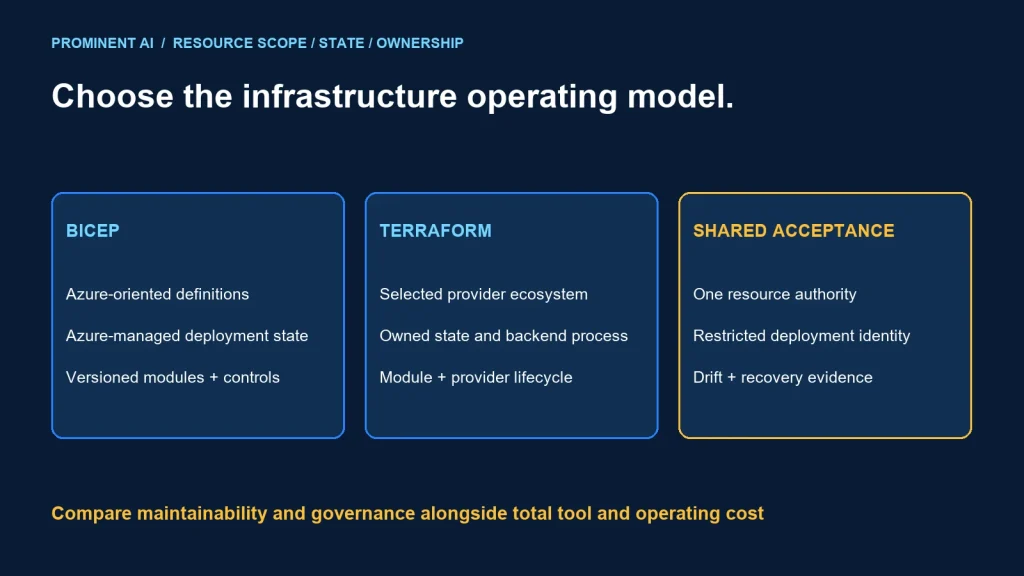
Choose Bicep when an Azure-focused deployment model and Azure-native resource definitions fit the team. Choose Terraform when its provider ecosystem and an owned state workflow support the wider infrastructure scope. Neither tool removes the need for deployment identity, change review, drift management and recovery. Select the operating model you can maintain.
Key takeaways
- A shared language across clouds does not make resource designs portable automatically.
- Terraform state needs secure storage, concurrency controls and recovery ownership.
- Bicep avoids a separate client-managed state file, but Azure deployment operations still need governance.
- Compare maintenance and migration effort alongside tool or platform fees.
Terraform vs Bicep: compare the deployment model
Microsoft’s Bicep overview describes a declarative language for Azure resources, reusable modules and what-if previews. Azure manages the deployment state without a separate Bicep state file for the team to maintain.
HashiCorp’s state documentation explains how Terraform binds configured resource instances to real objects. That mapping is part of its lifecycle workflow and needs a deliberately managed backend in a collaborating team.
For either tool, inventory the actual resource types and operations. “Supports Azure” is too broad a requirement. Test the chosen API versions or providers, existing-resource onboarding, updates and retirement for the workload you intend to operate.
For multicloud estates, Terraform can provide a common configuration workflow across supported providers. It does not make an Azure network resource interchangeable with another cloud’s network or eliminate separate identity and policy models. Reusable patterns still need provider-specific implementation.
Enterprise comparison matrix
| Area | Bicep candidate | Terraform candidate | Evidence to request |
|---|---|---|---|
| Primary scope | Azure resource deployment | Resources exposed by selected providers | Required resource/API support in the chosen versions |
| State ownership | Azure deployment-managed state | Explicit resource bindings in Terraform state | Concurrency, recovery and access design |
| Reuse | Versioned Azure-oriented modules | Versioned modules and provider dependencies | Module ownership and upgrade tests |
| Change preview | Review what-if output and limitations | Review plan and execution context | Expected and destructive-change fixtures |
| Governance | Pipeline permissions and Azure controls | Pipeline/platform controls and Azure authorization | Denied deployment and bypass tests |
| Cost | Authoring and operating workflow | Authoring, state and selected platform/edition | Current terms and measured team effort |
Confirm current product and licensing terms for the exact edition rather than treating a language comparison as a complete commercial comparison. Preview output is useful evidence, but it does not guarantee that deployment will succeed or that every runtime dependency is correct.
State management and sensitive data
For Terraform, define who can read, write, recover and administer the backend. Check supported locking behavior, encryption, authentication and retention. Keep production state boundaries small enough to make ownership and change impact understandable.
HashiCorp’s sensitive-data guidance explains that state and plan artifacts can contain sensitive values. Marking a value sensitive can redact display without removing it from persisted artifacts. Use supported nonpersisted-value features only where the selected Terraform and provider versions allow them.
Do not store state in ordinary source control. Keep plans and pipeline artifacts under appropriate access controls as well. A reviewer who can download a plan may have access to more infrastructure detail than the visible log suggests.
For Bicep, inspect parameter, output, deployment-history and pipeline-log handling. Avoiding a separate state file does not remove all places where a secret could be exposed. Use supported secure parameter and secret-reference designs and verify the complete workflow.
In both cases, restrict the deployment identity. A well-reviewed template executed by an overprivileged identity still creates a broad blast radius if the workflow is compromised.
Maintainability, drift and resource ownership
Give each resource one clear management authority. If Bicep, Terraform and manual portal changes all modify the same properties, the next deployment can overwrite another team’s intent. Document any deliberate boundary between tools.
Version modules and provider/API dependencies. Test upgrades on a representative environment before promoting them. A module interface is a product contract: changing a default can affect many consuming workloads even when their source files do not change.
Define drift response. Decide which changes are accepted emergency interventions, which should be reverted and how approved changes return to code. Repeatedly deploying old intent after an incident can undo an important repair.
For migration between tools, create a resource-by-resource ownership plan. Import or existing-resource handling requires validation; it is not proof that every property matches the desired configuration. Avoid simultaneous writes from both deployment systems during handover.
One resource owner
  → versioned desired configuration
  → reviewed preview and policy checks
  → approved deployment identity
  → verified resource and workload behavior
  → drift review and controlled recovery
Rollback is not always “apply the previous file.” Some changes replace resources, alter data or have irreversible side effects. Include backups, migration steps and recovery decisions where the resource lifecycle requires them.
Total-cost assumptions
| Cost area | Record for each option | Evidence |
|---|---|---|
| Tool/platform | Selected edition, hosted service and support | Current agreement and quote |
| Implementation | Modules, identity, policy and pipeline setup | Bounded pilot effort |
| State and artifacts | Storage, access, recovery and audit handling | Operational design and tests |
| Maintenance | API/provider changes and module upgrades | Observed support workload |
| Migration | Existing-resource adoption and ownership handover | Inventory and rehearsal |
| Cloud resources | Deployed infrastructure and test environments | Actual workload estimates |
Separate tool cost from infrastructure cost. A free authoring tool can deploy an expensive architecture; a paid management platform might or might not justify its fee through reduced operating effort. Measure the same delivery responsibilities rather than comparing unlike scopes.
No universal cost winner is claimed. Use reviewed rates and staff estimates, then track actual maintenance after rollout.
A selection worksheet and pilot
- List required resources, clouds and governance boundaries.
- Identify the team’s existing skills and deployment tooling.
- Implement one representative environment in shortlisted options.
- Exercise create, update, failed deployment and drift cases.
- Test sensitive-data handling and a denied deployment.
- Demonstrate ownership handover and recovery for existing resources.
- Compare total maintenance effort and document the decision.
Azure-focused team: Bicep can be a direct fit when Azure-native definitions and a simpler state operating model match the requirements. Prove module reuse and deployment controls in the actual delivery environment.
Provider-spanning platform team: Terraform can fit a common workflow across several supported systems when the team owns provider lifecycle and state operations. Keep cloud-specific controls explicit.
Existing mature estate: retain a functioning, governed standard unless migration delivers a clear benefit. A language preference alone rarely justifies recreating years of tested modules and operating knowledge.
Align the workflow with the enterprise CI/CD comparison and the Azure landing-zone checklist.
Common questions
Should Azure teams use Terraform or Bicep?
Choose from resource scope, state ownership, skills, governance and maintenance evidence. An Azure-focused team and a provider-spanning platform team can reasonably choose differently.
Does Bicep require a separate state file?
No separate Bicep state file is maintained by the team. Azure deployment state and the surrounding delivery process still require governance.
Does sensitive marking remove secrets from Terraform state?
Not by itself. Review persisted artifacts and supported nonpersisted-value features for the exact versions and provider capabilities.
Can both tools manage the same environment?
Yes, with explicit nonoverlapping resource ownership. Avoid competing management of the same resource properties.
Is a successful preview enough to approve production?
No. Validate identity, policies, resource behavior, workload dependencies and recovery in addition to the preview.
Choose an infrastructure workflow your team can own
Bring resource scope, existing modules and governance requirements to a review. Discuss a cloud architecture and cost review to compare Terraform and Bicep through a representative deployment pilot.