
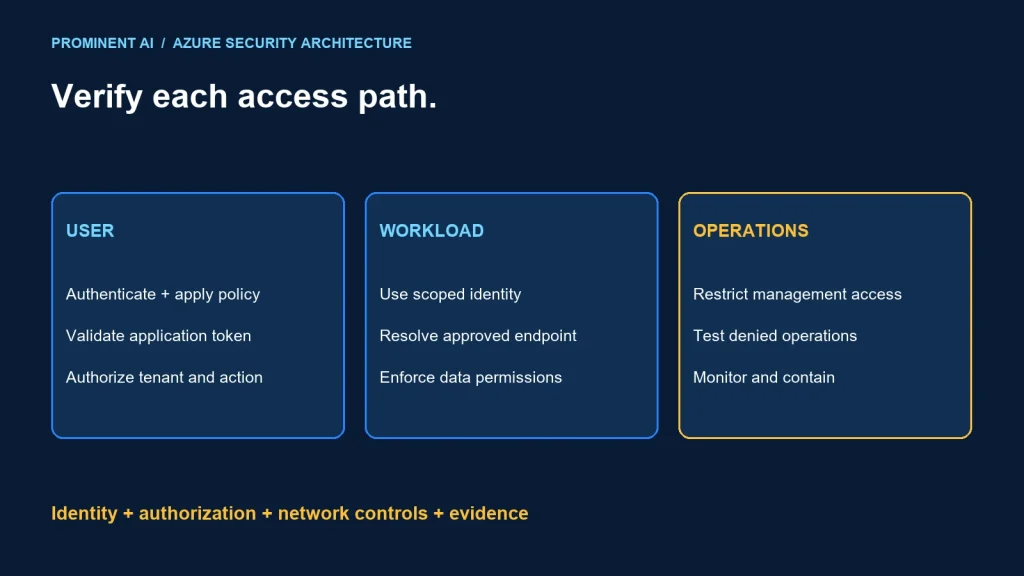
Implement Azure Zero Trust architecture by verifying identities, enforcing application authorization, limiting workload permissions and constraining network paths while monitoring the complete access chain. Microsoft Entra ID, Conditional Access and private endpoints solve different parts of that design. A private IP address alone does not establish that a caller may read a record or perform an action.
Key takeaways
- Separate user authentication, business authorization, workload identity and network reachability.
- Model both control-plane and data-plane permissions.
- Verify private DNS, public endpoint settings and real client connectivity.
- Test denied access as deliberately as successful access.
Start with explicit trust boundaries
Microsoft’s Zero Trust principles are explicit verification, least privilege and assuming breach. Apply them to a specific application path rather than treating Zero Trust as a product installation or a completed certification.
Inventory users, administrators, service identities, data stores and external systems. Draw where requests cross identity, application, network and organizational boundaries. Identify the data and actions at each crossing. A boundary should have an owner and an enforcement mechanism.
Distinguish an employee application from a public customer portal. Their identity populations, access policies and recovery requirements may differ. Do not copy an employee access policy into a customer journey without checking the supported identity model and user experience.
Map the management path too. A protected application can still be altered through an overprivileged deployment identity or administrator account. Resource configuration changes, role assignment and secret access need their own review.
An application access-path diagram
USER PATH
User + device → Entra authentication and applicable access policy
→ application validates token → tenant/record/action authorization

WORKLOAD PATH
Application identity → permitted data operation
→ approved network route + DNS → private endpoint → data service

MANAGEMENT PATH
Approved operator or deployment identity → scoped management role
→ reviewed change → audit evidence and alerting
This conceptual diagram does not prescribe a particular gateway or hosting tier. Select the actual ingress and network design from the application’s exposure requirements. Keep token validation, business authorization and data permissions explicit even when the traffic remains on a private network.
For every arrow, record the identity, destination, protocol, permitted operation and evidence source. Unknown arrows often reveal integration credentials, administrative shortcuts or background processes missing from the main design.
Entra ID and Conditional Access protect different decisions
Microsoft’s Conditional Access overview explains policy decisions based on signals such as user, device and application context. It also notes that enforcement follows first-factor authentication and is not a denial-of-service defense.
Determine which users, applications and sign-in flows the chosen policy covers. Validate licensing and feature requirements for the actual tenant. Workload identity controls require separate assessment; do not assume a policy designed for employee sign-in applies identically to every service principal or managed identity.
The application still needs correct token validation and business authorization. Check issuer, audience, signature and token validity using supported libraries and configuration. Then enforce tenant membership, record ownership and permitted actions server-side.
A valid token means that the authentication contract was satisfied; it does not automatically grant access to every customer record. Avoid accepting tenant identifiers or role claims from untrusted request fields as proof of permission.
Use distinct workload identities where separate responsibilities warrant them. Grant each identity only the required resource operations and scope. Prefer a managed identity where the service supports the required authentication path, while still reviewing its effective permissions and lifecycle.
Stage access-policy changes with a pilot and appropriate evaluation mechanisms. Include monitored emergency access and a tested recovery procedure so an incorrect rollout does not prevent administrators from repairing the environment.
Private endpoints, DNS and network controls
Azure’s private endpoint documentation describes a network interface with a private address that connects to a supported Private Link resource. Endpoint approval, the target subresource and client connectivity are part of the configuration.
Treat private connectivity and service authorization as separate gates. A reachable storage or database endpoint still needs the appropriate authenticated permissions. Conversely, a correct identity does not compensate for a broken route or incorrect DNS resolution.
Check whether the service’s public network access remains enabled and what the application requires. Creating a private endpoint should not be treated as proof that every public access path has been closed. Review service-specific settings and test from both intended and unintended locations.
Trace DNS resolution from the actual application runtime and from on-premises clients where applicable. A developer laptop resolving a private address is insufficient evidence for a hosted worker using a different resolver. Document forwarding and private-zone ownership to prevent later changes from breaking connectivity.
Review subnet rules, routes, firewalls and egress paths against the service’s supported behavior. Private endpoint network policies and inspection designs are configuration-specific. Validate the intended path rather than assuming every packet crosses a central firewall.
Retain encryption in transit and certificate validation. Private addressing does not justify weakening transport security. Include connection monitoring and a support path that does not depend on opening broad temporary access during incidents.
A permission worksheet for least privilege
| Principal | Required purpose | Scope to define | Negative test |
|---|---|---|---|
| Application workload identity | Read approved business data | Specific data resources and required operations | Cannot modify unrelated data or assign roles |
| Background processor identity | Consume assigned work and persist results | Owned queue and result location | Cannot read another workload’s queue |
| Deployment identity | Change approved application resources | Deployment boundary and necessary management actions | Cannot alter unrelated subscriptions or grant arbitrary privilege |
| Support operator | Investigate incidents | Required diagnostic access with approved elevation path | Cannot retrieve business data merely through a support role |
| End user | Perform permitted business actions | Application tenant, record and action policy | Cannot access another tenant by changing an identifier |
This worksheet is a starting point, not a list of Azure built-in role assignments. Select and test actual roles against the service’s management-plane and data-plane permissions. Review inherited group access and broad parent scopes as well as direct assignments.
Define ownership for permission reviews, identity removal and incident containment. A least-privilege design decays if unused roles and old integration identities remain indefinitely.
Practical threat scenarios
A compromised user token reaches the API
Validate the token and enforce the user’s actual resource permissions. Log denied cross-tenant attempts without recording tokens or sensitive payloads. Test how the supported identity and application controls respond to revocation and session changes instead of assuming every session is terminated immediately.
An application identity is overprivileged
A private endpoint does not limit what a compromised workload can do with valid broad permissions. Reduce resource scope, separate duties and alert on unexpected operations. Containment should identify how to stop or restrict the workload without relying solely on blocking public ingress.
Private DNS changes unexpectedly
Verify destination resolution and access behavior from the workload. Alert on connectivity failures and unexpected endpoint configuration changes. Recover through reviewed DNS configuration rather than disabling certificate checks or opening unrestricted network access.
A deployment pipeline attempts to grant extra access
Restrict role-assignment authority and review deployment changes. Capture the denied operation and confirm the pipeline cannot silently switch to another privileged credential. The management path should receive the same architectural attention as user requests.
Validation checklist before production
- Confirm authorized sign-in and an expected denied sign-in scenario.
- Reject invalid or wrong-audience tokens through supported validation.
- Test cross-tenant and unauthorized record access at the API.
- Prove permitted and denied data operations for each workload identity.
- Verify DNS and connection paths from every supported client location.
- Test public endpoint behavior against the approved exposure design.
- Check management changes and role-assignment restrictions.
- Verify logs, alert delivery, incident ownership and emergency access.
These are proposed architecture validation scenarios, not evidence of a completed penetration test. Run them in an authorized environment with suitable test identities and data. Preserve configuration versions and results so later changes can be reviewed against the same access contract.
Relate the controls to the Azure landing-zone design and infrastructure deployment workflow. This article focuses on application access boundaries rather than repeating a full platform landing-zone plan.
Common questions
How do you implement Zero Trust for an Azure application?
Map user, workload and management paths; verify identities; enforce scoped authorization; constrain network access; and test both allowed and denied behavior with monitoring.
Does a private endpoint replace authentication?
No. It provides a private connectivity path to a supported resource. Identity and operation-level authorization remain necessary.
Does Conditional Access replace API authorization?
No. The API must validate tokens and enforce tenant, record and action permissions. Sign-in policy does not define every business authorization rule.
Does creating a private endpoint automatically close public access?
Do not assume that. Review and test the service-specific public networking configuration against the approved design.
What is the most useful least-privilege test?
Prove the identity can complete its assigned task and cannot perform an adjacent unauthorized operation, including inherited access and management actions.
Review the complete Azure access path
Bring your identity flows, resource permissions and network diagram. Discuss a cloud architecture and cost review to identify trust boundaries, access tests and a practical operating plan.