
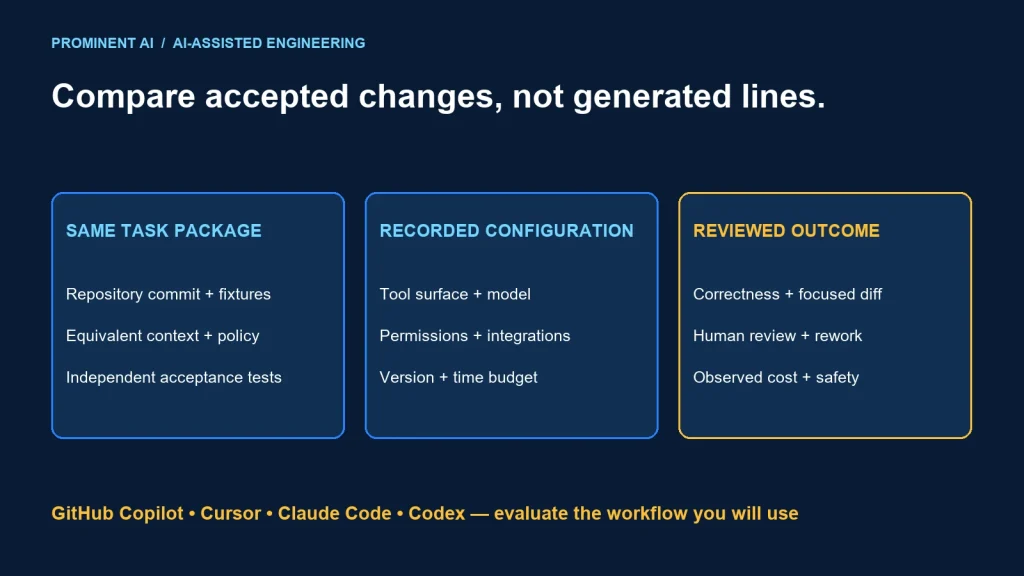
The best enterprise coding assistant is the one that produces reviewable changes within your repository, data and execution policies. Compare GitHub Copilot, Cursor, Claude Code and Codex using the same tasks, acceptance tests and governance checks. Product names alone do not describe the model, interface or permissions used in a particular session.
Key takeaways
- Compare a specific product surface and configuration, not an entire brand in the abstract.
- Repository context and tool permissions affect results as much as the prompt.
- Measure accepted outcomes, review effort and escaped defects, not generated lines.
- Keep enforcement in repository and infrastructure controls as well as agent instructions.
- Calculate total cost using usage, developer time, review and rework.
Compare workflow fit before model preference
The following is a decision matrix, not a performance ranking. Features and enterprise controls change, and available models can vary by plan or organization policy. Verify the exact product version, surface and contract at procurement time.
| Product | Workflow to evaluate | Important question |
|---|---|---|
| GitHub Copilot | Repository collaboration and available coding/review surfaces | Which policies apply to the chosen client or cloud session? |
| Cursor | Editor-centered work and the selected local or cloud agent | What are the file, command and network boundaries? |
| Claude Code | Repository work through the chosen supported interface | Which permission mode and managed settings govern execution? |
| Codex | Task execution and review in the chosen supported surface | Which repository guidance and execution controls are active? |
GitHub’s enterprise guidance explains governance for Copilot cloud sessions and notes that policy coverage differs across surfaces. Inspect the current policy model rather than assuming an IDE setting controls every agent or cloud workflow.
Cursor’s Run Modes documentation describes local agent approvals, sandbox behavior and team controls, while distinguishing cloud-agent execution. Test the actual mode your team will use; local and cloud sessions should not be treated as identical trust boundaries.
Claude Code’s permission documentation describes permission modes, rules and managed configuration. Evaluate effective settings in the chosen deployment. Do not assume a developer’s local allow rule is equivalent to an organization-enforced control.
Official OpenAI documentation on Codex review rules explains using repository guidance in AGENTS.md to add project-specific review context. Keep tests, branch protections and required approvals as enforcement mechanisms rather than treating prose instructions as a substitute.
Repository context is part of the system
A coding assistant needs the relevant architecture, conventions and acceptance criteria. A large repository can contain conflicting examples, obsolete instructions and generated files. Give the tool a clear entry point and a task boundary instead of asking it to infer every organizational rule from source history.
Create a short repository guide describing build commands, important boundaries and test expectations. Keep secrets and production data outside the evaluation workspace. Review instruction changes as code because they influence future work.
When comparing products, distinguish equivalent intent from identical file syntax. Different products can have different supported guidance mechanisms. Put the same substantive policy into the appropriate supported mechanism, then record how it was loaded.
Also compare context failure: a misleading example, a stale document or a user comment that looks like an instruction. The agent should not gain new authority merely because it reads text that tells it to ignore the task boundary.
A reproducible enterprise task evaluation
This is a proposed evaluation protocol. We did not run a four-product benchmark or measure comparative completion times for this article. The score sheet is intentionally unfilled so teams can collect their own evidence.
1. Freeze the task package
Use the same repository commit, dependencies, fixture data and acceptance criteria. Give each tool a clean branch or isolated worktree. Record product version, model where exposed, permission mode, tool integrations and time budget. Do not compare one unrestricted agent with another that cannot run the tests.
2. Use several representative tasks
| Task | Acceptance criteria | Failure to watch |
|---|---|---|
| Fix a duplicate-event bug | One durable business effect under replay; conflict case covered | In-memory deduplication hides a persistence defect |
| Add an API field | Contract, validation and compatibility tests updated | Unrelated breaking changes |
| Refactor a module boundary | Behavior preserved; public dependency boundary maintained | Broad rewrite with weak evidence |
| Review a seeded defect | Specific issue, evidence and practical correction | False positives or unsupported security claims |
For a duplicate-event task, the prompt could be:
At the supplied repository commit, fix duplicate processing of the
same tenant-scoped event. Preserve the public API. Add tests for:
same key and same payload, same key with conflicting payload,
different tenant, and failure before commit.
Use only the fixture data. Do not access production or add secrets.
Explain the storage/concurrency assumptions and tests actually run.
Return a focused diff and any remaining limitations.
3. Keep independent acceptance tests
Have the evaluator own the expected behavior. An assistant that changes both implementation and tests can make incorrect behavior look successful. Review test modifications and use independent cases for the final decision.
4. Record results without a single misleading score
| Evidence field | Record for each product/configuration |
|---|---|
| Acceptance | Passed, failed or blocked, with test evidence |
| Review effort | Time and substantive corrections required |
| Scope control | Unnecessary files, dependencies or behavior changes |
| Execution safety | Boundary violations, approval behavior and blocked actions |
| Explanation quality | Accurate claims about tests and limitations |
| Cost | Observed usage plus review and rework effort |
Repeat tasks and rotate order where feasible. A single successful demonstration is not a reliable estimate of team-wide performance. Keep failures and blocked runs in the report rather than counting only completed attempts.
Enterprise governance comparison checklist
- Data handling: inspect the current contract, retention, subprocessors and model-provider behavior for the selected feature.
- Identity: verify organization-managed access and joiner/mover/leaver behavior.
- Repository scope: confirm which repositories and external files are reachable.
- Execution: test commands, network egress, credentials and production-access boundaries.
- Tool integrations: review MCP servers and other connectors independently.
- Review: keep protected branches, checks and release approvals effective.
- Evidence: understand available session logs and avoid storing secrets in them.
- Policy drift: revalidate after product, model or configuration changes.
Do not equate a privacy-mode label with local-only processing or every possible enterprise requirement. Ask where code is processed, what is retained and which controls apply to each surface. Verify contractual details with the vendor rather than extrapolating from another plan.
Use a sanitized repository for initial governance testing. A coding tool should not receive production credentials simply because a developer already has them in the terminal environment.
Compare total cost and adoption effort
Seat price is only one variable. Include usage charges or credits, developer interaction time, human review, CI execution, rework and administrative overhead. Avoid a precise savings claim until the team has measured accepted outcomes against an appropriate baseline.
A useful comparison is cost per accepted task class, accompanied by quality and risk evidence. A tool that completes many easy edits cheaply may still be unsuitable for a high-risk refactor if review effort is excessive.
Start with a small group and clearly scoped repositories. Teach engineers how to specify acceptance criteria, inspect diffs and challenge unsupported claims. Broader adoption should follow evidence, not pressure to make every workflow autonomous.
Choose by task and control boundary
Shortlist products that fit the team’s existing workflow, then eliminate configurations that cannot meet required governance. Evaluate the remaining options on the same tasks. It is reasonable for different teams or task classes to use different approved configurations.
For architectural work, make boundaries explicit before generating code. The modular monolith guide provides an example of decisions that should survive an automated refactor.
Common questions
Which AI coding assistant is best for enterprise development teams?
There is no universal winner. Compare the specific product configuration on your tasks, acceptance criteria, review effort and governance requirements.
Should all four tools receive the same prompt?
Keep the task intent and acceptance criteria equivalent, while using each product’s supported context and instruction mechanisms. Record configuration differences.
Does passing generated tests prove the change is correct?
No. Review the tests and use independent acceptance cases. A tool can accidentally change the expected behavior along with the implementation.
How should costs be compared?
Combine observed tool usage with developer time, review, CI and rework for accepted tasks. Avoid relying only on seat price or generated-code volume.
Can coding agents replace repository protections?
No. Keep branch protections, independent checks, access controls and required release approvals effective.
Evaluate AI-assisted engineering with evidence
Bring a representative repository and the tasks your team repeats. Discuss AI-assisted engineering adoption with a focused task pack and governance review.