
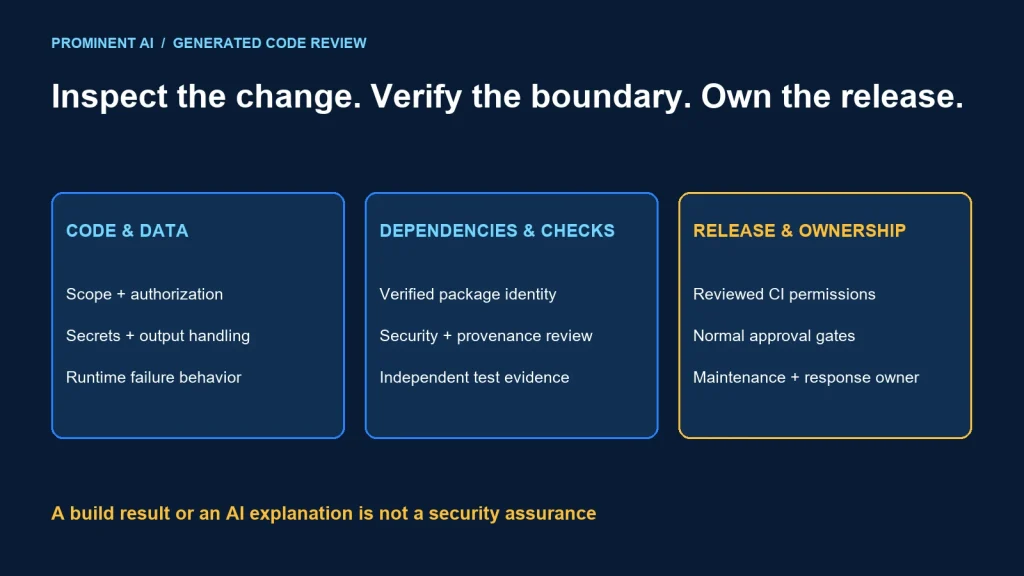
Review AI-generated code as untrusted proposed code before production: inspect behavior, secrets, dependencies, authorization, licensing information and test evidence. A plausible explanation or a successful build does not prove that a change is secure or suitable for the application.
Key takeaways
- Assign an engineer who understands and owns the accepted change.
- Inspect the entire diff, including build scripts, dependencies and CI configuration.
- Keep secrets outside agent-readable workspaces and routine logs.
- Use independent tests and security tooling with reviewed findings.
- Record dependency provenance and route license exceptions through the organization’s process.
What can go wrong in a generated change?
OWASP’s Secure Coding with AI guidance highlights risks including invented dependencies, insecure generated patterns, secret exposure and overly privileged coding agents. Use it as a reference for a risk-based review. The scenarios below are original review exercises, not reported incidents.
| Scenario | What looks reasonable | What the reviewer must establish |
|---|---|---|
| Customer record endpoint | Returns the correct record by ID | Caller can access that tenant and record |
| Dependency added for a small helper | Package name resembles a familiar library | Package identity, necessity and maintenance are verified |
| Connection failure workaround | Request succeeds after certificate checks are disabled | Transport validation remains effective |
| Build automation change | CI becomes green | Tests and security checks were not skipped or weakened |
| Diagnostic logging | More detail makes debugging easier | Tokens and confidential payloads are not exposed |
Start with the effect of the change, not whether it was generated. The same authorization defect matters in human-written code. AI assistance adds workflow concerns such as context exposure, misleading explanations and automated edits beyond the requested scope.
The production review checklist
1. Scope and behavior
Compare the diff with the approved task. Identify unrelated refactoring, new outbound calls and changed defaults. Review error handling and partial failure. A small feature should not quietly replace a framework or change public contracts without a design decision.
2. Secrets and sensitive data
Inspect configuration, fixtures, logs and generated documentation for credentials or unnecessary personal data. Use approved secret storage and access boundaries. A file ignored by version control may still be readable by a coding tool; repository exclusion and tool access are different controls.
GitHub’s secret-scanning documentation describes finding supported exposed credentials. Use the appropriate scanning capability in the workflow, but do not assume a clean result detects every secret or every form of data leakage.
3. Authorization and tenant boundaries
Verify the caller, resource and permitted action at the trusted server boundary. Test another user’s record and another tenant’s identifier. A hidden button or a client-side filter is not sufficient authorization.
4. Input and output handling
Review how untrusted values reach database queries, templates, file paths, commands and external requests. Use the platform’s safe APIs and explicit validation. Check generated output before passing it into another interpreter or business action.
5. Runtime and infrastructure controls
Inspect timeouts, retries, certificate validation, filesystem access and process execution. Confirm that a local debugging workaround has not become the production default. Review any change to CI permissions and deployment configuration separately.
The NIST SSDF provides broader secure-development practices for protecting software, verification and vulnerability response. This checklist supports engineering review; it does not establish compliance or certify the application.
Dependencies, provenance and license review
For every new dependency, record why it is needed, its actual registry identity, version, upstream source and relevant review evidence. Check transitive dependencies and lockfile changes. A generated package name should never be treated as proof that the package exists or is the intended one.
Use the organization’s vulnerability and dependency-review tooling. Inspect findings and documented exceptions rather than disabling a failing check to complete the task. Keep update ownership after release.
GitHub’s license-compliance overview describes tooling for tracking dependency licenses and enforcing configured policy. Tool availability depends on the repository’s product configuration. A tool’s classification is evidence for review, not a universal legal conclusion.
Route unclear provenance, attribution requirements or license-policy exceptions to the responsible reviewer. Do not ask a coding assistant to invent a legal determination from a package name. Preserve notices and source information according to the approved process.
| Field | Evidence to capture |
|---|---|
| Identity | Exact registry package and upstream project |
| Purpose | Why the dependency is needed instead of an existing capability |
| Version | Resolved version and lockfile change |
| Security | Review result, findings and approved exceptions |
| License/provenance | Declared information and policy-review decision |
| Ownership | Maintainer inside the application team |
A small static-analysis review signal
We ran a local Python AST fixture with six assertions. It flags direct eval/exec calls and calls containing the literal keyword verify=False, while checking several simple counterexamples. Fixture strings were parsed, not executed.
def review(source):
    findings=[]
    for node in ast.walk(ast.parse(source)):
        if isinstance(node,ast.Call) and isinstance(node.func,ast.Name) and node.func.id in ('eval','exec'):
            findings.append((node.lineno,'dynamic-execution-review'))
        if isinstance(node,ast.Call):
            for kw in node.keywords:
                if kw.arg=='verify' and isinstance(kw.value,ast.Constant) and kw.value.value is False:
                    findings.append((node.lineno,'disabled-verification-review'))
    return sorted(findings)
This is a deliberately limited teaching example, not a security scanner. It does not understand aliases, interprocedural data flow, framework semantics or whether a keyword named verify controls TLS. It can miss dangerous code and flag harmless code. A finding means “review this,” not “a vulnerability has been proven.”
For production, use appropriate language/framework analysis and manual review. Keep a tested rule set and documented suppressions. Do not claim a clean tiny fixture proves an application’s security.
Verify tests as well as implementation
Require negative cases for authorization, malformed input and dependency failures where relevant. Keep independent acceptance cases outside the assistant’s ability to redefine the intended behavior. Review whether tests assert a meaningful outcome instead of simply mirroring implementation details.
For an API change, useful evidence includes allowed access, denied cross-tenant access, invalid input and a downstream failure. For an integration, include duplicate delivery and uncertain outcomes. The idempotency guide provides a focused example of replay behavior.
Inspect test removal, skipped checks, broad mocks and weakened assertions in the diff. Passing CI is less meaningful if the change has made CI stop checking the important behavior.
Keep a truthful check record: command or test suite, result, environment and limitations. Distinguish compiled, unit-tested, integration-tested and not tested. Do not promote an assistant’s summary into evidence without checking it.
A practical pull-request policy template
AI-assisted change review
Owner: named engineer accountable for the accepted change
Scope: requested behavior and files/components affected
Sensitive data: no unauthorized prompts, fixtures, tokens or logs
Dependencies: identity, necessity, version and review evidence
Authorization: caller/resource/action and tenant-boundary tests
Security checks: findings reviewed; exceptions authorized
Provenance/licensing: approved review path followed
Verification: independent cases and checks actually run
Infrastructure: CI, permissions and deployment changes reviewed
Release: normal approvals, recovery and operational ownership
Unresolved items: explicit blockers or accepted limitations
Adapt the template to the application’s risk. A formatting-only edit does not need the same evidence as a payment or identity change, but it still should not introduce unrelated code or weaken the workflow.
Use the AI-assisted SDLC playbook to connect PR review with requirements and release. For tool selection, the coding-workflow comparison provides a proposed governance evaluation.
After release, keep vulnerability response and dependency maintenance active. Generated code does not become safer merely because it was reviewed once.
Common questions
How do you review AI-generated code before production?
Inspect the full diff, verify scope and authorization, review secrets and dependencies, run independent checks and retain an accountable owner and normal release gates.
Does a successful build prove generated code is secure?
No. A build verifies only part of the change. Security depends on behavior, access boundaries, dependencies and deployment controls.
Can an AI-suggested package name be trusted?
Verify the exact package and upstream project before installation. Review necessity, version, security findings and provenance.
Can static analysis replace human review?
No. Tools provide useful signals but can miss issues and produce false positives. Review findings in application context.
Who should resolve licensing uncertainty?
Use the organization’s responsible license or legal-review process, supported by package and provenance evidence. Do not treat a generated answer as a legal determination.
Make generated changes reviewable before release
Bring the repository, dependency workflow and current review gaps. Discuss AI-assisted engineering adoption with practical security gates and ownership.