
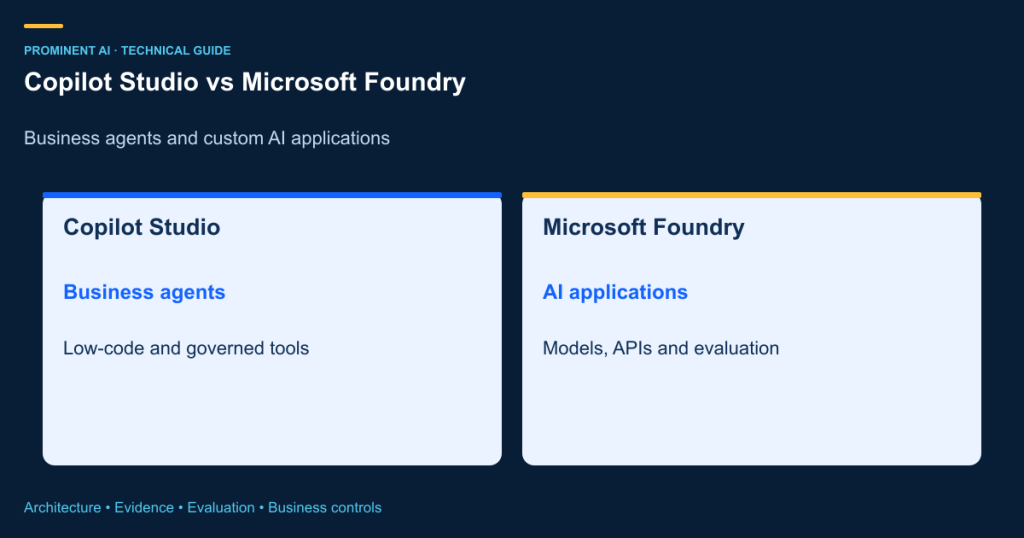
Choose Copilot Studio when a governed, low-code business-agent experience is the main requirement. Choose Microsoft Foundry when the application needs developer-controlled AI integration, model evaluation and an Azure operating model. Combine them only where a clear specialist boundary justifies the additional complexity. Azure AI Foundry is now Microsoft Foundry; the older name remains in this comparison because many teams still use it when evaluating the platform.
An enterprise agent is not merely a chat interface. It retrieves information, calls tools and may influence business decisions. The platform choice therefore affects who owns its behavior, how access is enforced, what is tested and how cost is controlled. A low-code demonstration can hide a privileged connection; a custom SDK implementation can hide missing review controls. Evaluate the whole service rather than treating low-code and code-first as a quality ranking.
Key takeaways
- Copilot Studio is not the same product or license as Microsoft 365 Copilot.
- Microsoft Foundry includes multiple model and agent development paths with feature-specific availability.
- Neither platform automatically makes private data retrieval permission-aware.
- Agent actions need explicit authorization, validation and appropriate review.
- Estimate credits, tokens, tools, retrieval and operating costs separately.
- A native agent connection described as preview must not be presented as generally available production functionality.
What is Microsoft Copilot Studio?
Copilot Studio provides a graphical, low-code environment for building and managing agents and workflows. Makers can define behavior, connect approved knowledge and tools, test interactions and publish to supported channels. Professional developers can contribute APIs and custom integration. Current documentation also covers evolving agent and workflow experiences, so verify the exact authoring mode and maturity rather than assuming every demonstrated capability is part of an established production path. See the Copilot Studio overview.
For example, an internal IT assistant might answer approved support questions and create a ticket after confirming the required fields. The agent’s connection must have only the permissions needed for that task. A policy document containing an instruction to disclose credentials is still untrusted content; it must not change the tool’s authority. The user should see whether the ticket was actually created or only drafted.
What is Azure AI Foundry, now Microsoft Foundry?
Microsoft’s AI platform terminology has evolved from Azure AI Studio through Azure AI Foundry to Microsoft Foundry. Use the current documentation and project type when designing a new solution; older hub-based or classic portal examples may have different resources and APIs. The Microsoft Foundry overview describes a platform grouping models, agents, tools and governance. It also explicitly notes that some capabilities are preview.
A Foundry application can use model endpoints directly, an appropriate managed agent path or hosted custom agent code. The application still needs a user interface, identity boundary, business API and operational ownership. A model catalog does not imply that every model, tool or customization method is available in every region or agent mode. Distinguish the platform resource, selected model, agent runtime and additional retrieval or integration services in both architecture and budget.
Feature comparison: 22 enterprise dimensions
| Dimension | Copilot Studio | Microsoft Foundry |
|---|---|---|
| Primary purpose | Managed business agents and workflows | Developer-oriented AI applications and agent services |
| Typical owner | Professional maker with business and IT governance | AI/application engineering with Azure operations |
| Development style | Graphical and low-code, with extensions | Portal, APIs, SDKs and appropriate custom code |
| Agent development | Supported agent authoring experiences | Prompt, hosted or other supported development paths |
| Model choice | Supported choices for selected experience | Catalog and deployment-specific choices |
| Customization | Instructions, knowledge, tools and supported extensions | Model/application techniques subject to selected model support |
| Data integration | Knowledge sources and connectors | Retrieval and API/tool integration under application control |
| RAG | Configure supported knowledge behavior | Design retrieval, indexing and evaluation explicitly |
| Multi-agent design | Child/connected capabilities with status checks | Supported orchestration or custom application design |
| Workflow automation | Business workflows and tool actions | Integrate workflow services or implement explicit logic |
| Microsoft 365 | Relevant supported publishing and integration paths | Requires selected channels and integration setup |
| Custom APIs | Approved connectors or tools | Application APIs and supported tool contracts |
| Deployment | Managed channel publishing | Application/runtime and endpoint deployment choices |
| Security | Environment, agent and connection controls | Azure resource, model and application controls |
| Identity | Configured user and connection authentication | Entra and service identities as supported |
| Networking | Verify supported data and connection boundaries | Verify selected service and deployment network support |
| Observability | Agent and workflow analytics | Tracing/evaluation and application telemetry |
| Scale | Service limits and workload entitlements | Quotas, model capacity and runtime design |
| Testing | Conversation, tool and workflow evaluation | Task datasets, application tests and model evaluation |
| Lifecycle | Governed environments and supported deployment process | Versioned code, configuration and resource deployment |
| Billing | Copilot Credits and applicable entitlements | Models, tools and selected hosting/services |
| Best-fit scope | Governed business agent with suitable channels | Custom AI application requiring engineering control |
The practical trade-off is responsibility. A managed authoring environment can reduce interface and orchestration work, but governance and testing remain necessary. A custom application can provide more control over data and behavior, but the team owns more of the engineering lifecycle. Neither is universally more secure, cheaper or more scalable; those outcomes depend on the selected configuration and service requirements.
Three reference architectures and their trust boundaries
A. Copilot Studio enterprise agent

Separate conversational identity from connection identity. If a tool uses an application account, enforce the user’s permitted operation at the service boundary. Restrict knowledge sources, record provenance and check sensitive-data behavior. A user must not receive a document simply because the agent’s backend account can read it. Validate handoff and outage behavior before enabling a critical process.
B. Foundry enterprise AI application

The application API establishes tenant and user context, applies rate limits and validates inputs. Retrieval applies the appropriate access filters before evidence is returned to the model. Tools expose narrow operations rather than broad database or administrative access. Treat the model’s proposed action as untrusted until schema, policy and authorization checks pass. Retain a correlation ID across the application, agent and downstream system.
C. Hybrid business agent and specialist service

Microsoft’s connected-agent overview identifies Foundry agent connections as public preview in the documented experience. Another Foundry connected-agent guide specifies a preview GitHub Copilot harness, the current Foundry portal, an enabled Activity protocol and appropriate access. Do not combine those pages into a claim that every Copilot Studio agent can connect to every Foundry project in production.
A hybrid should preserve authorization, conversation scope and tool boundaries across the handoff. Verify whether identity is delegated or an application credential is used; do not assume one is equivalent to the other. A documented, approved API integration can be assessed as an alternative, but it has its own engineering and support requirements. If one platform already meets the use case, adding another agent may only increase latency, failure points and cost.
Pricing: compare total workload cost, not starting prices
Copilot Studio uses Copilot Credits with relevant pay-as-you-go, capacity and pre-purchase arrangements. Applicable Microsoft 365 Copilot rights are a separate licensing question, not a universal substitute for all Copilot Studio usage. Consult the current Copilot Studio licensing guidance and product terms for the actual scenario. Do not assume a fixed credit cost per conversation; operations and features can consume usage differently.
Foundry cost depends on the selected model and service path. The Foundry Agent Service pricing overview currently distinguishes native prompt/workflow agents from hosted agents: it describes no additional charge for creating or running the native agent itself, while underlying model and tool charges remain, and hosted agents use container-compute billing. “No additional agent charge” does not mean the solution is free.
Include input and output tokens, selected retrieval/search, tools, storage, telemetry, networking and application hosting where applicable. Model rates and availability differ. The Microsoft Foundry pricing page directs buyers to selected service pricing and the calculator; displayed estimates are not a contract quote. Verify region, currency, agreement and feature status immediately before procurement.
Copilot Studio platform cost = sum(billable credits by operation x applicable rate)
  subject to purchased entitlement, capacity and current terms

Foundry platform cost = selected model inference + applicable agent hosting
  + retrieval/search + tools + storage + network + monitoring

Solution TCO = platform cost + application hosting + integration
  + evaluation + human review + security operations + maintenance
# Avoid double counting a service already included in another line.| Illustrative workload | What to measure | What not to assume |
|---|---|---|
| Pilot: 1,000 interactions/month | Credits, tokens, tool calls and evaluation work | That one interaction equals one billable unit |
| Growing: 10,000/month | Peaks, retries, conversation length and support | That cost scales only with user count |
| Larger: 100,000/month | Capacity, quotas, retrieval, safety and operating load | That higher volume guarantees a lower unit price |
Use measured pilot traces to estimate operation counts and token distributions. A short answer can still involve multiple retrievals and tool calls. Long conversation history and repeated retries can increase cost. Caching, smaller suitable models and narrower tool paths may help, but must preserve authorization, freshness and task quality. Budget alerts and quotas should be combined with an application response for exhausted capacity; an alert alone does not stop spending or provide a graceful user experience.
Ten enterprise use cases and platform starting points
| Scenario and objective | Starting point and components | Risk and useful measure |
|---|---|---|
| HR/IT helpdesk: route routine requests | Copilot Studio with approved knowledge and ticket API | Sensitive data; correct routing and verified resolution |
| Teams knowledge assistant: locate policy | Copilot Studio with permission-aware sources | Unauthorized disclosure; source-backed answers |
| Customer service: support bounded requests | Either based on channel and integration needs | Unsafe actions; reviewed task completion |
| Financial documents: summarize evidence | Foundry application or justified hybrid | Unsupported claims; critical-field and evidence accuracy |
| Insurance workflows: prepare reviewed cases | Hybrid where business review and specialist analysis differ | Unfair decisions; rework and review quality |
| Enterprise RAG: controlled knowledge retrieval | Foundry application for explicit retrieval design | Access leakage; groundedness and permission tests |
| Multi-agent operations: separate specialists | Only justified connected or custom agent architecture | Cascading errors; end-to-end completion and cost |
| AI SaaS application: tenant-aware features | Foundry-backed application with explicit tenant controls | Cross-tenant exposure; isolation and reliability |
| Healthcare administration: organize records | Bounded reviewed agent on a suitable platform | Privacy and wrong-patient errors; verified correctness |
| Cross-system workflow: coordinate approved action | Copilot Studio plus API/workflow integration where needed | Partial writes; reconciliation and exception workload |
These are hypothetical architectures, not client implementations. Select a platform after testing the hardest requirement: the restricted document, privileged action, unsupported connector or unusual failure. A successful general chat test does not establish suitability for any of these workflows. Define the denominator of a success metric and include abstentions, escalations and rejected outputs.
Security, retrieval and responsible operation
Establish Entra identities and least privilege, then verify environment or resource access independently from business authorization. Power Platform data policies and Azure network controls address different layers; neither automatically filters every retrieved record for the end user. Secrets belong in approved credential mechanisms, not prompts or repository configuration. Test cross-user and cross-tenant access deliberately.
Prompt injection can arrive in a document, tool response or user message. Treat each as untrusted input and keep action authority outside generated text. Restrict tools to narrow schemas, validate arguments and require approval where consequences justify it. Model refusal or content filtering is one layer, not the entire security design. Redact sensitive data from telemetry and establish retention and support access.
Neither platform automatically guarantees GDPR, HIPAA, SOC 2 or other organizational compliance. Confirm service availability, data boundaries, contracts and customer responsibilities for the jurisdiction and use case. Foundry’s agent service documentation describes multiple development paths and feature-specific capabilities. Verify the selected path rather than extrapolating a platform-level statement to every runtime and model.
Which should your organization choose?
| Requirement | Decision question |
|---|---|
| Business ownership | Can a governed maker team maintain the workflow? |
| Custom application | Does the product need a dedicated API, UI and tenant model? |
| Model requirements | Is the required model and customization supported in the chosen path? |
| Microsoft 365 use | Are the needed channels and entitlements actually available? |
| Integration complexity | Can supported tools express the approved operation safely? |
| Data boundary | Can authorization and networking meet the requirement? |
| Operations | Who evaluates, deploys, monitors and responds to incidents? |
| Budget | What do measured workload traces imply for full TCO? |
Decision sequence: if the main need is a supported business-agent experience with governed makers, assess Copilot Studio first. If custom application and model engineering dominate, assess Foundry. If both have genuinely distinct responsibilities, evaluate a hybrid with a documented interface. If the process is deterministic, an ordinary workflow or API may be simpler than an agent. Do not add autonomous planning where a reviewed form and rule solve the problem.
Eight steps from pilot to production
- Define a bounded task, user and success measure.
- Assess authorized sources, integrations and consequences of error.
- Select the smallest architecture that meets those needs.
- Establish identities, permissions, network boundaries and review authority.
- Build a controlled proof with representative permitted data.
- Evaluate task quality, unsafe actions, access control, latency and cost.
- Release through versioned configuration and approval with rollback.
- Monitor outcomes, exceptions and spend; re-evaluate changes before scaling.
A release dataset should include unanswered questions, malicious source instructions, revoked access, unavailable tools and ambiguous requests. Test the full user journey rather than only isolated model responses. Maintain a fallback or human handoff for unsupported tasks. Record model, instructions, retrieval settings and tool versions so a regression can be investigated.
Frequently asked questions
Is Azure AI Foundry now Microsoft Foundry?
Yes, the current platform name is Microsoft Foundry. Older articles and project experiences can still use Azure AI Foundry or Azure AI Studio terminology. Verify the current portal, project type and API documentation before copying an older implementation.
Is Copilot Studio the same as Microsoft 365 Copilot?
No. They are related within Microsoft’s ecosystem but are distinct products and licensing questions. Copilot Studio builds and manages agents and workflows. Check the current entitlement for the specific agent, channel and usage rather than assuming a Microsoft 365 license covers everything.
Which platform is better for enterprise AI?
Neither is universally better. Copilot Studio can fit governed business-agent experiences; Foundry can fit custom AI application engineering. Evaluate team skills, data boundaries, integrations, feature availability and total operating cost. A deterministic workflow may be more suitable than either agent design.
Can the platforms work together?
They can be integrated through suitable supported paths, but native connected-agent features have experience-specific preview and prerequisite constraints. Verify the exact documentation and tenant availability. An authenticated API integration is a separate architecture and should not be presented as proof of universal native parity.
Is every Foundry capability generally available?
No. Microsoft documents feature-specific preview capabilities. Check the selected runtime, model, region and integration before committing to production. A generally available platform does not make every feature shown in a tutorial generally available.
Is Foundry Agent Service free?
The current pricing overview describes no additional native prompt/workflow agent charge, but models, tools and other services still incur applicable costs. Hosted agents have a different compute-based model. Review the complete service path rather than treating an agent line item as total solution cost.
How is Copilot Studio usage priced?
Relevant Copilot Credits and entitlement arrangements apply, with operation-dependent usage and current terms. Do not assume a fixed credit count per conversation. Use the current licensing guide and measured traces for the actual features and workload.
Can either platform securely search private documents?
It can support an appropriate design, but access-controlled retrieval must be configured and tested. The backend’s ability to read a document does not grant every user permission to see it. Test denied access, changed permissions and tenant boundaries.
Do agents need human approval?
It depends on the action and consequences. Establish explicit authority for writes, payments, account changes or other consequential operations. A model’s proposed tool call should pass schema, policy and authorization checks, with human review where required.
How should agent quality be measured?
Use representative tasks and defined acceptance criteria. Measure verified completion, evidence fidelity, unauthorized actions, escalation behavior, latency and full cost. Include difficult and adversarial cases. A pleasing demonstration or fluent answer is not sufficient evidence of production reliability.
Should every solution use multiple agents?
No. Multiple agents add interfaces, latency, cost and failure modes. Use them only when separate responsibilities create a clear benefit. A single bounded agent or ordinary workflow can be easier to evaluate, secure and maintain.
What should a pilot deliver?
A bounded task, documented data and identity paths, measured evaluation results, cost assumptions and a deployment decision. It should identify unresolved risks and feature constraints, not merely show a conversation. Retain versions and a repeatable test set for later changes.
Technical references
- Copilot Studio overview
- Microsoft Foundry overview
- connected-agent overview
- Foundry connected-agent guide
- Copilot Studio licensing guidance
- Foundry Agent Service pricing overview
- Microsoft Foundry pricing page
- agent service documentation
Technical source review: 1 November 2026. Illustrative architectures, assumptions and examples are not client implementations or measured production results. Deployment-specific verification is required.