
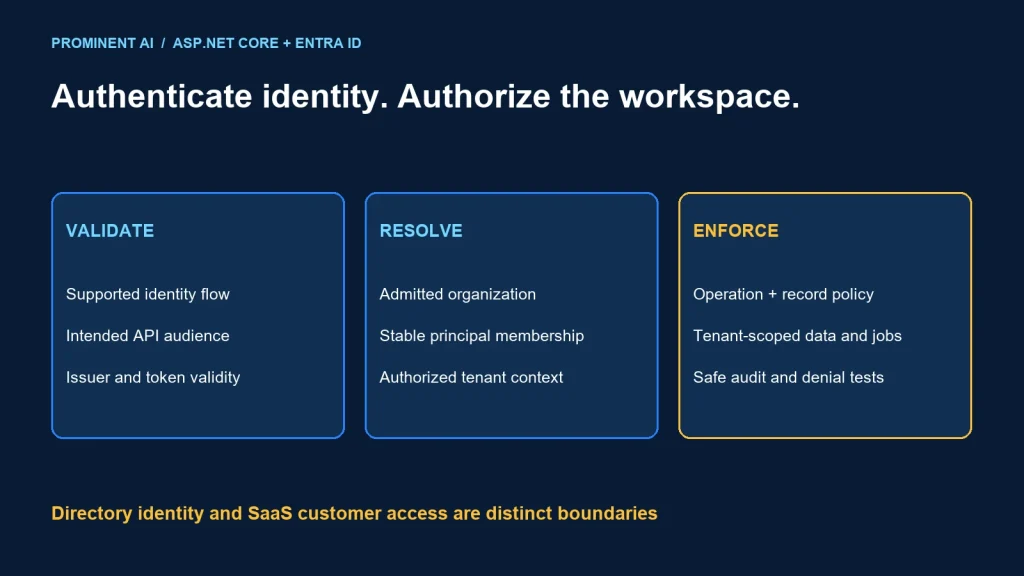
Secure multi-tenant authentication in ASP.NET Core by validating identity with supported middleware, admitting only intended organizations and resolving an authorized SaaS tenant before any data operation. Microsoft Entra sign-in establishes an identity context; your application must still decide which product tenant, records and actions that identity can access.
Key takeaways
- An Entra directory tenant and a SaaS customer tenant are not automatically the same concept.
- A multitenant app registration does not grant every signed-in organization product access.
- Validate tokens for the intended API and authorize delegated or application callers explicitly.
- Carry the resolved tenant through data, cache, jobs and audit paths.
ASP.NET Core multi tenant authentication: define the identities
Define three concepts separately: the identity provider’s directory, the person or application principal, and the product’s customer workspace. An enterprise may operate several workspaces, and a person may have approved membership in more than one customer context.
Microsoft’s multitenant application guidance explains registration, issuer handling and consent across Entra tenants. Those platform steps enable the identity flow; the SaaS product still owns admission and workspace authorization.
Document whether customers use their own workforce directories, guest collaboration or another supported identity model. Do not describe these options as interchangeable. Choose the supported model from the actual customer population and licensing requirements.
Create a trusted organization-onboarding process. Confirm who may associate a directory with a customer workspace and how administrators approve access. A successful sign-in from an arbitrary directory should not silently create broad access to existing customer data.
A tenant-aware access-path diagram
Browser or client → supported Entra sign-in/token flow
→ ASP.NET Core authentication middleware
→ validated principal for the intended application/API
→ admitted organization + product membership lookup
→ authorized workspace selection
→ operation and record authorization
→ tenant-scoped data/cache/job access

Denied at any boundary → controlled response + safe audit signal
The workspace requested in a URL or header is input, not authority. Match it to a server-side membership and policy decision before selecting a database or reading a record.
For a separate API, distinguish its access token from the web application’s sign-in session. Do not use an ID token as a general substitute for an API access token. Use supported authentication libraries for the chosen flow rather than implementing cryptographic token validation manually.
App registration, customer onboarding and consent
Record the application’s supported account types, redirect URIs, API identifiers and required permissions. Keep development and production settings appropriately separated. Request only permissions needed for the product’s documented behavior.
Consent and product entitlement are different decisions. Consent can permit an application relationship in a directory without deciding which subscription, workspace or business role a user receives. Maintain that product mapping explicitly.
Design onboarding states such as pending verification, active and suspended. Confirm the handling of tenant removal, customer cancellation and administrative change. A directory remaining technically capable of sign-in should not override a suspended product entitlement.
Keep credentials, certificates and secrets in the approved configuration and rotation process. Avoid shipping client secrets to browser code. A public client and a confidential server application have different responsibilities.
Validate user and administrator journeys in an authorized test directory. This article supplies an implementation design and checklist; no Entra tenant configuration or production sign-in test is claimed.
Token validation and caller authorization
Microsoft’s protected API configuration guide describes bearer-token handling with supported ASP.NET Core integration. Configure the authority, audience and accepted token behavior for the actual app registration and flow.
Microsoft’s claims-validation guidance identifies audience, tenant, subject and actor checks and recommends stable identifiers for authorization decisions. A valid tenant claim by itself does not authorize every principal in that directory.
Let supported middleware perform signature, issuer and lifetime validation according to the configured identity platform. Do not disable issuer validation to make a multitenant error disappear. Resolve the intended issuer and tenant model using supported configuration.
Authorize delegated scopes and application permissions according to the endpoint’s contract. A service principal and an employee caller should not receive the same access merely because both present a valid token.
Map validated stable identity values into product membership. Do not use a mutable email address or display name as the sole authorization key. Review guests and cross-directory identities against the chosen model rather than assuming every visible email domain identifies a customer.
Keep authorization on the server for every operation. Hiding a button can improve the interface, but it cannot prevent a direct API call. Verify record ownership and tenant scope after the user is authenticated.
Tenant resolution through the full application
Produce an immutable per-request tenant context after validation and membership checks. Downstream components should receive that resolved context rather than repeatedly trusting raw request values.
For database-per-tenant designs, resolve an approved catalog location from that context. For shared databases, enforce tenant-aware reads, writes and relationships. Include raw SQL and reporting paths in the review.
Scope cache keys by the tenant and other relevant permission dimensions. A cache shared across customer contexts can bypass otherwise correct database authorization if its key omits the boundary.
Background jobs need an authorized tenant context too. Store only the necessary job identity and scope, revalidate entitlement where the workflow requires it and avoid relying on a browser session that no longer exists. Define behavior for suspended tenants and removed users.
For workspace switching, verify the new workspace before changing context. Keep simultaneous tabs from accidentally sharing a mutable global tenant selection. Test that one request cannot overwrite another request’s context.
Connect the identity design to the SaaS database-tenancy comparison. Separate storage does not repair an incorrect membership or routing decision.
Implementation checklist
| Boundary | Implementation decision | Acceptance evidence |
|---|---|---|
| Registration | Supported account types and intended API audience | Correct sign-in and wrong-audience rejection |
| Organization admission | Verified directory-to-customer mapping | Unknown organization cannot access existing data |
| Membership | Stable principal mapping and product roles | Removed or unassigned principal is denied |
| Workspace selection | Server-authorized tenant context | Tampered workspace input fails |
| Business authorization | Operation and record policy | Unauthorized action and cross-tenant record denied |
| Infrastructure paths | Scoped data, cache and background work | No leakage across requests or jobs |
| Operations | Safe audit logs, rotation and incident ownership | Denied access is observable without exposing tokens |
Review library and runtime versions through the normal dependency process. Use the current supported vendor samples for the actual application type. A generic snippet cannot establish secure configuration across every web app, API and customer identity model.
A practical acceptance-test matrix
Use at least two authorized test organizations and two product workspaces. Create users with intentionally different memberships and an application caller where app-only access is supported. Use synthetic records that make cross-tenant results easy to detect.
- Confirm the intended user can sign in and perform an allowed operation.
- Reject expired, invalid or wrong-audience token scenarios through supported validation.
- Deny a valid identity from an unadmitted organization.
- Deny a signed-in user without the requested workspace membership.
- Change route, header and record identifiers to test cross-tenant denial.
- Verify role removal and customer suspension under the documented session policy.
- Test connection and cache reuse across alternating tenant requests.
- Exercise a background job after its originating user session ends.
- Confirm safe logs and a documented incident response path.
For a fictional purchasing SaaS, a user belongs to customer A but requests a record under customer B’s route. The request must fail before data is returned, even if the record ID is valid. An authorized support operator needs a distinct, approved access path rather than impersonating an ordinary customer session.
Document session and revocation behavior based on the actual platform and application controls. Do not promise immediate invalidation of every existing session without verifying how it works. Include this behavior in customer support procedures.
Assess the surrounding network and workload permissions with the Azure Zero Trust access-path guide.
Common questions
How do you authenticate users in multi-tenant .NET SaaS?
Use a supported identity flow and middleware, then map the validated principal to an admitted organization and authorized product workspace before allowing business operations.
Is an Entra tenant the same as a SaaS tenant?
Not necessarily. The directory and product workspace are different concepts. Define their relationship explicitly in the application’s trusted membership model.
Does a multitenant registration authorize every organization?
No. Registration enables the identity relationship; the product must enforce customer admission, entitlement and user permissions.
Can a tenant ID in a request header be trusted?
It can identify the requested context, but it must be checked against validated identity and server-side membership before use.
Should issuer validation be disabled for multitenant sign-in?
No. Use supported multitenant configuration and resolve issuer or tenant errors correctly instead of bypassing validation.
Make the tenant boundary explicit in every access path
Bring your customer identity model, workspace mapping and authorization requirements. Discuss your .NET modernization roadmap to define secure onboarding, tenant resolution and acceptance tests.