
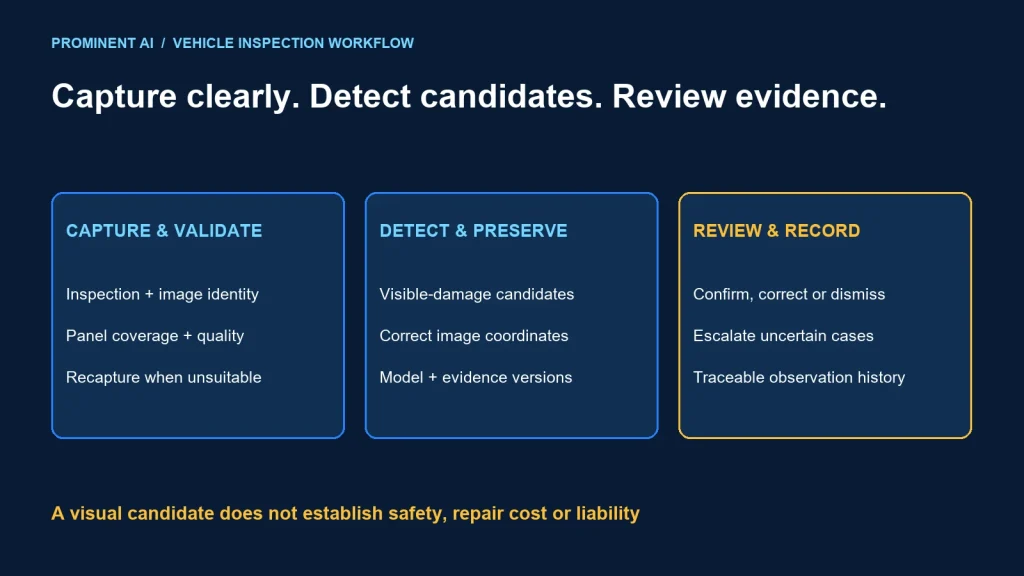
Vehicle damage detection AI can flag visible damage candidates in inspection photographs and route them for human confirmation. A dependable workflow begins with capture quality and vehicle-panel coverage, then preserves image evidence, model versions and review outcomes. A visual detection is not proof of structural condition, roadworthiness, repair cost or insurance liability.
Key takeaways
- Reject or recapture unusable images before interpreting detections.
- Track panel coverage and inspection identity, not just image count.
- Evaluate missed damage and false alarms by condition and damage type.
- Keep annotated evidence and reviewer corrections together.
- Separate visible-damage observations from safety, repair and claims decisions.
Define what the inspection is allowed to conclude
A rental return, fleet check and repair intake may use similar photos but have different evidence requirements. Start with the intended decision, inspection conditions and authorized reviewer. Do not reuse a model’s score as an automatic conclusion across these workflows.
For a proposed rental-return pilot, the output could be a set of candidate visible marks with panel references and an exception queue. A reviewer compares these observations with prior records under the organization’s approved process. The model does not determine who caused a mark or whether a customer owes money.
| Output | Reasonable technical interpretation | Not established by the output |
|---|---|---|
| Candidate scratch region | Image area requiring review | Cause, age or responsibility |
| No detection | No candidate passed the configured threshold | Absence of all damage |
| Image-quality flag | Capture may be unsuitable | Vehicle condition |
| Damage category suggestion | Model’s proposed label | Repair method or cost |
Write these boundaries into the interface and acceptance criteria. A polished inspection report must not imply a more comprehensive assessment than the image coverage supports.
Capture quality is part of the product
Define required views and panel coverage for the pilot. Guide the operator through consistent distance, angle and lighting where feasible. Confirm that the uploaded images belong to the intended inspection before merging observations.
Common problems include blur, glare, shadows, rain, dirt, occlusion and cropped panels. A reflection can resemble damage; a deep shadow can hide it. Use capture checks to request a better image or mark the inspection incomplete rather than forcing a confident result.
Store quality outcomes separately from damage predictions. “Unable to assess” is an important state. It should not be converted into “no damage” because a downstream report requires a binary field.
Photographs can include faces, registration plates and location clues. Limit collection and access to the approved purpose, apply an appropriate retention policy and protect the original evidence. If redacted derivatives are used, retain clear lineage without unnecessarily exposing originals.
A reference damage-detection workflow
Inspection session + approved purpose + vehicle reference
                         ↓
Guided photo capture → upload integrity + view/quality checks
                         ↓
Incomplete/unsuitable → recapture or manual assessment
                         ↓
Panel mapping → visible-damage candidate detection
                         ↓
Candidate region + proposed class + model/configuration version
                         ↓
Reviewer sees original evidence and uncertainty
  ├─ confirm / correct / dismiss
  ├─ request another view
  └─ escalate beyond visual-assessment scope
                         ↓
Reviewed observation record + evidence lineage + audit history

Repair, safety, liability and payment decisions remain separate
This original architecture is a design proposal, not a deployed vehicle-inspection service or a measured model benchmark. The right detector, segmentation approach or image service depends on the available labeled data and required output.
Use stable identifiers for inspection, image, vehicle reference and observation. A job retry should not create a second independent damage record. If an image is replaced, identify which predictions and reviews used the previous version.
Retain the original image and the transformation metadata used for inference. Resizing and rotation can affect bounding-box coordinates. The reviewer overlay must map back to the correct image orientation and dimensions.
Separate queue status from model status. A successful inference job does not mean the inspection is complete, all panels are covered or a reviewer has approved the report.
Evaluate the whole inspection, not only a detector score
Create a labeled evaluation set that reflects the intended capture environment. Use consistent definitions for damage classes, panel boundaries and difficult or unassessable images. Have suitable domain reviewers resolve ambiguous labels.
Split related captures carefully. Near-duplicate images or repeated views of the same vehicle can leak information between training and evaluation, making results look stronger than deployment behavior.
The NIST AI RMF core emphasizes defined context, measurement and ongoing risk management. Apply that general framework to the actual inspection use and consequences; it does not certify a detector or prescribe a vehicle-inspection accuracy threshold.
| Dimension | What to inspect |
|---|---|
| Candidate detection | Missed labeled damage and false-positive regions |
| Localization | Region overlap and correct panel association |
| Class interpretation | Confusion between defined damage categories |
| Capture variation | Lighting, color, angle, weather and surface condition |
| Coverage | Required views present and assessable |
| Review usability | Can a reviewer find, correct and explain an observation? |
Report performance for relevant subsets, not only one average. Set review-routing thresholds based on evaluated error tradeoffs. A confidence score is not a universal probability that a vehicle is damaged or safe.
Measure inspection-level failures as well: wrong vehicle association, missing images, duplicate jobs and incomplete reviews. These can invalidate an otherwise accurate prediction.
Human review and auditable evidence
Show the original context alongside the candidate region. Let reviewers change the class, reject a reflection, request recapture or mark an area unassessable. Preserve both the model proposal and the reviewed observation with an appropriate reason.
When comparing before-and-after inspections, verify comparable views and evidence quality. Different angles or lighting can change appearance. The system should surface uncertainty rather than assigning responsibility from visual difference alone.
Record model version, thresholds, preprocessing and relevant image versions. If a model is withdrawn, these records identify the affected inspections. Define when cases require re-review instead of silently regenerating their conclusions.
Restrict access to evidence and audit records. Operational logs should carry identifiers and diagnostic details without unnecessarily copying photographs or personal information into broad monitoring systems.
A release should include representative regression cases and a rollback procedure. Monitor shifts in capture quality and reviewer corrections; a change in camera workflow can matter as much as a model update.
A practical pilot checklist
- Define the inspection purpose and excluded decisions.
- Agree required views and panel coverage.
- Specify recapture and unable-to-assess states.
- Establish annotation rules with qualified reviewers.
- Keep related vehicle captures separated appropriately during evaluation.
- Evaluate errors by damage type and capture condition.
- Verify overlay coordinates and evidence lineage.
- Test retries, replacement images and incomplete sessions.
- Confirm reviewer authority and correction paths.
- Document access, retention, monitoring and release recovery.
A first release should prove that it helps reviewers inspect evidence reliably. No accuracy percentage, cost saving, repair estimate or customer deployment outcome is claimed in this guide.
Common questions
How is computer vision used for automated vehicle inspection?
It can check capture quality and suggest visible-damage regions or classes for review, with image evidence and a clear route for correction or recapture.
Does no detection mean there is no damage?
No. Damage may be hidden, outside the captured views or missed by the model. Preserve coverage and unable-to-assess information.
Can an image model determine roadworthiness?
This workflow does not establish roadworthiness. Safety assessment requires the appropriate qualified inspection process beyond visible-image candidates.
What causes false positives?
Reflections, shadows, dirt, surface patterns and unsuitable capture conditions can resemble damage. Evaluate those cases and enable reviewer correction.
What should an audit record include?
Inspection and image references, model/configuration versions, candidate observations, reviewer changes and evidence lineage under approved access and retention rules.
Design inspection assistance around evidence
Bring the capture process, inspection purpose and representative failure cases. Discuss a domain-specific AI solution with usable review and explicit decision boundaries.