
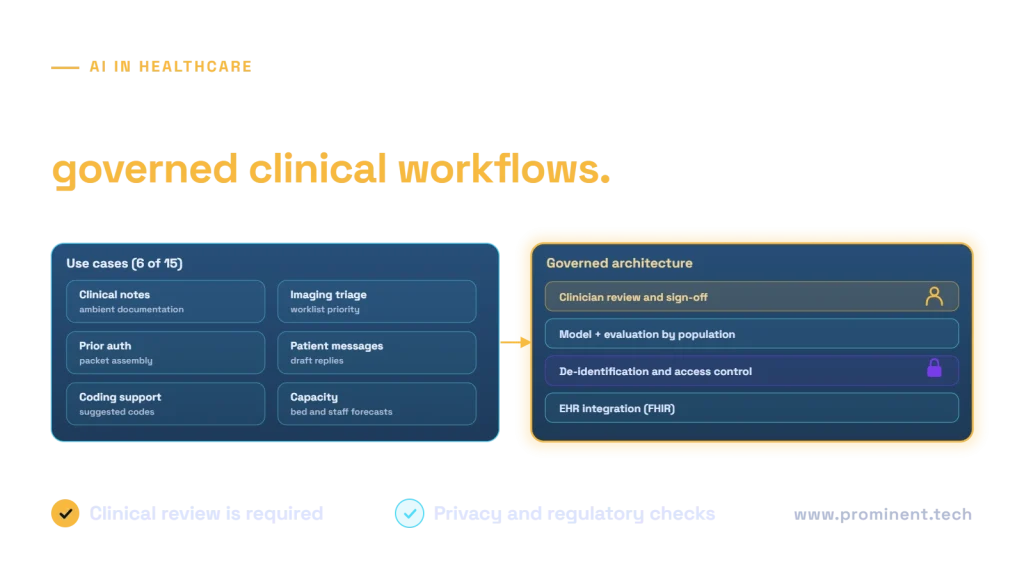
AI in healthcare can help teams interpret images, organize records, draft documentation and plan operations. The appropriate implementation depends on the intended use, available evidence and consequences of error. Start with a measurable workflow, preserve clinician authority over clinical decisions, and validate performance in the population and setting where the system will be used. A technically impressive model is not evidence that a service is safe, useful or ready for clinical deployment.
For a hospital CIO, the initial decision is rarely which model to buy. It is which bottleneck can be improved without creating an unmanageable safety, privacy or integration burden. A scheduling assistant, an imaging triage tool and an oncology decision-support system have very different evidence requirements. This guide separates those applications and shows how to connect them to responsible operating practices. It is educational architecture guidance, not medical, regulatory or legal advice.
Key takeaways
- Choose the clinical or operational workflow before choosing an AI model.
- Keep source provenance, permissions and review evidence with every consequential output.
- Evaluate performance by site, population and workflow, including the effect on staff workload.
- Administrative automation can still affect care access and deserves an impact assessment.
- Use intended purpose and jurisdiction to establish the regulatory pathway; a cloud product does not make the application compliant.
- Fund integration, review, monitoring and incident response alongside inference.
What healthcare AI includes—and what it does not prove
Healthcare AI includes prediction from structured records, computer vision, language processing, document extraction and generative systems. Prediction estimates an outcome from historical patterns. Generative AI produces a new response or draft. Retrieval-augmented generation supplies selected source material to a model; it does not establish that the answer is clinically correct. A rule-based reminder may be more suitable than either approach when a clear, stable business rule solves the problem.
Separate three questions: can the system perform its technical task, does it improve the real workflow, and is the intended use acceptable under applicable obligations? The WHO guidance on ethics and governance of AI for health provides an ethical framework; an organization still needs a local clinical safety and governance process. No general-purpose model should be presented as an autonomous replacement for a qualified professional.
15 practical healthcare AI use cases
1. AI-assisted medical imaging
Department: Radiology. Large imaging queues make consistent prioritization difficult. Computer vision over properly acquired DICOM studies and verified labels.
Workflow: Validate study → propose finding or priority → radiologist reviews. Practical output: A worklist flag or marked image, not a final autonomous diagnosis.
Review and risk: Missed findings, equipment differences and automation bias. A named professional or operational owner reviews consequential outputs before use. Evaluation: Sensitivity at an acceptable false-positive rate, reading workload and subgroup performance. Implementation complexity: High: device status, clinical validation and image integration.
2. Digital pathology assistance
Department: Pathology. Whole-slide review can involve extensive searching and counting. Image analysis over digitized slides, stain metadata and pathologist annotations.
Workflow: Check slide quality → identify candidate regions → pathologist adjudicates. Practical output: Reviewable regions and measurements with slide coordinates.
Review and risk: Scanner and staining shift, missed tissue and inadequate labels. A named professional or operational owner reviews consequential outputs before use. Evaluation: Case-level agreement, false negatives and review time. Implementation complexity: High: very large images and specialist validation.
3. Early deterioration and sepsis risk
Department: Acute care. Clinical teams need timely signals from changing observations. Time-aware prediction using vitals, laboratory results and documented events.
Workflow: Validate recent observations → estimate risk → clinician assesses and acts. Practical output: A contextual risk alert with supporting observations.
Review and risk: Alert fatigue, label leakage and harmful delayed escalation. A named professional or operational owner reviews consequential outputs before use. Evaluation: Calibration, sensitivity, alerts per bed-day and clinical response time. Implementation complexity: High: prospective safety evidence and workflow ownership.
4. Ambient clinical documentation
Department: Clinical administration. Documentation consumes time and may fragment the consultation. Speech recognition and constrained summarization of an authorized encounter.
Workflow: Capture with appropriate permission → draft note → clinician edits and signs. Practical output: An approved encounter note with a traceable draft history.
Review and risk: Omitted negatives, incorrect medications and inappropriate recording. A named professional or operational owner reviews consequential outputs before use. Evaluation: Clinically significant corrections, completeness and total review time. Implementation complexity: Medium: integration and rigorous note review remain necessary.
5. Clinical decision support
Department: Clinical services. Relevant guidance may be spread across complex records and protocols. Rules, prediction or source-grounded retrieval depending on the intended task.
Workflow: Retrieve authorized evidence → present rationale → qualified professional decides. Practical output: A source-linked suggestion with limitations and escalation options.
Review and risk: Outdated guidance, unsupported recommendations and excessive reliance. A named professional or operational owner reviews consequential outputs before use. Evaluation: Evidence fidelity, unsafe suggestion rate and clinician usability. Implementation complexity: High: intended use determines the evidence and regulatory pathway.
6. Remote patient monitoring triage
Department: Community care. Teams must distinguish meaningful changes from noisy device readings. Time-series analysis using validated measurements and an agreed care pathway.
Workflow: Check signal quality → flag pattern → care team reviews and contacts patient. Practical output: A triage task linked to observations and an escalation policy.
Review and risk: Disconnected devices, missing data and false reassurance. A named professional or operational owner reviews consequential outputs before use. Evaluation: Missed escalation, false alerts and response coverage. Implementation complexity: High: patient safety and service availability.
7. Patient support and symptom navigation
Department: Patient services. People need accessible information and help reaching the right service. Constrained conversational retrieval over approved patient information.
Workflow: Identify request → provide approved information → route uncertain or urgent cases. Practical output: A supported navigation response or human-service handoff.
Review and risk: Unsafe advice, language exclusion and incorrect urgency handling. A named professional or operational owner reviews consequential outputs before use. Evaluation: Safe escalation, answer grounding and access across languages. Implementation complexity: Medium to high: scope must exclude unsupported diagnosis.
8. Appointment scheduling and no-show support
Department: Outpatient operations. Unused appointments and avoidable communication friction reduce capacity. Scheduling rules and carefully evaluated attendance prediction.
Workflow: Check availability → propose reminder or slot → patient or scheduler confirms. Practical output: A confirmed booking or outreach task.
Review and risk: Disadvantaging patients with transport or digital-access barriers. A named professional or operational owner reviews consequential outputs before use. Evaluation: Completed appointments, equitable access and reminder effectiveness. Implementation complexity: Medium: calendar integration and fairness review.
9. Medical coding and billing assistance
Department: Revenue cycle. Coding teams review lengthy records for defensible billing information. Document extraction and code suggestions against approved coding guidance.
Workflow: Read authorized note → propose evidence-linked codes → coder validates. Practical output: A reviewed coding suggestion and supporting text.
Review and risk: Upcoding, incorrect context and payer-rule changes. A named professional or operational owner reviews consequential outputs before use. Evaluation: Audited coding accuracy, correction workload and denial reasons. Implementation complexity: Medium: trained coding review and rule maintenance.
10. Prior authorization and claims preparation
Department: Utilization management. Incomplete submissions create repeated requests for information. Document extraction, checklist rules and summary generation.
Workflow: Collect permitted evidence → check submission requirements → specialist approves. Practical output: A completeness report or reviewed submission packet.
Review and risk: Missing evidence, incorrect benefit interpretation and inequitable delays. A named professional or operational owner reviews consequential outputs before use. Evaluation: Submission completeness, rework and time to appropriate review. Implementation complexity: Medium: policy-specific validation and payer integration.
11. Population health risk stratification
Department: Public and population health. Outreach resources must be allocated across diverse populations. Calibrated risk models using suitable longitudinal records.
Workflow: Assess cohort quality → estimate risk → care team designs outreach. Practical output: A reviewed outreach list with eligibility and rationale.
Review and risk: Historical inequity, missing populations and inappropriate proxies. A named professional or operational owner reviews consequential outputs before use. Evaluation: Calibration by group, outreach uptake and intervention outcomes. Implementation complexity: High: representativeness and intervention evaluation.
12. Clinical trial matching
Department: Research operations. Eligibility requirements are difficult to reconcile with patient records. Structured rules plus language extraction from approved protocols and records.
Workflow: Extract criteria → identify possible match → research team verifies consent and eligibility. Practical output: A candidate list requiring investigator confirmation.
Review and risk: Misread exclusions, obsolete protocols and privacy misuse. A named professional or operational owner reviews consequential outputs before use. Evaluation: Verified eligible matches and screening effort. Implementation complexity: High: protocol interpretation and ethical research controls.
13. Drug discovery and pharmaceutical research
Department: Life sciences research. Researchers explore large experimental and molecular search spaces. Predictive models or generative candidates using curated research data.
Workflow: Generate or rank hypothesis → test experimentally → scientist evaluates evidence. Practical output: A research hypothesis or ranked candidate, not a proven treatment.
Review and risk: Unreliable training evidence, toxicity and poor experimental reproducibility. A named professional or operational owner reviews consequential outputs before use. Evaluation: Experimental validation, reproducibility and research-stage relevance. Implementation complexity: High: domain expertise and costly empirical validation.
14. Hospital staffing and capacity planning
Department: Operations. Demand changes can create staffing and bed-capacity pressure. Forecasting and constrained planning using demand, acuity and workforce availability.
Workflow: Forecast workload → check staffing constraints → manager approves plan. Practical output: A feasible staffing or capacity scenario.
Review and risk: Poor forecasts, unsafe staffing assumptions and ignored workforce rules. A named professional or operational owner reviews consequential outputs before use. Evaluation: Forecast error, constraint violations and operational service measures. Implementation complexity: Medium: data quality and operational accountability.
15. Intelligent medical document processing
Department: Health information management. Referral packets and scanned records require repeated manual sorting. OCR, classification and schema-validated extraction.
Workflow: Classify document → extract source-linked fields → staff resolve exceptions. Practical output: A verified structured record or routing task.
Review and risk: Wrong-patient matching, unreadable scans and unsupported extraction. A named professional or operational owner reviews consequential outputs before use. Evaluation: Field-level accuracy, patient-match errors and exception workload. Implementation complexity: Medium: identity reconciliation is a critical control.
| Application group | Potential starting point | Review owner | Main evidence burden |
|---|---|---|---|
| Administration | Scheduling, document routing, coding drafts | Scheduler, records officer or coder | Workflow accuracy, access and rework |
| Clinical assistance | Imaging, deterioration alerts, decision support | Qualified clinician | Local clinical validity and safety |
| Research | Trial matching, drug discovery | Investigator or scientist | Protocol, experimental and ethical validity |
| Planning | Staffing and population outreach | Operations and clinical governance | Constraints, fairness and intervention effectiveness |
A governed healthcare AI architecture
Use six layers with explicit ownership. EHR, laboratory, imaging and device systems supply information; adapters validate identity, timestamps, units and provenance. A governed data layer enforces retention and access. Task-specific models or retrieval services produce suggestions. Clinical or operational review controls action. Monitoring connects outcomes and incidents back to a controlled improvement process. Keep training extracts separate from production access paths.

FHIR provides a resource-based exchange standard, but implementations differ in versions, profiles and supported operations. Verify the actual interface contract rather than assuming that two FHIR endpoints are interchangeable. Existing HL7 v2 messages and DICOM imaging may require separate integration paths. See the HL7 FHIR overview. A source identifier must survive transformation so staff can inspect the record behind a generated statement.
An Azure implementation might use API Management for controlled endpoints, Functions or Container Apps for orchestration, an approved SQL or Fabric data layer, and Azure Machine Learning or Microsoft Foundry for selected AI tasks. Azure AI Search can support retrieval where appropriate; Entra ID, Key Vault and Monitor support identity, secrets and observability. These are candidates, not a mandatory bill of materials or a compliance certificate. Select regions, network boundaries and contractual terms for the actual workload.
Example: documentation assistance with an approval boundary
An authenticated clinician starts an authorized encounter. The application obtains only permitted context and records recording permissions where applicable. A drafting service returns a structured note with uncertainty markers. The clinician compares it with the encounter, corrects errors and signs. Only the approved version is written back using the approved EHR interface. Audit events record the version, reviewer and write outcome without putting unnecessary clinical text into general application logs.

Safety, privacy and regulatory questions before development
Regulatory assessment follows intended purpose, users and jurisdiction. In the United States, not every administrative AI tool is a medical device; clinical software functions may be. The FDA clinical decision support guidance distinguishes relevant software functions. The presence of a clinician does not automatically remove a tool from oversight. Record the intended use and seek qualified regulatory review before deployment.
For US covered entities and business associates, HIPAA cloud arrangements require appropriate analysis and agreements where applicable; a vendor badge alone is insufficient. See HHS cloud computing guidance. For EU and UK deployments, assess applicable data-protection, medical-device and AI obligations with local specialists. Canada and Australia require their own privacy and health-product assessments. Do not apply a US checklist as a substitute for another jurisdiction’s requirements.
The European Commission AI regulatory framework describes a risk-based framework. Application dates and classification need verification for the specific deployment; avoid claiming that every hospital chatbot has the same classification or that all obligations begin on one date. Contractual commitments, clinical standards and operational policies may impose additional requirements even where a particular AI provision does not apply.
| Risk | Practical control | Evidence to retain |
|---|---|---|
| Wrong patient | Reconcile identifiers; block ambiguous matches | Match decisions and exception handling |
| Missing or stale data | Display freshness; fail safely | Data-quality checks |
| Unsupported generated claim | Source checks and professional review | Reviewed output and provenance |
| Population bias | Evaluate relevant subgroups | Stratified results and limitations |
| Alert fatigue | Tune for operational capacity | Alert and response audits |
| Privacy leakage | Minimize access and payloads | Access tests and retention rules |
| Prompt injection | Treat retrieved text as untrusted | Adversarial tests and tool restrictions |
| Unauthorized actions | Separate model suggestions from execution | Authorization and approval events |
| Model or source change | Version, revalidate and approve | Release and rollback records |
| Service outage | Maintain a manual care pathway | Downtime drills |
| Overreliance | Train users and allow rejection | Usability and correction evidence |
| Unclear accountability | Name clinical and operational owners | Incident and escalation responsibilities |
Implementation roadmap and acceptance gates
| Stage | Accountable owner | Acceptance evidence |
|---|---|---|
| Define intended use | Clinical sponsor | A precise user, decision and excluded-use statement |
| Establish governance | Safety, privacy and regulatory owners | Documented assessment and accountable approval |
| Audit data | Data steward | Representative, permitted and traceable data |
| Measure baseline | Workflow owner | Current error, delay, workload and access measures |
| Prototype safely | Engineering team | Synthetic or approved test data; no uncontrolled clinical action |
| Validate offline | Independent evaluators | Locked test set, subgroup results and error analysis |
| Test workflow | Clinical and operations teams | Usability, escalation and downtime scenarios |
| Pilot under supervision | Named service owner | Defined cohort, monitoring and stop criteria |
| Release deliberately | Change authority | Approved evidence, training and rollback |
| Monitor and improve | Service and model owners | Incident review, drift response and controlled updates |
Time depends on access, integration complexity, intended use and validation requirements. An administrative pilot can be smaller than a clinical decision-support program, but a prototype completion date is not a safe deployment commitment. Start with one site and workflow where the baseline is measurable. Expand only after the team demonstrates that reviewers can use, reject and escalate outputs reliably.
Build, buy or integrate—and how to estimate cost
| Option | Suitable when | Check before committing |
|---|---|---|
| Buy a specialized product | The intended use matches a validated product | Evidence, integration, updates and data terms |
| Build a bounded component | The workflow has a genuine unmet need | Validation capability and long-term ownership |
| Integrate existing systems | The bottleneck is fragmented information | Source contracts, identity and reconciliation |
| Hybrid | A product solves the core task but needs workflow adaptation | Clear responsibilities across vendors and the provider |
A useful cost model includes data access, integration, validation, inference, human review, support and change control. As an explicitly hypothetical planning example, suppose one-time implementation and validation cost 90,000 currency units, annual operations cost 36,000, and verified usable staff capacity is valued at 60,000 per year. First-year net financial value is 60,000 − 36,000 − 90,000 = −66,000. Steady-state annual value is 24,000, before discounting or additional changes. Simple recovery of the initial investment would take 3.75 steady-state years under these assumptions. This is arithmetic, not a healthcare project quotation or clinical benefit claim.
Time saved only becomes financial savings when it changes expenditure or creates usable capacity; do not count both for the same hours. Measure quality, safety and access separately. A cheaper tool that shifts unmanageable review work to clinicians may have a worse total cost. Include failed pilots, refresher training and ongoing validation in the budget.
How to evaluate a pilot without overstating success
Predefine the population, outcome, comparison and observation window. For an extraction workflow, measure verified field errors and the time needed to resolve them, not only raw model confidence. For risk prediction, report calibration and the consequences of thresholds. For generated notes, review clinically significant omissions and inaccuracies rather than relying on similarity to a reference paragraph. Keep an untouched evaluation set and document cases excluded from analysis.
Test failure modes deliberately: an unreadable scan, missing consent, an inaccessible source, a duplicate patient, a time-zone mismatch and an unavailable downstream system. Reviewers need enough context and time to disagree with the model. A pilot should be stopped or narrowed when the agreed safety or workflow limits are breached. Post-release monitoring must include input changes, unresolved exceptions and whether people are bypassing the intended controls.
Frequently asked questions
What is the best first AI use case for a healthcare organization?
Choose a bounded workflow with an accountable owner, accessible data and measurable rework. Document routing or scheduling support may be suitable starting points, but assess local consequences first. The best pilot is one where errors can be detected and corrected safely, not necessarily the most visually impressive demonstration.
Can AI diagnose patients independently?
This guide does not recommend autonomous diagnosis. Diagnostic use depends on the product’s intended purpose, clinical evidence, authorization and local requirements. A qualified clinical and regulatory team must determine the permitted workflow. General-purpose text generation should not be treated as a validated diagnostic device.
Is healthcare AI automatically HIPAA compliant on Azure?
No. Compliance depends on the organization, agreements, configuration, data handling and operational practices that apply to the workload. Select suitable services and regions, assess access and retention, and establish appropriate contractual arrangements. Obtain qualified privacy and legal advice for the actual implementation.
Does FHIR eliminate healthcare integration work?
No. FHIR provides an exchange standard, but endpoints can differ in version, profiles, extensions and supported operations. Identity matching, terminology mapping, permissions, historical data quality and workflow semantics still require testing. Validate the actual EHR interface and its write-back behavior.
Can a model train on patient records?
Only after the organization establishes a valid basis, permissions, contracts and controls for that use. Access for treatment does not automatically authorize model training. Consider minimization, de-identification limitations, retention, re-identification risks and whether the proposed training is necessary at all.
How should generated clinical notes be approved?
Treat the note as a draft. The responsible clinician should review significant facts, medications, negatives and omissions before signing. Preserve the approved version and audit trail, and use a controlled write-back path. A low correction rate alone does not prove that missed errors are absent.
Which metrics matter for healthcare AI?
Match metrics to the decision. Extraction needs field-level correctness and exception workload; prediction needs calibration and threshold consequences; documentation needs clinically significant error review. Include subgroup performance, operational usability and safety events. A single aggregate accuracy percentage is insufficient.
How much does a healthcare AI project cost?
Cost depends on integration, validation, data readiness, model usage, professional review and ongoing support. Separate implementation from recurring operations and model several workload scenarios. The numerical example in this guide is illustrative arithmetic and should not be used as a project estimate.
Can a patient chatbot provide clinical advice?
Its permitted scope must be defined and reviewed. A navigation assistant can provide approved information and route users to appropriate services. It needs clear escalation for uncertainty and urgent concerns. Personalized diagnosis or treatment recommendations introduce different evidence and regulatory questions.
Should hospitals build or buy AI?
Evaluate specialized products when their validated intended use matches the need. Build only when the organization can maintain the necessary engineering, clinical validation and governance. A hybrid integration often works well, provided responsibilities for source data, model changes and incident response are explicit.
How can healthcare AI reduce bias?
Evaluate data coverage, labels, access pathways and subgroup outcomes before choosing thresholds. Test whether an intervention actually helps affected groups, rather than optimizing a proxy alone. Monitor changes after deployment and provide a correction or appeal route where decisions affect people.
What happens when the model or clinical guidance changes?
Treat the change as a release requiring an impact assessment, regression testing and approval proportional to risk. Version models and source material, retain rollback options and update user guidance. Automatically deploying every new model version can invalidate the evidence supporting the existing workflow.
Technical references
- WHO guidance on ethics and governance of AI for health
- HL7 FHIR overview
- FDA clinical decision support guidance
- HHS cloud computing guidance
- European Commission AI regulatory framework
Technical source review: 1 November 2026. Illustrative architectures, assumptions and examples are not client implementations or measured production results. Deployment-specific verification is required.