
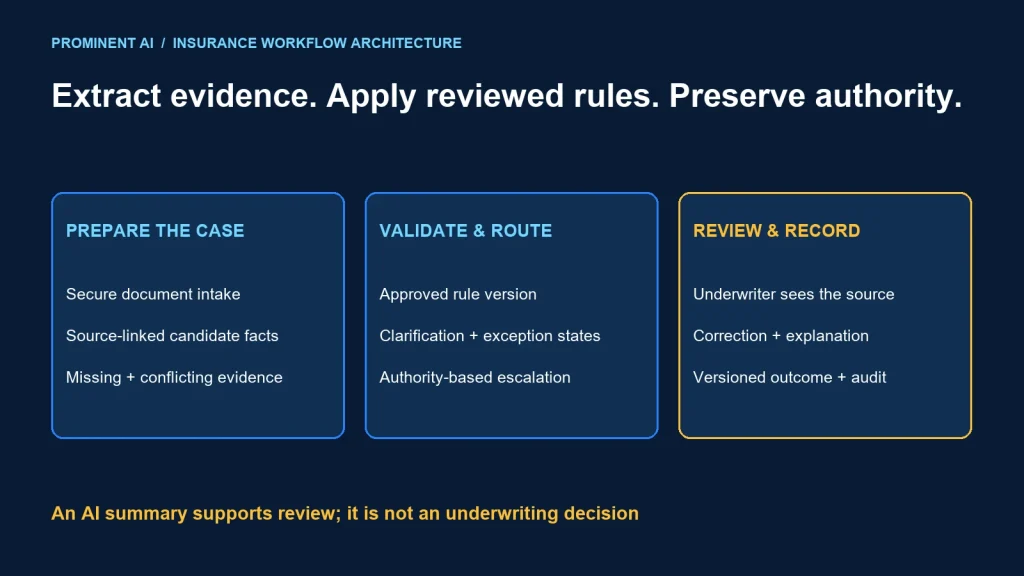
AI underwriting automation can organize submissions, extract document evidence and route exceptions while keeping underwriting authority explicit. Separate machine-produced observations from approved rules and from the authorized decision. A confident extraction or generated summary is not a reason to accept, decline or price a risk automatically.
Key takeaways
- Start with document preparation and completeness, not an unreviewed decision model.
- Retain source evidence for extracted facts.
- Version business rules and route ambiguity to authorized reviewers.
- Test error impact, subgroup behavior and meaningful human oversight.
- Keep consumer-impacting decisions, explanations and exceptions traceable.
Choose an assistive starting point
For a fictional commercial-insurance submission, the first pilot might identify document types, organize evidence and flag missing or contradictory information. It need not decide whether a customer receives coverage.
The NAIC’s model-bulletin announcement emphasizes governance and risk management for AI used to make or support consumer-impacting decisions. Applicability and adoption depend on the jurisdiction and business context; this architecture is not a legal-compliance determination.
| Capability | Assistive output | Authority boundary |
|---|---|---|
| Document classification | Suggested document type | Reviewer can correct misclassification |
| Field extraction | Candidate value with source location | Critical values require defined validation |
| Completeness check | Missing-evidence queue | Approved submission requirements determine completeness |
| Rule evaluation | Policy-versioned result or referral flag | Rules and changes have accountable owners |
| Underwriting decision | Reviewed case and supporting evidence | Authorized underwriter or approved decision process |
Document the intended use and exclusions. Do not let an extraction pilot quietly become an eligibility or pricing system because a score is available in the interface.
A reference architecture with human review
Submission + approved collection purpose
                  ↓
Secure intake → document inventory → malware/format controls
                  ↓
Classification + extraction → source-linked candidate facts
                  ↓
Validation + consistency checks + approved rule version
                  ↓
Review queue
  ├─ missing or conflicting evidence → clarification
  ├─ authority or policy exception → escalation
  └─ reviewed case → authorized underwriting decision
                  ↓
Recorded outcome + explanation + operational audit

Model output cannot independently widen authority or change policy
This is a proposed architecture, not a deployed insurer system. Assign owners for intake, extraction, rules, underwriting authority and support. Keep the handoffs explicit so an exception does not disappear between systems.
Store a stable submission identifier and version. If a customer supplies a replacement document, identify which extracted values and review conclusions are now stale. Preserve the reason for corrections rather than overwriting every prior observation without history.
Separate source files from derived summaries and approved case facts. A generated paragraph should not replace the evidence an underwriter needs to inspect.
Document extraction must preserve evidence
For each candidate fact, retain the document reference, location, extraction version and validation status. Distinguish missing, unreadable, conflicting and explicitly stated values. Treating all four as an empty field can hide important uncertainty.
| Field | What to retain |
|---|---|
| Candidate value | Extracted text or normalized representation |
| Source | Submission, document version and page/region reference |
| Transformation | Normalization rule and relevant model/configuration version |
| Validation | Confirmed, unresolved, conflicting or rejected status |
| Review | Authorized correction and reason |
Use confidence as a routing signal only after evaluating what it means for the task. A model’s confidence is not a calibrated probability of an underwriting fact being correct by default. Critical fields need evidence-based validation and a defined escalation path.
Test document variation: scans, tables, handwritten notes, attachments, duplicate pages and conflicting versions. Avoid accepting a polished summary when the underlying extraction has not been checked.
Keep sensitive material within approved processing and storage boundaries. Do not send full submissions to a model provider simply because a developer can access the files.
Rules, referrals and decision authority
Version rules with their owner, effective period and applicability. Distinguish deterministic completeness checks from actuarial or underwriting judgment. An automation can say a required document is absent without deciding the applicant’s eligibility.
Define who can override a referral, approve an exception or finalize a decision. Record the reason and evidence. An agent should not resolve an authority gap by assigning itself or a broader user group permission.
Use a review interface that shows the relevant source and uncertainty. A human reviewer needs enough time, information and authority to challenge the output. A mandatory click on an opaque recommendation is weak oversight.
The NIST AI RMF core provides governance, mapping, measurement and management context, including defined human-AI responsibilities and evaluation. Use those ideas to design oversight around the actual consequences and operating environment.
For handoffs and escalations, the stateful approval-workflow guide provides technical patterns. Its example does not establish an insurer’s underwriting policy.
Evaluate both technical errors and decision impact
Create an approved evaluation set with representative document types and known expected facts. Include ambiguous and incomplete submissions. Use synthetic or appropriately governed information and document its limitations.
Measure extraction accuracy at the field level, but also inspect which errors matter to the workflow. A formatting error and a materially incorrect evidence value may have very different consequences.
Review performance across relevant populations and submission channels with the appropriate domain, risk and legal specialists. A good overall average can conceal uneven error patterns. Do not infer fairness from one aggregate score or from removing a single sensitive field.
Track reviewer corrections, unresolved cases, overrides and escalations. Investigate whether the interface encourages uncritical acceptance. Test whether a reviewer can locate the source and correct an incorrect candidate fact.
After a model, prompt, extraction service or rule change, re-run the relevant cases before broad deployment. Record the versions that produced each case’s evidence. No accuracy percentage, savings figure or production outcome is claimed here.
An implementation decision checklist
- Define the assistive purpose and prohibited uses.
- Identify submission data, processing boundaries and responsible owners.
- Preserve source-linked facts and document versions.
- Separate extraction, validation, rules and decision authority.
- Define exception, clarification and escalation states.
- Test error impact and representative variation.
- Evaluate meaningful review and correction capability.
- Review consumer-impacting uses through the appropriate governance process.
- Record decisions, versions, overrides and explanations.
- Plan monitoring, incident handling and withdrawal of an unsafe version.
Deploy initially to an approved limited workflow with clear acceptance criteria. A pilot should demonstrate evidence quality and review usability, not merely that a model can summarize a submission.
Keep an operational reconciliation process for failed intake, missing documents and incomplete handoffs. A case must not be silently treated as complete because one processing job returned success.
Common questions
How can insurers automate underwriting without removing human oversight?
Automate preparation and evidence checks, preserve sources and uncertainty, and keep explicit authority, review, escalation and audit paths for consumer-impacting decisions.
Is document-extraction confidence enough to finalize a case?
No. Evaluate and validate important facts against their sources. Confidence needs task-specific interpretation and does not replace underwriting authority.
What should an underwriter see in the review screen?
Relevant source evidence, candidate facts, conflicts, applicable rule version and a clear way to correct or escalate the case.
How should model changes be released?
Version the change, re-run representative evaluations, review its effects and use a controlled release and recovery process.
Does this architecture guarantee compliance or fair outcomes?
No. The insurer must assess applicable requirements, validation and consumer impact through its qualified governance process.
Build assistive underwriting around evidence and authority
Bring the submission workflow, review bottlenecks and governance boundaries. Discuss a domain-specific AI solution with source-linked evidence and accountable review.