
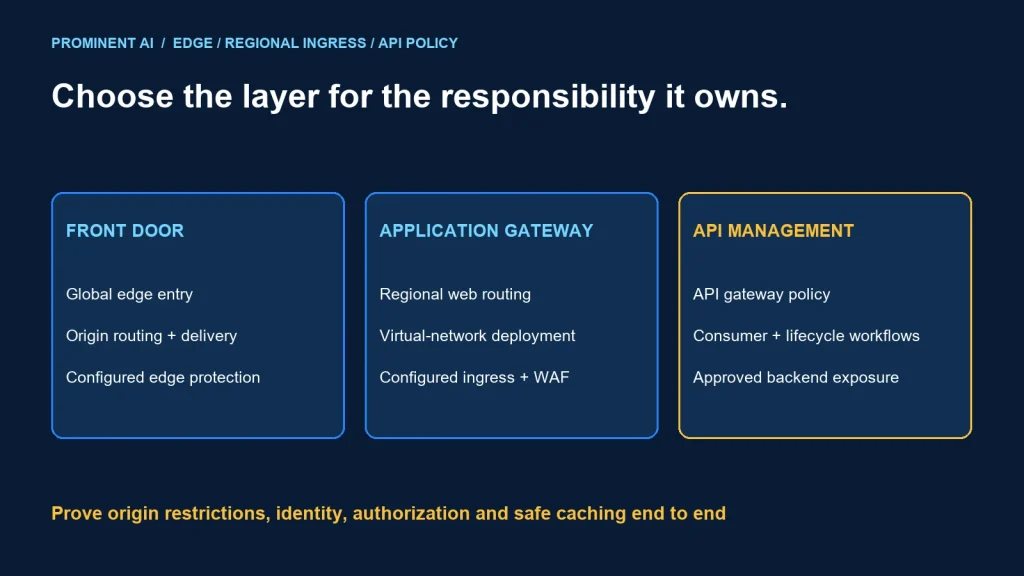
Use API Management for API-facing policies and lifecycle management, Application Gateway for regional application-layer routing in a virtual-network deployment, and Front Door for global edge delivery and routing. These services address different responsibilities and can be combined. Add each layer because it enforces a required boundary, not because three gateways appear more secure than one.
Key takeaways
- API consumer policy is different from edge routing and application load balancing.
- WAF inspection does not replace application authorization.
- Keep origin access controlled so clients cannot bypass required front-door policies.
- Validate tier-specific networking, security and capacity before committing to the design.
What each service does
Azure API Management
Microsoft’s API Management overview describes a gateway, management plane and developer portal. Gateway policies can validate credentials, apply usage controls, transform requests and emit telemetry. Feature and capacity availability depend on the selected tier.
Use it when APIs need an explicit consumer contract: authentication checks, policy consistency, onboarding, versioning or governed exposure of backends. Keep domain authorization in a trusted application or service boundary; a valid token alone does not establish ownership of every requested record.
Azure Application Gateway
Application Gateway’s overview describes layer-7 web routing based on attributes such as host and URL path. The v2 family supports application traffic management and optional WAF capabilities. It is deployed with dedicated subnet requirements in a virtual network.
Evaluate it for regional ingress and backend routing where that deployment and network control fit the workload. It does not provide a complete API product-management experience simply because it can forward API requests.
Azure Front Door
Microsoft’s Front Door overview describes global edge delivery for static and dynamic web content, origin routing, health probes and security integration. Evaluate the specific Standard or Premium capabilities required by the workload rather than treating every networking option as universally included.
Use it when a public application needs an edge entry point and a justified global origin strategy. A multi-origin configuration still needs application and data recovery design. Routing traffic to a healthy web endpoint does not prove that its dependencies can serve correct requests.
API Management vs Application Gateway vs Front Door
| Decision area | API Management | Application Gateway | Front Door |
|---|---|---|---|
| Primary job | API gateway policies and API lifecycle | Regional web application routing | Global edge delivery and origin routing |
| Consumer management | API product and onboarding workflows | Not a substitute for API lifecycle management | Not a substitute for API lifecycle management |
| Typical routing concern | API operations to approved backends | Hosts and paths to backend pools | Edge requests to configured origins |
| Protection focus | API-specific credential and usage policy | Configured regional ingress/WAF boundary | Configured edge/WAF boundary |
| Design checks | Tier, policy behavior and backend access | Subnet, DNS, probes and backend TLS | Origins, caching, probes and bypass prevention |
This is a responsibility matrix, not an exhaustive SKU inventory. Confirm current service limits, supported protocols and networking features for the exact configuration before sizing or purchasing.
Place authentication, WAF and API policy intentionally
Separate four questions: where traffic enters, which requests are structurally suspicious, who the caller is and what that caller may do. A WAF can help inspect web traffic patterns, but it cannot infer all application-specific entitlements. An API key is not an adequate replacement for user identity when user-level authorization is required.
Validate token issuer, audience and required claims at the appropriate trusted boundary. Then authorize the requested operation and resource. Avoid relying on a user-controlled header to claim an internal identity, customer or privilege.
If one layer forwards trusted identity context, define how it removes spoofed incoming values and how the backend verifies the source. Keep direct backend access restricted to the approved path. Otherwise, a client may call the origin and bypass the policies you designed.
Define TLS and certificate ownership for every hop, not only the public hostname. Review hostname forwarding, redirects and original-client context. A broken host-header assumption can create routing or authentication failures that are hard to diagnose across several proxies.
Be deliberate with caching. Public static assets and personalized API responses have different safety requirements. A cache key or rule that ignores identity can expose one consumer’s response to another. Test authenticated and anonymous requests, not just a fast public page.
Three architecture patterns
Pattern 1: regional application ingress
Client → regional Application Gateway candidate
       → approved application backends
       → application authorization + data services
This can fit a regional web application with specific network and routing needs. Decide whether public or private ingress is required and prove the intended client paths. Add API Management only if an API policy or lifecycle need justifies it.
Pattern 2: managed API exposure
API consumer → API Management
             → approved backend API
             → domain authorization and data boundary
A partner API may need consistent token checks, consumer onboarding, quotas and versioning. Verify how usage limits behave under concurrency and failure. Do not describe a gateway limit as a guaranteed financial or security boundary without testing its actual scope.
Pattern 3: global edge plus API policy
Global clients → Front Door edge entry
               → regional API Management origin(s)
               → approved backend services
                    ↕ identity + data + recovery design
This combines global entry and API-specific governance when both are needed. Application Gateway may also be justified by a distinct regional ingress requirement, but it should not be inserted automatically. Every extra hop adds configuration, cost and failure modes.
These patterns are conceptual alternatives, not deployed customer systems. Private connectivity and origin restrictions depend on service tiers and supported integration options. Prove the exact path in a representative environment.
A practical decision flow
- List the traffic: public web, internal application, partner API or global consumer API.
- Define the required API contract and consumer-management needs.
- Determine whether global edge routing is necessary.
- Determine whether a regional virtual-network ingress layer is necessary.
- Choose the smallest combination that meets those responsibilities.
- Validate security, failover, latency, operations and total cost.
For a static-and-dynamic global site, edge delivery may be the main need. For an internal integration API, identity and API policy may be more important than global caching. For a regional private application, public edge delivery may add no useful capability.
Validation checklist before production
| Test | What to prove |
|---|---|
| Direct origin request | Required policies cannot be bypassed |
| Invalid or wrong-audience token | The intended authentication boundary rejects it |
| Cross-customer resource request | Application authorization denies unapproved data |
| Personalized response caching | Responses do not leak across identities |
| Backend failure | Probes and routing reflect usable service health |
| Certificate/hostname change | Every hop retains valid TLS and routing |
| Load and retries | Accepted latency and controlled amplification |
| Incident investigation | Correlated request evidence reaches the owner |
Use a correlation strategy across layers, with appropriate handling of client-supplied identifiers. Keep logs useful without retaining secrets or complete sensitive payloads unnecessarily. Document which team owns policy, origin routing, certificates and incident response.
Estimate gateway capacity, requests, data processing, transfer, security features and log retention together. A price comparison of base instances alone misses meaningful operating cost. Measure the complete user path and failure recovery before accepting the architecture.
For the shared environment, use the Azure landing-zone checklist. Keep network and identity decisions consistent with the workload’s deployment boundaries.
Common questions
When should you use Azure API Management instead of Front Door?
When the primary need is API consumer policy and lifecycle management. Use Front Door for a justified global edge-delivery role; both can be used when those separate needs coexist.
Can Application Gateway replace API Management?
It can route API traffic, but it does not replace the full API lifecycle and consumer-management role.
Does WAF replace authentication or authorization?
No. Traffic inspection, verified identity and permission to access a business resource are different controls.
Should every application use all three services?
No. Add a layer only for a demonstrated responsibility and validate the resulting cost, latency and failure behavior.
What is an important bypass test?
Attempt an appropriately controlled direct-origin request and confirm that the required gateway or edge policies cannot be avoided.
Put each gateway where it adds a clear responsibility
Bring traffic patterns, API requirements and origin-access constraints to a review. Discuss a cloud architecture and cost review to choose and validate the right routing and policy layers.