
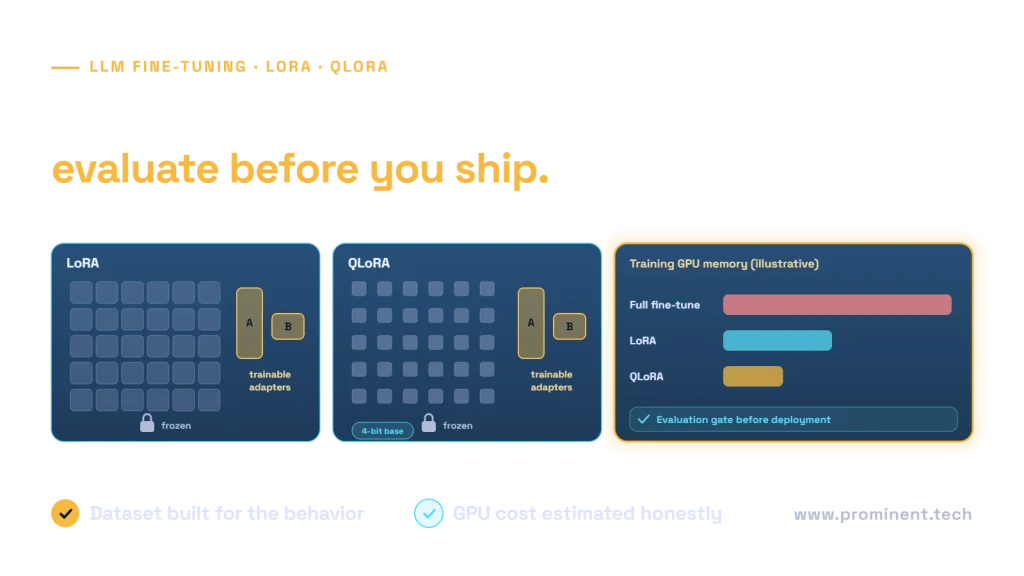
LoRA trains small low-rank updates while keeping the original model weights frozen. QLoRA combines adapter training with a quantized frozen base model to reduce its memory footprint. Choose between them by measuring task quality, peak training memory and the deployment path. Neither method removes the need for clean examples, an independent evaluation set or a controlled release.
Key takeaways
- Start with a prompt-only baseline so you know what adaptation must improve.
- Separate training examples from evaluation by customer, document family or time where leakage is possible.
- Account for activations, optimizer state and runtime overhead, not just stored model weights.
- Test the exact base revision, adapter and serving precision together.
LoRA vs QLoRA: what changes?
The original LoRA paper describes learning a low-rank weight update instead of updating the entire pretrained weight matrix. For a matrix with dimensions d by k, an adapter with rank r introduces r(d+k) parameters rather than d×k parameters. This is parameter arithmetic for one adapted matrix, not a full training-memory estimate.
The QLoRA paper adds a frozen four-bit base and trains adapters through it. Its design includes NF4, double quantization and paged optimizers. Published experiments belong to their stated models, datasets and hardware; they do not guarantee the same quality or GPU requirements for your workload.
| Decision | LoRA with a higher-precision base | QLoRA-style training |
|---|---|---|
| What is trained? | Adapter parameters; base remains frozen | Adapter parameters; quantized base remains frozen |
| Main memory trade-off | Base weights occupy more memory at the chosen precision | Lower-bit base storage, with quantization metadata and runtime overhead |
| Engineering questions | Adapter targets, rank and serving support | The same questions plus quantization backend and hardware compatibility |
| Release evidence | Quality and latency for the deployed combination | Quality and latency for the deployed combination, including precision changes |
Use higher-precision LoRA when it fits and offers a simpler supported path. Consider QLoRA when base-model memory is a constraint and the supported quantization stack meets your evaluation gates. Do not assume the lower-memory choice trains faster; measure end-to-end throughput and retries.
Design the dataset around the behavior you need
Write a narrow task contract before collecting examples. For an internal classification assistant, specify allowed labels, ambiguity handling and the expected output schema. For a drafting assistant, define the audience, evidence requirements and when to abstain. Fine-tuning is a poor substitute for retrieving frequently changing business facts; evaluate retrieval separately.
- Record provenance and usage rights. Identify where examples came from and who can approve their use. Remove secrets and unnecessary personal information.
- Normalize the conversation format. Keep role boundaries and the model’s supported chat template consistent. Verify which tokens contribute to the training loss.
- Review contradictory labels. Resolve disagreements with domain owners rather than multiplying inconsistent examples.
- Split before generating variations. Keep near-duplicates and derived examples in the same partition.
- Preserve difficult cases. Include uncertainty, invalid inputs and unsupported requests in the evaluation set.
A smaller reviewed dataset can be a better starting point than a large unreviewed collection, but there is no universal minimum example count. Run a learning curve with a fixed holdout and inspect error categories. Keep the final test set unavailable to iterative tuning decisions.
Architecture and a configuration starting point
The training path is: versioned examples → tokenizer and chat template → frozen base plus trainable adapters → checkpoints → independent evaluation → approved deployment. Store a manifest linking dataset revision, base-model revision, package versions, adapter settings, random seed and evaluation results. A checkpoint without that context is difficult to reproduce or roll back.
The following is an illustrative adapter configuration, not an executed GPU training run or a complete training script. The Hugging Face PEFT quantization guide documents preparing quantized models for adapter training. Pin compatible library versions, verify model support and test your chosen quantization backend before use.
from peft import LoraConfig

adapter_config = LoraConfig(
    r=16,
    lora_alpha=32,
    target_modules="all-linear",
    lora_dropout=0.05,
    bias="none",
    task_type="CAUSAL_LM",
)
# Illustrative values, not tuned recommendations.
# Load and prepare a supported base model separately.
# Verify trainable parameters before starting training.
Inspect the resolved target modules rather than assuming every architecture uses the same layer names. Confirm that trainable parameters are limited to the intended adapters. Run a tiny batch through forward and backward passes, save and reload an adapter, and compare outputs before launching a larger job. These smoke tests catch integration errors; they do not demonstrate task improvement.
Estimate memory and GPU cost honestly
Raw weight storage is only a lower-bound component. For an illustrative seven-billion-parameter model, two bytes per weight is 14 billion bytes, while half a byte per weight is 3.5 billion bytes. Those are decimal byte calculations, not observed GPU allocations. Quantization metadata, activations, adapters, gradients, optimizer state, temporary buffers and the framework add memory.
Sequence length and microbatch size can dominate activation memory. Measure peak allocated and reserved memory after warm-up using representative sequences, not only short demonstration prompts. Record effective batch size, gradient accumulation, checkpointing, tokens processed per second and any out-of-memory recovery.
| Record | Why it matters |
|---|---|
| GPU hours × actual hourly charge | Compute spend for completed and failed runs |
| Experiment and evaluation runs | A single successful run understates iteration cost |
| Data review and labeling effort | Quality improvement requires specialist time |
| Serving and rollback capacity | Training savings do not establish operating cost |
Compare cost per accepted task outcome against the prompt-only baseline. A cheaper training run is not a useful saving if the released model needs more retries, review or a larger serving instance.
Evaluation gates and deployment
Evaluate both the original base and adapted candidate on the same held-out tasks. Review correctness, schema validity, abstention, harmful or sensitive disclosures and the business errors that matter. Break results down by language, task type and difficult input slice. Treat automated grading as evidence to calibrate with human review, not an unquestioned verdict.
Test the actual serving stack: base revision, tokenizer, adapter, precision and generation settings. Merging or changing quantization can alter the deployment artifact, so repeat evaluation on that artifact. Keep a rollback route to the previous approved combination and monitor errors after release.
Troubleshooting checklist
- Loss falls but answers worsen: inspect leakage, incorrect target masking, format mismatch and overfitting.
- Out of memory: profile long sequences and runtime buffers; adjust batch or length within the task contract.
- Adapter has no effect: verify loading, target modules and active adapter selection.
- Local and serving results differ: compare templates, revisions, precision and generation parameters.
Common questions
Is QLoRA a different base model?
No. It is an adaptation approach using a quantized frozen base with trainable low-rank adapters. The chosen base model still determines licensing and supported capabilities.
Does QLoRA always match full fine-tuning?
No universal guarantee applies. Evaluate your dataset, model and deployment configuration against the baseline and acceptance criteria.
Which LoRA rank should I choose?
Treat rank as an experiment parameter. Compare a small controlled set using the same validation split, memory budget and task-quality gates.
Can fine-tuning replace RAG?
They address different needs. Adaptation can shape behavior; retrieval supplies selected current evidence. A combined system still needs independent evaluation.
How much GPU memory will I need?
Measure the full workload. Base size and precision matter, alongside sequence length, batching, activations, optimizer state and implementation overhead.
Plan adaptation around a measurable task
Read RAG versus fine-tuning and prompt engineering before choosing an adaptation path. For dataset review, evaluation gates and a controlled deployment, discuss a production AI reliability roadmap.