
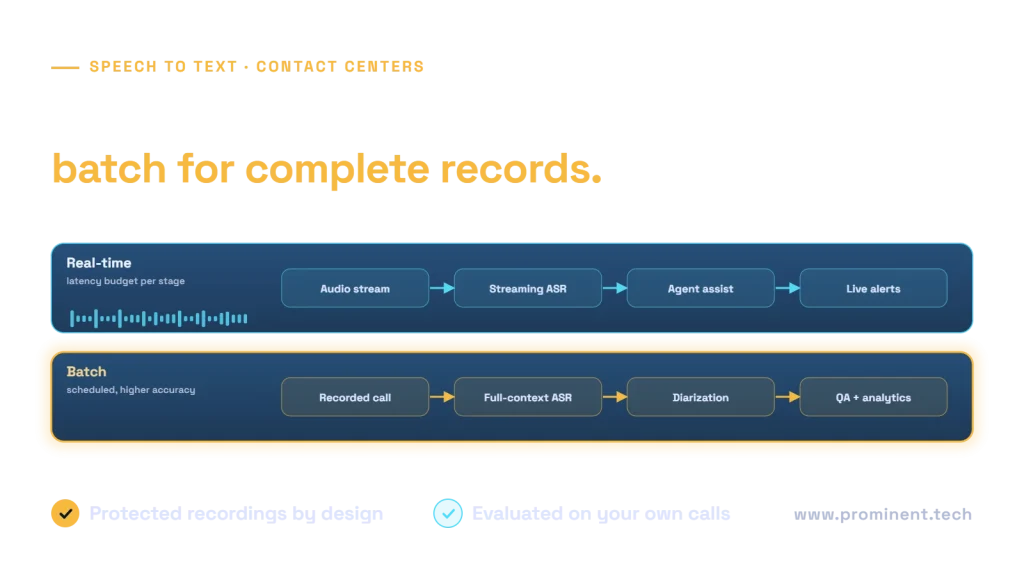
Use real-time transcription when text is needed during the conversation; use batch transcription when recorded audio can be processed after the call. Contact centers often need both: a streaming path for live assistance and a controlled post-call path for finalized transcripts and review. Neither architecture guarantees accurate speaker attribution or business decisions without evaluation.
This guide compares the request paths, gives a latency-budget template and explains speaker diarization, scheduling and operational checks. The examples are illustrative; no call recording or customer performance result is implied.
Architecture 1: real-time speech to text
Authorized call audio
    → capture and supported audio encoding
    → authenticated streaming connection
    → partial hypotheses + finalized segments
    → ordered transcript state with timestamps
    → live agent display or bounded assistance
    → approved retention and post-call reconciliation
Partial text can change as more speech arrives. The application must distinguish provisional text from finalized segments and avoid appending every hypothesis as a new sentence. Preserve segment identifiers or the service’s documented update semantics.
A live assistance feature may use provisional text for suggestions, but consequential updates should follow an appropriate confirmation or review boundary. Do not automatically turn an uncertain recognized phrase into an irreversible customer-record action.
Architecture 2: recorded-audio batch transcription
Approved recording + call metadata
    → protected object storage
    → validated job manifest and transcription settings
    → queued asynchronous transcription
    → completion / failure tracking
    → transcript, timing and supported speaker labels
    → quality checks, review and downstream processing
    → retention and deletion workflow
Azure’s batch transcription overview describes asynchronous processing of recorded audio. A submitted job is not a completed transcript. Track state, correlate outputs with the original recording and handle item-level failures.
Post-call processing can support review, search and summarization without meeting the same live latency budget. It still needs a completion objective and a reliable route for failed or delayed jobs. Verify the current API, region, audio format and supported options before implementation.
Real-time vs batch transcription: selection matrix
| Workload | Starting architecture | Main requirement | Important test |
|---|---|---|---|
| Live captions | Streaming | Readable incremental text during speech | Partial updates and display delay |
| Agent assistance | Streaming plus bounded downstream analysis | Useful suggestions while the call continues | Latency, provisional wording and false suggestions |
| Post-call quality review | Batch | Completed transcript and review evidence | Accuracy on relevant call types |
| Historical recording archive | Batch scheduling | Throughput and controlled processing cost | Backlog completion and retries |
| Live assistance plus final record | Combined paths | Clear distinction between live and reviewed artifacts | Reconciliation, source version and duplicate prevention |
Batch is not automatically more accurate, and streaming is not automatically unsuitable for final records. Compare the supported service configurations and actual audio. The architecture choice starts with when the text is needed.
Build a streaming latency budget by stage
Measure from the relevant spoken event to useful display or assistance, not only the provider’s recognition time. Audio buffering, network transfer, endpointing, transcript updates and downstream analysis all contribute.
| Stage | Measure | Design question |
|---|---|---|
| Capture and buffering | Audio arrival to frame submission | Are frames unnecessarily delayed? |
| Transport | Submission to service receipt where observable | Are connectivity and reconnect behavior stable? |
| Recognition | First partial and final-segment timing | Does endpointing fit the conversation? |
| Application update | Event receipt to visible text | Are updates ordered and efficiently rendered? |
| Assistance | Transcript event to useful suggestion | Is downstream reasoning or retrieval the bottleneck? |
This worksheet intentionally provides no invented universal millisecond target. Set a user-facing objective, instrument each stage and test under relevant concurrency and network conditions. Report partial-text delay separately from final-segment delay.
A reconnect needs an explicit recovery strategy. Check what audio was acknowledged or retained and whether replay could duplicate transcript content. Do not assume a streaming session can always resume from an arbitrary point without application handling.
Diarization is not identity verification
Speaker diarization groups speech by apparent speaker. A label such as “Speaker 1” does not prove the person’s name or authority. Map agent and customer roles using trusted channel or session metadata where available, and retain uncertainty when attribution is ambiguous.
Azure’s real-time diarization guidance demonstrates speaker-labeled transcription. Its language and diarization configuration guide covers supported configuration choices across transcription modes. Verify the exact feature combination for your API and audio format.
Separate audio channels can provide useful role information when recording topology preserves it; they are not the same as diarizing a mixed channel. Evaluate overlap, interruptions, transfers and multiple participants. A supervisor joining the call can invalidate a simplistic two-speaker assumption.
Batch scheduling, retries and protected recordings
Use a job manifest with stable recording IDs, source locations, language configuration and processing status. Keep a distinct record for submission, completion and downstream publication. Retry transient failures within bounds and avoid reprocessing successful recordings unnecessarily.
Limit access to audio and transcript storage. Avoid long-lived public recording URLs. Apply the organization’s approved notice, access and retention requirements, with responsible review for the operating locations. Do not infer legal compliance from the transcription product’s feature list.
Protect derived data too
Transcripts, summaries, embeddings and search snippets can expose the original conversation. Propagate access restrictions and deletion requirements through downstream systems. Keep sensitive content out of unrestricted operational logs.
If both streaming and batch outputs exist, label their status clearly. A post-call transcript should not silently overwrite reviewed notes without provenance. Link each derivative to its source recording and processing configuration.
Evaluate the business-relevant transcription errors
Use an approved audio set covering relevant accents, languages, channel quality, noise and vocabulary. Obtain reviewed references. Word error rate is useful, but inspect critical entities, quantities, negation, speaker attribution and timestamps separately.
A transcript can have acceptable overall word accuracy while getting an account identifier or the phrase “do not approve” wrong. Evaluate the downstream task as well: a summarizer cannot reliably repair an unsupported transcription guess.
| Dimension | Test examples | Evidence |
|---|---|---|
| Recognition | Noise, accents, terminology and code switching | Reviewed transcript comparison |
| Speaker attribution | Overlap, transfers and additional participants | Speaker and role errors |
| Timing | Pauses, interruptions and long utterances | Partial/final delay and segment alignment |
| Reliability | Network loss, job failure and replay | Missing or duplicate segments and recovery outcomes |
| Downstream quality | Summaries, action suggestions and search | Support, correctness and review effort |
Use the application testing playbook for any LLM-based post-processing. Keep recognition metrics separate from generated-summary quality so the failing stage remains visible.
Common questions
When should a contact center use real-time transcription?
When text is needed during the conversation, such as live captions or agent assistance. Evaluate incremental updates, finalization, network recovery and the full user-facing latency.
When is batch transcription a better fit?
When recorded audio can be processed after the call, including quality review and historical archives. Define completion, retry and retention requirements rather than assuming asynchronous means unmonitored.
Does diarization identify the customer?
No. It distinguishes apparent speakers, not verified identities. Use trusted session or channel metadata for role mapping and preserve uncertainty.
Can a partial transcript change?
Yes. Treat partial recognition as provisional and follow the service’s update and finalization semantics. Avoid storing every partial revision as a separate final sentence.
Should a company use both streaming and batch?
It can, when live assistance and a post-call processing workflow both have value. Keep outputs labeled, reconcile provenance and avoid duplicate downstream actions.
Choose the transcription path around the conversation workflow
For AI post-processing choices, read RAG versus fine-tuning and prompt engineering. To review speech capture, transcription and reliable downstream assistance, discuss your production AI reliability roadmap.