
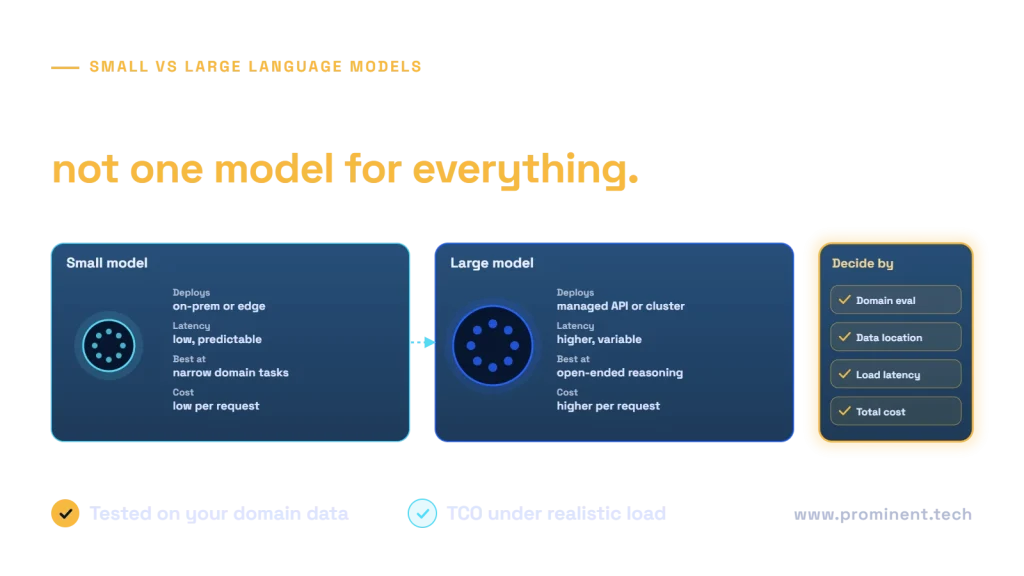
Choose a small language model when it meets the task’s quality requirements and its deployment footprint, latency or operating model provides a measured advantage. Choose a larger model when its capabilities justify the additional serving or API cost. Size alone does not establish privacy, accuracy or total cost, and a routed combination may serve different task classes better than one universal model.
This comparison provides a feature matrix, a decision flow and fictional application examples. It does not claim that a particular model was benchmarked or that every small model can replace a larger one.
SLM vs LLM: avoid a false binary
“Small language model” generally describes a more compact model relative to larger alternatives, but there is no single universal parameter cutoff that settles the enterprise decision. Architecture, training, quantization, context handling and serving implementation also affect behavior.
Parameter count, memory footprint and response quality are different measurements. A compact model may perform a narrow extraction task well while struggling with an ambiguous cross-document question. A larger model may offer broader capability while still producing unsupported claims.
Microsoft’s model-selection guidance frames the choice around workload requirements and evaluation. Apply that approach rather than selecting a model solely because it is described as small, frontier, local or enterprise-ready.
Small vs large language models: comparison matrix
| Dimension | Small-model candidate | Larger-model candidate | Evidence to collect |
|---|---|---|---|
| Task quality | Can suit bounded, well-defined tasks | May suit broader or harder reasoning tasks | Held-out results by task slice |
| Serving footprint | Can reduce memory and compute requirements | May need more substantial serving resources | Actual model, precision, context and runtime requirements |
| Local deployment | Often a practical candidate for constrained environments | Feasibility depends on hardware and configuration | Supported devices, throughput and update process |
| Privacy | Local processing can reduce some data movement | Managed or private deployments have their own controls | Complete data flow, telemetry and access review |
| Latency | Potential benefit if well matched to hardware and workload | May benefit from optimized managed serving | End-to-end latency under relevant concurrency |
| Total cost | Lower unit compute can be offset by operations or fallbacks | Higher unit cost may support fewer repair steps | Cost per accepted task, including ownership |
The entries are evaluation hypotheses, not universal rankings. A poorly provisioned local model can be slower than an optimized hosted service. A cheaper call can become expensive when it creates repeated failures.
Domain quality matters more than a generic leaderboard
Define the actual work: classification, structured extraction, drafting, document explanation or tool selection. Include the vocabulary, exceptions, languages and ambiguity users will encounter. Keep successful routine cases separate from difficult ones.
Evaluate a prompt baseline first. If the model lacks current enterprise knowledge, consider permitted retrieval rather than assuming fine-tuning is the answer. Fine-tuning can target behavior or domain patterns, but it does not automatically establish freshness or source authorization.
See RAG versus fine-tuning and prompt engineering for that separate decision. Test any specialized model against held-out data so apparent domain improvement is not merely memorization of training examples.
Quantization is another change to evaluate
A quantized model may reduce memory requirements, but the effect on task quality and speed depends on the model, precision, runtime and hardware. Validate the exact deployed artifact. Do not transfer scores from an unquantized reference to a different build without testing.
Deployment location changes responsibility, not just geography
Local or on-premises inference can keep some processing closer to the data and support environments with limited connectivity. It also requires an approved runtime, artifact distribution, patching, resource management and an operating owner.
Azure App Service documents a local SLM sidecar pattern within an application environment. This is one deployment option, not proof that every small model runs on every device. Confirm supported hardware, model format, licensing and application requirements.
The research study Demystifying Small Language Models for Edge Deployment examines model and hardware considerations across its evaluated set. Its results are useful context, but should not be treated as a benchmark for an untested enterprise installation.
Local does not mean automatically private
Review logs, telemetry, update services, crash reports, caches and downstream tools. A locally running model can still send data through connected components. Restrict access to model files, prompts and output storage, and define retention and deletion behavior.
Likewise, assess a hosted service using its actual data-handling contract and configuration rather than assuming every remote call has identical risk. The security decision belongs to the full application data flow.
Compare latency and TCO under realistic load
Measure request preparation, model loading where user-visible, inference, output validation and any fallback. Include peak concurrency, context length and expected output size. Warm single-user tests can hide cold-start or contention problems.
Total cost includes hardware or API usage, runtime maintenance, deployment, monitoring, evaluation, upgrades and specialist review. Low utilization can make dedicated infrastructure unattractive even when per-token compute looks inexpensive. High and predictable volume can change that calculation.
Use the inference routing worksheet to account for fallback calls. A small-first architecture must count both the initial call and any larger-model retry.
Three fictional use cases
Structured ticket classification
A compact model is a candidate for assigning approved categories and extracting explicit fields. Test rare categories, ambiguous requests, schema validity and handoff behavior. Keep business routing rules and access checks outside the model.
Offline document assistance on a managed device
A local model may help with approved documents when network access is limited. Test supported hardware, document size, source citations and uncertain answers. Review whether logs or synchronization move content off the device.
Complex enterprise research
A larger or combined route may be appropriate when questions require many sources, qualifications and tool interactions. Test evidence coverage and action boundaries. A bigger model does not remove the need for retrieval authorization or approval.
These are selection scenarios, not completed projects or measured outcomes. A company can use different routes for different tasks rather than forcing one model to handle every workflow.
A practical decision flow
- Specify the task and hard boundaries: required quality, data location, hardware, languages and permitted actions.
- Select a small set of candidates: include a simple compact baseline and a relevant larger alternative.
- Evaluate exact deployment artifacts: prompts, quantization, runtime and retrieval configuration.
- Measure difficult slices: exceptions, no-answer cases, denied access and malformed inputs.
- Measure operating cost and latency: include fallbacks, review and ownership.
- Choose the simplest passing design: compact, larger or routed.
- Monitor and retest changes: preserve a rollback and update plan.
Keep an explicit rejection criterion for each candidate. If a compact model cannot meet the task requirement after reasonable configuration, do not mask the gap with confident wording. If a larger model adds cost without useful improvement, document that result too.
Common questions
When should a company choose an SLM over an LLM?
When the compact model meets the actual task requirements and offers a validated deployment, latency or total-cost advantage. Test the exact model and environment rather than relying only on size.
Are small language models always faster?
No. Hardware, runtime, model precision, context length, concurrency and serving configuration matter. Measure the end-to-end application under realistic conditions.
Are local models automatically more private?
No. Local inference can reduce some data movement, but logs, telemetry, caches, synchronization and connected tools still need review. Evaluate the entire data flow.
Can an SLM use RAG?
Yes. Retrieval can provide permitted source evidence to a compact model. Evaluate whether it can correctly interpret that evidence and preserve important qualifications.
Can a company combine small and large models?
Yes. A validated router can assign suitable tasks to different models and use bounded fallbacks. Include routing overhead, failure rates and access controls in the design.
Select the model for the work it must do
Use the LLM application testing playbook to compare candidates. To review model selection, deployment and operating ownership, discuss your production AI reliability roadmap.