
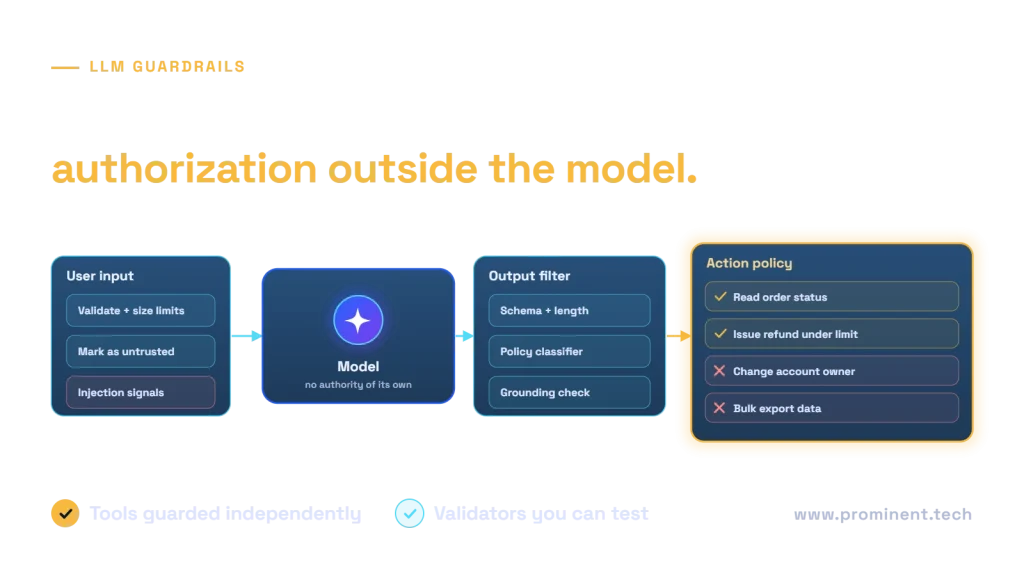
LLM guardrails are controls around model inputs, outputs and actions that constrain application behavior and enforce policy. Rules, classifiers and model-based reviewers can help, but they have different strengths and failure modes. Keep authorization and business invariants in trusted application services; do not ask a safety classifier or the generating model to grant access.
This guide compares control types and provides a runnable output-validator example. The example checks a narrow fictional support response. It does not prove factual correctness, detect every unsafe message or replace a production security review.
Place controls at the boundary they protect
Authenticated request
    → input size, format and scope checks
    → permitted evidence and approved tool definitions
    → model generation
    → parse and validate output contract
    → evidence and content checks
    → independent authorization for any action
    → safe rendering or approved execution
    → auditable result and failure handling
One “safe” score should not bypass later checks. A harmless-sounding sentence can still request an unauthorized operation, while valid JSON can contain an unsupported claim. A tool call that passes schema validation can still target the wrong tenant.
OWASP’s output-handling guidance emphasizes treating generated material as untrusted before downstream use. Apply context-appropriate encoding for presentation and validated, constrained interfaces for backend operations. Never execute generated text as an unrestricted shell command or query.
Compare guardrail types by what they can establish
| Control | Good fit | Limit | Example |
|---|---|---|---|
| Deterministic rules | Types, bounds, allowlists and explicit business invariants | Do not understand every semantic variation | Reject unknown action names or an invalid identifier |
| Classifier | Detect a defined content category at scale | False positives, false negatives and domain shift | Flag likely sensitive disclosure for review |
| Model-based reviewer | Assess nuanced relevance or evidence support against a rubric | Fallible, variable and potentially influenced by untrusted text | Review whether a response preserves a policy exception |
| Authorization service | Enforce caller rights and tenant boundaries | Needs trustworthy identity and current policy | Deny access to another customer’s record |
| Human approval | Resolve ambiguity or authorize a consequential proposed action | Needs clear evidence, scope and accountability | Approve a reviewed external communication |
Use complementary controls rather than expecting a probabilistic reviewer to replace deterministic policy. Calibrate classifiers and reviewers against relevant examples, retain their versions and measure error types that matter to the application.
Validate inputs without pretending they become trusted instructions
Enforce request size, file types, expected fields and authenticated scope. Treat attachments, retrieved passages and tool responses as data from their respective trust levels. Labels or delimiters can help distinguish evidence from instructions, but they do not make malicious content harmless by themselves.
OWASP documents direct and indirect prompt injection, including instructions embedded in external material. Keyword blocking alone is a weak boundary: ordinary text can be misclassified, and adversarial instructions can be rephrased or spread across inputs.
Restrict what an injection could cause. Provide only necessary tools, keep credentials out of model-visible content and enforce source eligibility before retrieval context. Use the permission-aware RAG design for document boundaries.
Worked example: validate a bounded support reply
Imagine an application that accepts only “answer,” “clarify” or “handoff” responses, a bounded message and references to sources already authorized for this request. The following standard-library Python example rejects extra fields and references outside that trusted set.
"""A narrow fictional support-response validator; no API calls or actions."""
def validate_reply(value, permitted_sources):
    if not isinstance(value,dict) or set(value)!={'status','message','source_ids'}:
        raise ValueError('Unexpected response structure')
    if value['status'] not in ('answer','clarify','handoff'):
        raise ValueError('Unsupported status')
    if not isinstance(value['message'],str) or not 1<=len(value['message'])<=1000:
        raise ValueError('Message must be nonempty and bounded')
    refs=value['source_ids']
    if not isinstance(refs,list) or not all(isinstance(x,str) for x in refs):
        raise ValueError('Source references must be strings')
    if any(x not in permitted_sources for x in refs):
        raise ValueError('Source outside trusted permitted set')
    if value['status']=='answer' and not refs:
        raise ValueError('Answer requires a permitted reference')
    return value

if __name__=='__main__':
    good={'status':'answer','message':'See the approved policy.','source_ids':['doc-1']}
    assert validate_reply(good,{'doc-1'})==good
    bad=[
      {**good,'execute':'delete'},
      {**good,'status':'execute'},
      {**good,'source_ids':['private-doc']},
      {**good,'source_ids':[]},
      {**good,'message':'x'*1001},
    ]
    for value in bad:
        try: validate_reply(value,{'doc-1'})
        except ValueError: continue
        raise AssertionError('Expected validation rejection')
    print('PASS: allowed fixture and five invalid response fixtures')
The local run accepted the declared valid fixture and rejected five invalid fixtures. These tests establish the demonstrated contract behavior only. A permitted citation does not prove that the message is supported by that source. A separate evidence check must inspect the claim-to-source relationship.
The trusted permitted-source set must come from server-side authorization, not from the model response. The message must also be safely rendered. Passing this function does not authorize an action or make HTML safe to insert into a page.
Schema, support and policy are separate verdicts
- Schema: does the response have the expected structure and values?
- Support: do material claims follow from the permitted evidence?
- Policy: may this caller receive the content or perform the proposed action?
Keep failures distinguishable so an operator can diagnose them. Retrying generation may repair malformed output; it cannot grant a missing permission.
Guard tools with independent authorization
OWASP’s excessive-agency guidance distinguishes risks from unnecessary functionality, permissions and autonomy. Limit each tool to a narrow contract and apply the caller’s authorized scope at execution time.
For a fictional support tool, allow “get ticket status” without also exposing generic database execution. Validate ticket ownership in the backend. If a workflow can send a message or change a record, bind approval to the concrete proposed action, target and relevant content so it cannot be reused for a different operation.
Use idempotency for retried side effects and preserve an audit trail appropriate to the application. Do not treat “the model said the user approved” as approval evidence. The human-in-the-loop guide develops this boundary further.
Define safe behavior when a guardrail fails
Each control needs a failure route: reject, clarify, hand off, retry within a bound or return a limited response. Avoid endless regeneration until a response happens to pass. Keep the original reason and retry count visible to authorized operators.
| Failure | Reasonable starting behavior | Unsafe shortcut |
|---|---|---|
| Malformed output | Bounded repair or controlled failure | Parse arbitrary text as executable instructions |
| Missing evidence | Clarify or abstain | Invent a citation to satisfy the schema |
| Authorization denied | Deny the action or source access | Ask a second model to override the policy |
| Reviewer unavailable | Follow the pre-agreed risk-specific fallback | Silently treat an unreviewed result as approved |
| Ambiguous consequential action | Obtain scoped review or approval | Execute because the wording sounds confident |
Failing closed is especially important for authorization. For other controls, define the appropriate availability and user-experience trade-off with the application owner. A content-review outage need not cause the same behavior for a read-only public FAQ and a privileged transaction.
Test false passes, false rejections and bypass paths
Build a suite with valid tasks, malformed outputs, denied sources, forbidden actions and adversarial content from every external route. Include multilingual and paraphrased examples relevant to your users. Inspect both user-visible output and downstream actions.
Measure legitimate tasks blocked unnecessarily as well as unsafe cases allowed through. Version the policy, classifier or judge settings. Re-run the suite when prompts, models, tools or rendering change, and add reviewed production failures to regression coverage.
Use the LLMOps release process to connect these checks to deployment gates and recovery ownership. Log enough to understand a failure without creating an unrestricted store of sensitive prompts.
Common questions
What are LLM guardrails?
They are controls around inputs, outputs and actions that constrain behavior and enforce application policy. They can include rules, classifiers, model reviewers, authorization and human approval.
Can guardrails eliminate hallucinations?
No. Evidence checks, constraints and review can reduce particular failures, but they do not guarantee factual correctness. Evaluate the target tasks and define an abstention or escalation path.
Is structured JSON output enough?
No. A valid structure can contain unsupported claims or unauthorized actions. Validate structure, evidence support and execution policy separately.
Should authorization be implemented with a model reviewer?
No. Enforce trusted identity and policy in application services. A model reviewer may provide additional content assessment but must not grant permissions.
How do I choose between rules and a model-based guardrail?
Use rules for explicit invariants and bounds. Use calibrated classifiers or model reviewers for semantic judgments where appropriate, with measured error rates and a defined failure route.
Build controls around the actual risk
For related application choices, see RAG versus fine-tuning and prompt engineering. To review validation, authorization and release testing in your application, discuss your production AI reliability roadmap.