
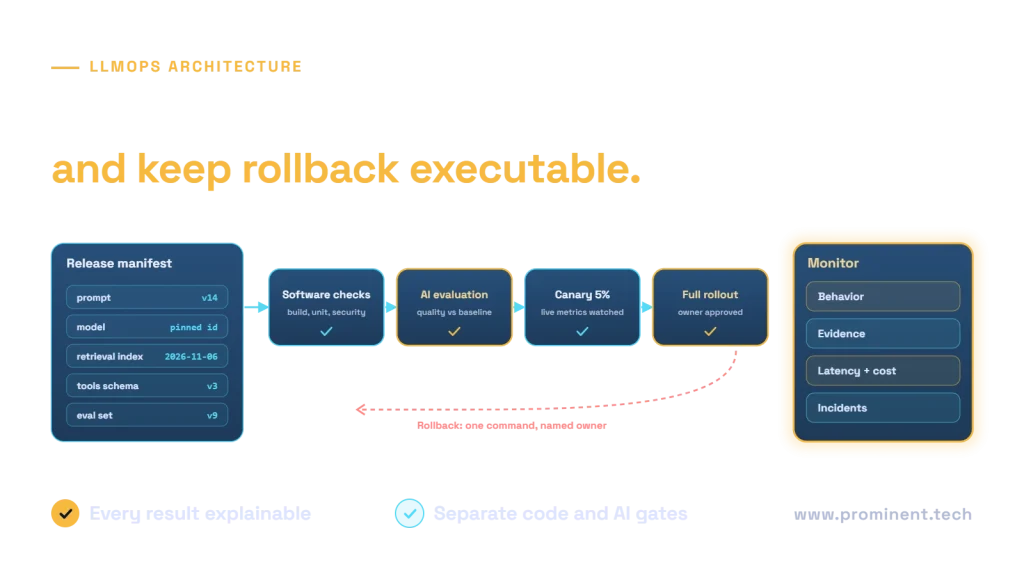
A production LLMOps pipeline versions the application and its AI behavior, tests changes against explicit acceptance criteria, deploys them gradually and connects monitoring to an owned response plan. Code, prompts, retrieval settings, model configuration, tool contracts and data policies can all change the result. A green software build alone does not show that an LLM application remains useful or safe.
This architecture guide provides a release manifest, evaluation gates and an ownership checklist. It is a reference design, not a claim that a particular pipeline or vendor integration has been deployed or certified.
What does an LLMOps architecture include?
Versioned application + prompt + model configuration
       + retrieval / tool contracts + evaluation definitions
    → build and software checks
    → integration and access-boundary tests
    → offline task evaluation with versioned evidence
    → release review and artifact promotion
    → staged deployment and live verification
    → monitored operation, incident response and rollback
    → reviewed failures become regression cases
Microsoft’s LLMOps guidance describes lifecycle management for LLM-based applications. AWS’s LLMOps overview also connects integration, deployment and ongoing tuning. The architecture here applies those lifecycle ideas without requiring one provider or assuming every application fine-tunes a model.
Separate the control plane from the request path. The control plane builds, evaluates and promotes configurations. The request path authenticates callers, retrieves permitted evidence, invokes approved tools and generates responses. Production traffic must not be able to rewrite release policy or deploy a new prompt through ordinary user content.
Version everything needed to explain a result
A Git commit identifies application code, but may not identify a model deployment change or a refreshed search index. Record the complete behavior configuration and distinguish immutable artifacts from external dependencies whose behavior can change.
| Artifact | Record | Why it matters |
|---|---|---|
| Application | Commit, build and dependency lock | Reproduce orchestration and validation logic |
| Prompt and output contract | Template version and schema | Explain behavior and downstream compatibility |
| Model configuration | Provider, deployment or model identifier and relevant settings | Track model changes and availability |
| Retrieval | Index schema, embedding model, chunking and ranking configuration | Explain evidence selection |
| Tools | API contract, permission scope and side-effect policy | Keep actions bounded and compatible |
| Evaluation | Dataset, rubric, scorer and judge configuration | Make release evidence interpretable |
| Policy | Authorization and retention configuration references | Validate access and data handling |
An illustrative release manifest
{
  "release": "support-assistant-r12",
  "application_build": "build-142",
  "prompt_bundle": "support-v7",
  "model_config_ref": "approved-deployment-config-v3",
  "retrieval_config": "hybrid-v4",
  "index_schema": "knowledge-v2",
  "tool_contracts": "support-tools-v5",
  "evaluation_dataset": "heldout-v6",
  "evaluation_rubric": "support-rubric-v3",
  "rollback_release": "support-assistant-r11"
}
These are fictional identifiers, not a product-specific manifest schema. Store references to secrets rather than secret values. Record deployment-time configuration so the artifact evaluated in staging is meaningfully connected to the artifact promoted to production.
Build software checks and AI evaluation into separate gates
Gate 1: deterministic correctness
Run unit tests, schema validation, dependency checks and tool-contract tests. Verify that timeouts, invalid responses and repeated requests do not bypass validation. For actions with side effects, test idempotency and approval requirements independently of model wording.
Gate 2: integration and access boundaries
Test identity propagation, source eligibility, tenant isolation and denied tools against an authorized test environment. A simulated tool response can test orchestration, but it does not prove that the deployed API enforces the same permissions.
Gate 3: task quality
Evaluate representative and held-out tasks with source-backed references or clear rubrics. Separate answer support, correctness, relevance and abstention. Break results into meaningful slices rather than allowing many easy cases to hide failures on exceptions.
Automated judges can assist review, but need calibration and versioning. A changed judge can change reported scores even when the application stays the same. Preserve examples, labels and reviewer decisions for important disagreements.
Gate 4: operating requirements
Measure end-to-end latency, cost, throttling and recovery behavior under a relevant workload. Include retries and fallback routes. A candidate that passes a small quality sample can still fail at peak concurrency or become too expensive to operate.
Set acceptance criteria with application owners before viewing candidate results. Authorization failures should be mandatory blockers, not merely negative points that can be outweighed by faster responses. Our RAG evaluation guide covers evidence-specific metrics.
Deploy gradually and make rollback executable
Promote a reviewed release artifact rather than rebuilding a different package for production. Verify environment configuration, network access, model availability and source connections. Keep test and production credentials and data routes appropriately separated.
A staged rollout can expose a limited portion of eligible traffic to the new release, with explicit stop criteria and an owner. Shadow evaluation can provide useful evidence, but must still follow data-handling rules and must not execute duplicate side effects.
Rollback has more than one layer
Reverting a prompt does not restore an incompatible index schema, a deleted source or an unavailable external model. Identify which components can be restored and which require forward repair. Keep compatible prior configurations where practical and rehearse the procedure with approved data.
For tool actions, rollback of software cannot reverse an already completed business operation. Design approvals, audit records and compensating procedures as needed. Do not label a deployment “reversible” merely because a container image can be switched back.
Monitor behavior, evidence and operations
Track request failures, stage latency, token or usage cost, retrieval outcomes and tool errors. Sample task quality under an approved review policy. User feedback is useful, but a thumbs-up count alone cannot establish factual correctness or permission safety.
MLflow tracing documentation describes visibility into application execution that can support diagnosis and evaluation. Choose a tracing approach that records relevant configuration and stage outcomes while limiting sensitive payload exposure. A trace is evidence to inspect, not an automatic quality verdict.
Distinguish source drift, usage changes and release regressions. A growing no-answer rate may come from missing documents rather than a model change. Connect incidents to the RAG diagnostic runbook so the response targets the failing layer.
Assign decisions to named responsibilities
| Responsibility | Owns | Release evidence |
|---|---|---|
| Application owner | Task scope and acceptance criteria | Approved behavior and reviewed limitations |
| Engineering lead | Build, integration and release configuration | Test results and artifact manifest |
| Data or source owner | Source quality, freshness and permitted use | Corpus and permission readiness |
| Security reviewer | Access boundaries and privileged actions | Denied-case and abuse-case results |
| Operations owner | Monitoring, alerts and recovery | Runbook, rollback rehearsal and on-call route |
These responsibilities may be held by a small team rather than separate departments. What matters is that an alert has an owner and a release decision has an accountable reviewer. Avoid a pipeline that produces scores nobody is authorized to act on.
Production readiness checklist
- The release manifest identifies the evaluated application behavior.
- Held-out tests cover successful, ambiguous, denied and no-answer cases.
- Scorers and model judges are versioned and reviewed.
- Source and tool permissions are enforced outside the model.
- Latency and cost measurements include fallbacks and retries.
- Deployment has observable stop conditions and an owner.
- Rollback and forward-repair limits are documented and rehearsed.
- Traces follow the approved access and retention policy.
- Reviewed production failures feed a controlled regression process.
Common questions
What is LLMOps architecture?
It is the combination of versioning, testing, evaluation, deployment and operating controls used to maintain an LLM application through its lifecycle, including prompts, models, retrieval and tools.
How is LLMOps different from normal CI/CD?
It retains software CI/CD checks and adds evaluation of model behavior, evidence support, prompt changes, source configuration and AI-specific failure modes. Deterministic tests remain necessary.
Should every prompt change run evaluation?
Changes that can affect behavior should receive evaluation proportionate to their scope and risk. Keep a versioned regression set and explicit gates rather than treating prompt edits as untracked copy changes.
Can an automated judge approve a release alone?
A judge can provide evidence, but it is fallible and needs calibration. Keep mandatory access checks and accountable review for consequential behavior and ambiguous results.
What should an LLM rollback restore?
The relevant application, prompt, model and retrieval configuration where available and compatible. Document limits when external models, source data or completed side effects cannot be restored by a software rollback.
Build a release process around observable behavior
For related design choices, read RAG versus fine-tuning and prompt engineering. To review evaluation gates, deployment ownership and recovery for your application, discuss your production AI reliability roadmap.