
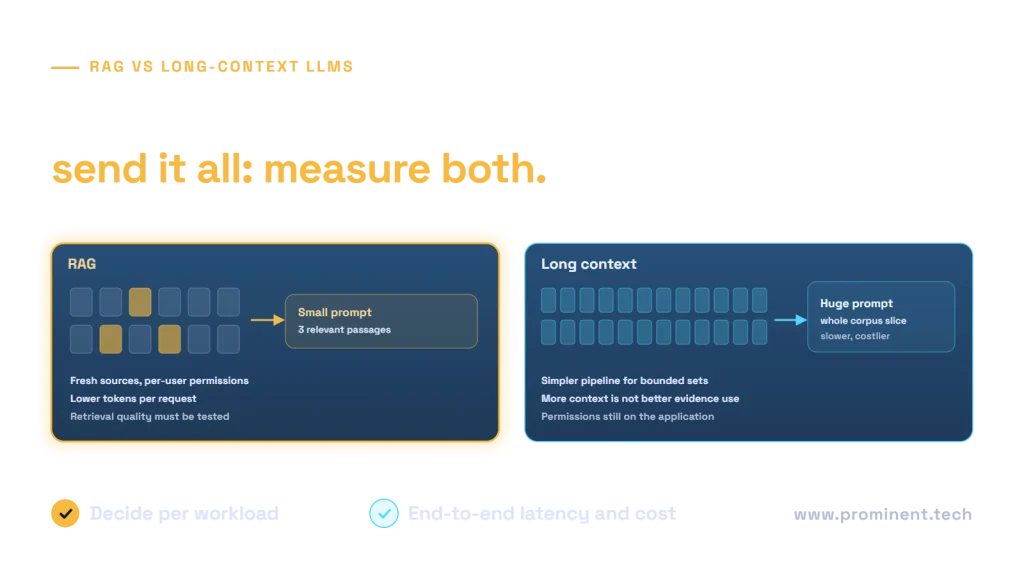
Long-context prompting can simplify analysis of a bounded, permitted document set; RAG is useful when the application must find relevant evidence across a larger or frequently changing corpus. They can also work together: retrieval selects the evidence and a long-context model reasons over the selected material. Choose by measured task quality, access boundaries, latency and total cost rather than context-window size alone.
This guide offers a decision flow, a comparison matrix and fictional use cases. It does not report a head-to-head model benchmark or claim universal performance or cost savings.
RAG vs long context: what changes?
RAG adds a retrieval step that selects source material before generation. Long-context prompting places a larger amount of selected material directly into the model’s input. Both require document preparation, appropriate source selection and an answer that faithfully uses the evidence.
A context window is a capacity limit, not an assurance that every relevant detail will be used correctly. Likewise, a retrieval index is not proof that the required passage will be found. One architecture can fail by missing evidence; the other can fail despite receiving it.
RAG path:
Question → authorized retrieval → selected evidence → model → cited answer

Long-context path:
Question + bounded permitted document set → model → cited answer

Combined path:
Question → authorized retrieval → larger evidence bundle
         → long-context model → validated, cited answer
For a conventional retrieval baseline, see our enterprise RAG architecture guide. Do not compare a tuned long-context setup with an unnecessarily weak vector-only baseline and call the result a verdict on all RAG systems.
A workload-based comparison matrix
| Dimension | Retrieval-centered design | Direct long-context design | Question to test |
|---|---|---|---|
| Evidence selection | Search determines the passages reaching the model | The application or user supplies a bounded set | Can the correct evidence be selected reliably? |
| Corpus size | Can search a corpus larger than one model input | Must fit the permitted input within supported limits | How much material is genuinely needed per task? |
| Changing sources | Needs indexing and update synchronization | Needs fresh document assembly for each relevant task | Which path exposes the correct version? |
| Relationships across documents | May require multiple retrieval steps or broader candidates | Can reason over supplied documents together | Are all required facts present and correctly connected? |
| Cost | Search infrastructure plus selected-context processing | Document assembly plus larger-input processing | What is the measured end-to-end cost? |
| Access control | Enforce eligibility before context construction | Enforce eligibility before loading each document | Can forbidden content enter prompts, caches or citations? |
Accuracy: more context is not the same as better evidence use
A retrieval pipeline can omit a necessary exception, return a stale document or select an irrelevant passage. Improve parsing, metadata, hybrid retrieval and context assembly before increasing model size as the only remedy.
Direct long-context input avoids a particular retrieval miss when the needed material is already included, but introduces other questions. Can the model find the detail among distractors? Does it preserve a condition stated far from the main rule? Can it reconcile conflicting versions without inventing a resolution?
The research paper Lost in the Middle studied how evidence position affected the models and tasks it evaluated. Treat that as a reason to test placement and distractors, not as a fixed performance prediction for every current model. Model generations and task designs differ.
Anthropic’s contextual retrieval work provides another retrieval approach that adds chunk-specific context. Its reported experiments concern that setup; they do not establish a universal winner between retrieval and long input. The practical lesson is to evaluate well-configured candidates against your own workload.
Separate presence from support
Measure whether the required evidence reached the model, whether each answer claim is supported and whether the task was answered correctly. A response can faithfully repeat an obsolete source. A correct-looking answer without evidence may be impossible to audit. Include version, permission and no-answer checks in the rubric.
Latency and cost require end-to-end measurements
RAG introduces retrieval and possibly reranking calls, but can reduce the amount of input sent for generation. A direct long-context path may remove search calls while processing more material. Actual latency depends on the model, input, concurrency, caching, network and serving configuration.
Record time to first useful output and time to complete the task. A fast first token does not establish that a lengthy answer is completed quickly. Include parsing and upload time if users experience them during the task rather than treating them as free background work.
Use comparable accounting
- RAG: ingestion, embeddings, index capacity or usage, retrieval, reranking, selected prompt tokens and output.
- Long context: document preparation, permitted input assembly, larger prompt processing, output and any supported caching.
- Both: monitoring, storage, validation, retries, specialist review and engineering operations.
Use measured token counts and current applicable prices. Repeated requests may benefit from provider-specific prompt caching, but billing and cache eligibility vary. Do not assume the whole request becomes free. Use our RAG cost worksheet and calculator as a starting framework and adapt the components for the direct-context alternative.
Permissions and freshness remain application responsibilities
A larger context window does not authorize the application to load more documents. Resolve the caller’s scope and enforce source eligibility before uploading or assembling the context. Restrict derivative summaries, cached prompts and conversation history as well.
For retrieval, measure the interval between a source or permission change and its effective index update. For direct context, ensure the loaded document set is current and permitted at the relevant point. A copied folder of old files can be just as stale as a neglected search index.
Citations need stable source references in either design. Require the answer to distinguish source-backed facts from interpretation and validate important references. An attractive citation label is not proof that the cited passage supports the claim. See the permission-aware retrieval guide for related cache and revocation tests.
A practical decision flow
- Is the permitted evidence set already known and comfortably bounded? Evaluate direct context as a simple baseline.
- Must the application find evidence across many sources? Evaluate retrieval with trusted scope and source freshness.
- Does the question need many connected passages? Test broader retrieval plus long-context reasoning, or an authoritative structured query where appropriate.
- Does either candidate fail permissions or evidence support? Fix that boundary before choosing on speed or price.
- Do both pass? Compare measured operating cost, latency and maintenance burden.
Example: review a small approved contract bundle
A user supplies a known set of permitted contracts for comparison. Direct context may avoid unnecessary indexing and help cross-document review. Test clauses, exceptions, page citations and conflicting versions. If the bundle exceeds supported or practical limits, selective retrieval or staged analysis may still be needed.
Example: employee knowledge assistant
Questions range across changing policies and technical documents with different access rules. Retrieval is a strong candidate because the application must locate current, permitted evidence. A long-context model can still process a larger selected bundle for difficult questions.
Example: recurring analysis of a stable reference pack
Both approaches deserve evaluation. Consider repeated processing, cache eligibility, update frequency and the actual questions. A stable corpus does not automatically mean that every request should include all of it.
A fair evaluation plan
- Use the same approved source snapshot and caller scopes.
- Label local lookups, cross-document questions, conflicts and no-answer cases.
- Test relevant facts at different positions with realistic distractors.
- Measure evidence presence, support, correctness and citation validity.
- Include document changes, access revocation and repeated queries.
- Record total latency, token use, retrieval calls and manual review.
- Choose the simplest design that meets the agreed acceptance criteria.
Do not collapse every result into one average. A design that excels at document summaries may fail exact exceptions. Keep task slices visible and retain a rollback configuration when changing retrieval or context assembly.
Common questions
Will long-context models replace RAG?
They can reduce the need for retrieval in bounded tasks, but do not eliminate evidence selection across larger, changing or permissioned corpora. Retrieval and long-context reasoning can be combined.
Is long-context prompting cheaper?
Not universally. Compare actual input processing, caching, preparation and output costs with retrieval infrastructure and selected-context generation under the same task requirements.
Does a bigger context window guarantee accuracy?
No. Supported capacity does not guarantee correct use of every detail. Test distractors, exceptions, source conflicts and evidence position on the chosen model.
Can RAG use a long-context model?
Yes. Retrieval can select a permitted evidence bundle, and a long-context model can reason over that bundle. Evaluate whether the larger input improves the target task enough to justify its cost.
Which design handles permissions better?
Neither is secure by label alone. Both must enforce source access before context construction and handle citations, caches, history and permission changes correctly.
Choose by evidence and workload
For related knowledge strategies, see RAG versus fine-tuning and prompt engineering. To compare direct context, retrieval and combined options for your sources, request an enterprise RAG architecture review.