
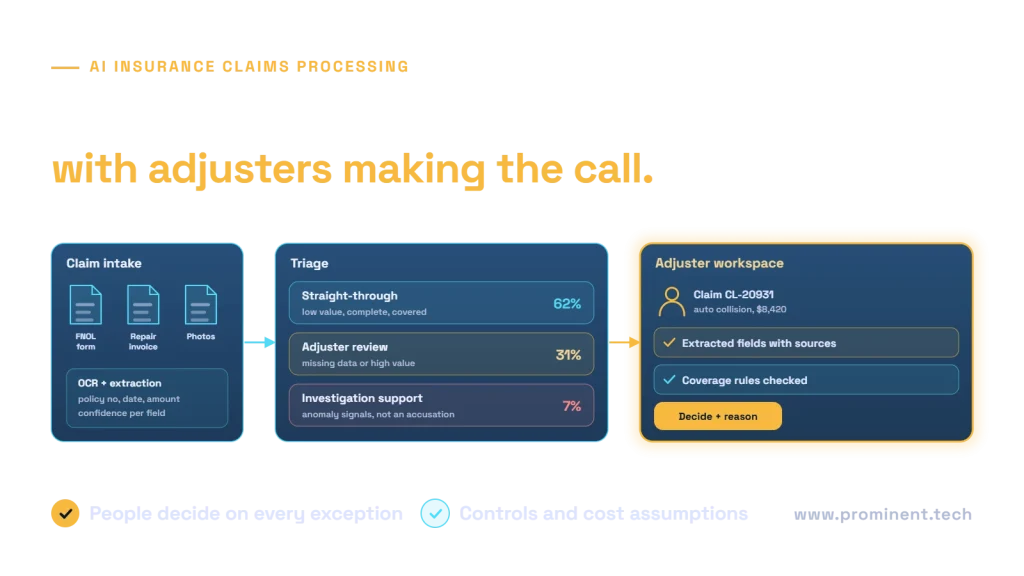
AI insurance claims processing combines document extraction, validation, policy checks and risk-based routing to help claims teams work through evidence. OCR turns documents into text; models can suggest fields or flag unusual patterns; workflow rules coordinate the next action. Neither extraction confidence nor a fraud score proves that a claim is valid or fraudulent. Keep accountable human review for consequential exceptions, coverage decisions and disputed outcomes.
The strongest business case often starts with incomplete evidence and repeated handling rather than replacing adjusters. A claim may arrive through a portal, email, broker or repair network with inconsistent documents and identifiers. The engineering problem is to create a reliable case record, identify what is missing and move it to the correct person without silently losing evidence. This guide separates that workflow from unsupported promises of fully autonomous claims settlement.
Key takeaways
- Separate extraction, coverage rules, fraud triage and payment authorization.
- Use source-linked fields and document versions so reviewers can inspect evidence.
- Design idempotent integrations before increasing processing speed.
- Evaluate fraud models against false-positive workload and confirmed outcomes.
- Include review, integration and ongoing change costs in the business case.
- Treat jurisdiction, product and customer vulnerability as deployment-specific factors.
What changes when claims processing uses AI?
| Capability | Useful role | What it does not establish |
|---|---|---|
| OCR | Recognize text and layout | Correct policy interpretation |
| Document classification | Route invoices, forms and reports | Authenticity or completeness |
| Field extraction | Suggest dates, amounts and identifiers | That the extracted value is true |
| Rules | Apply explicit versioned conditions | Resolution of ambiguous wording |
| Fraud analytics | Prioritize investigation | Proof of fraud |
| Generative AI | Draft evidence-linked summaries | An independently verified claims decision |
| Workflow automation | Track tasks and integration outcomes | Permission to pay or reject claims |
A conventional rules engine remains valuable when requirements are deterministic. A language model may help interpret varied document layouts, but amounts, dates and identifiers still need schema and cross-field checks. Treat document instructions as untrusted input; an attached PDF must not be able to alter payment destinations or bypass a review rule. The system should record why a case was routed and which version of the policy or rule was used.
An end-to-end claims processing architecture

At intake, assign a stable claim identifier and preserve the original evidence with its received time and source. Scan and validate files before extraction. Classify each attachment, distinguish duplicates from legitimate revised submissions and retain version relationships. An extraction result should point to the exact document, page and field location, not only contain a plausible value.
Validate mandatory fields, currency, date ordering and arithmetic. Resolve the policy and insured entity against authoritative systems rather than relying on text similarity alone. Rules then establish the next task. A low-risk, complete submission may enter a tightly scoped approved path; uncertain or consequential cases go to an adjuster. A suspected manipulation or unusual pattern enters an investigation queue, with a neutral reason and access controls.
The integration layer writes only approved changes. Queue messages carry a claim ID, operation ID, schema version and correlation ID. Consumers deduplicate operations and reconcile uncertain outcomes. A network timeout after a payment request must not trigger an unverified duplicate payment. Maintain a reconciliation ledger and a manual exception queue for partial failures.
A reviewable extraction record
{
  "claimId": "SYNTHETIC-001",
  "documentId": "invoice-v1",
  "field": "invoiceTotal",
  "value": 1250.00,
  "currency": "GBP",
  "source": {"page": 1, "region": "total-box"},
  "validation": {"arithmetic": "passed", "policyMatch": "pending"},
  "reviewRequired": true,
  "reason": "Coverage has not been confirmed"
}
This synthetic example deliberately does not convert extraction confidence into an approval. A confidence score is model-specific and requires calibration for the document population. If the source region is unreadable or the invoice includes several currencies, the field remains unresolved. Preserve uncertainty rather than silently filling a required value with a guess.
OCR and intelligent document processing
Document quality controls should detect rotation, cropping, low contrast, unreadable pages and unsupported formats. Evaluate typed invoices separately from handwriting and photographs. Use field-specific normalization: a policy number must retain significant leading zeros, while a date requires an explicit interpretation of locale. Keep the original value alongside normalized data so a reviewer can identify a transformation error.
Measure correctness on a representative, held-out set of actual document types that the organization is permitted to use. Include poor scans and unusual layouts; excluding them can make an evaluation look artificially strong. Track errors that matter to the workflow, such as an incorrect payee or total, separately from harmless formatting differences. Straight-through processing should apply only to an explicitly approved scope with a tested exception path.
For a deeper discussion of extraction boundaries, see intelligent document processing with AI. Claims architecture adds policy, investigation and settlement responsibilities around that extraction component; it should not duplicate the entire document-processing stack simply because another department owns it.
Fraud detection is investigation support, not an accusation
Useful signals can include duplicate invoices, inconsistent dates, unusual provider relationships and deviations from expected claim patterns. Supervised models require reliable confirmed labels; anomaly detection can highlight unusual behavior without knowing whether it is fraudulent. Historical investigation labels are selective: cases that were never reviewed may not be reliable negatives. Account for this when interpreting measured precision or recall.
| Signal | Possible benign explanation | Appropriate next step |
|---|---|---|
| Repeated invoice | Resubmission after a failed upload | Resolve document version and prior processing |
| Unusual amount | Specialist repair or exceptional circumstances | Compare evidence and request appropriate clarification |
| Shared contact details | Family, employer or authorized intermediary | Check relationships lawfully |
| New provider pattern | New business or changing geography | Review context and permitted external evidence |
| Image inconsistency | Compression or legitimate editing | Specialist evidence review |
Use precision-recall analysis for imbalanced outcomes and report the investigation workload created at each threshold. A model can identify more confirmed fraud while creating an unacceptable number of false alerts. Evaluate calibration, subgroup effects, drift and appeal outcomes. Investigators need interpretable evidence and a way to reject the signal. Never present a statistical association as proof or automate adverse action solely because a score is high.

Risk-based routing and human approval
| Route | Illustrative condition | Control |
|---|---|---|
| Standard handling | Complete evidence within a formally approved scope | Versioned rules, reconciliation and sampling |
| Adjuster review | Ambiguous coverage or inconsistent fields | Source evidence and recorded rationale |
| Specialist assessment | Complex damage, medical or legal issues | Qualified specialist and controlled access |
| Investigation | Documented risk signal requiring inquiry | Neutral triage, evidence review and due process |
| Customer clarification | Missing or unreadable evidence | Clear request and accessible support |
Thresholds must be calibrated for the insurer’s products and capacity. No universal confidence percentage or monetary amount safely defines an automated claim. Review can happen before a decision, during an investigation or through quality assurance; those are different controls. Post-payment sampling is not an adequate replacement for required pre-decision review. Keep escalation, complaint and reconsideration channels visible to customers.

Practical applications across six insurance lines
| Line | Evidence and task | Required review emphasis |
|---|---|---|
| Motor | Repair estimates, photographs and invoices; completeness and duplicate checks | Damage context, coverage and repair approval |
| Property | Reports, inventory and repair documentation; event and item reconciliation | Causation, exclusions and specialist assessment |
| Health | Bills, coding and supporting records; submission validation | Medical necessity and sensitive-data restrictions |
| Life | Beneficiary and supporting documentation; case completeness | Legal entitlement and compassionate handling |
| Travel | Receipts, itinerary and cancellation evidence; date reconciliation | Policy wording, circumstances and currency |
| Workers’ compensation | Incident and medical records; case coordination | Applicable law, clinical input and employer context |
The same extraction engine may support several products, but policy rules and review authorities should remain explicit. A health claim needs different access restrictions from a vehicle repair invoice. Workers’ compensation handling varies by jurisdiction. Reusing a component does not justify applying one product’s settlement rules to another product.
Platform choices: Azure, AWS or a custom integration
| Approach | Illustrative components | Design questions |
|---|---|---|
| Azure | Document Intelligence; Functions; Service Bus; SQL; selected Foundry models | Which regions, model versions and identity paths are approved? |
| AWS | Textract; Lambda; SQS; S3; selected Bedrock or SageMaker AI services | How are document permissions, retries and model access controlled? |
| Custom application | Python or .NET services; relational store; queues; existing workflow engine | Who operates model evaluation, scaling and incident response? |
These are candidate patterns, not equivalent feature bundles. Choose services after validating extraction quality, integration contracts and security requirements. A managed OCR service can reduce model operations work but still needs document-specific testing. A custom classifier may be justified for a specialized form; it does not remove the need for a monitored runtime. Connect to the insurer’s system of record through supported APIs, with an explicit schema and data ownership agreement.
A documented example—and its limits
Microsoft’s Direct Pojišťovna customer story, published 10 July 2026 reports reducing a described document-processing step from 15 minutes to about two minutes, an approximately 87% reduction. The story also reports automation of 60% of windshield claims with human involvement in the process. These are attributed customer-story figures for that implementation, not independently reproduced benchmarks, Prominent results or an expectation for another insurer.
When using such evidence in a business case, ask what the measurement includes: document handling, full claim cycle time or adjuster effort. Check product scope, exception handling, observation window and baseline. A large improvement in one task may have a much smaller effect on end-to-end settlement if other stages remain unchanged.
Governance and 14 implementation risks
The NAIC artificial intelligence topic resources discuss insurance AI governance in the US regulatory context; the NAIC is not itself a single nationwide lawmaker. Applicability depends on jurisdiction and adoption. The NIST AI Risk Management Framework is a voluntary risk-management resource, not a certification. Obtain specialist review of privacy, discrimination, consumer protection and insurance obligations for the actual deployment.
| Risk | Mitigation |
|---|---|
| Incorrect extraction | Source-linked validation and exception review |
| Policy mismatch | Authoritative policy lookup and effective-date checks |
| Duplicate payment | Operation ledger and reconciliation |
| Fraud false positives | Calibrated triage and meaningful investigation |
| Biased historical labels | Document limitations and evaluate affected groups |
| Sensitive-data exposure | Purpose-limited access and retention |
| Prompt injection | Untrusted input boundaries and restricted tools |
| Unclear decision ownership | Named adjuster and approval authority |
| Automation bias | Reviewer training and reject/escalate paths |
| Model drift | Monitor input and outcome changes |
| Rule changes | Versioned rules with regression tests |
| Vendor failure | Fallback queues and recovery drills |
| Opaque adverse outcomes | Reasoned decisions and challenge routes |
| Uncontrolled logs | Redaction, access controls and retention limits |
Implementation roadmap: seven gates
- Scope one claim type and a defined decision boundary; appoint a claims owner.
- Audit permitted documents, integration interfaces and current handling costs.
- Create an independently reviewed evaluation set including exceptions.
- Prototype extraction and validation without uncontrolled settlement actions.
- Integrate queues, identity, audit and reconciliation in a test environment.
- Pilot with supervised cases and predefined stop criteria.
- Release the approved scope; monitor outcomes and approve future changes.
At every gate, record what would make the project stop or narrow its scope. A successful OCR proof of concept does not establish that the coverage rules, fraud model or payment integration are ready. Review the complete case journey, including customer corrections and downstream reconciliation, before increasing volume.
Cost, ROI and the metrics that matter
Estimate monthly cost as documents × pages × extraction rate, plus model usage, workflow executions, storage, integration, support and human review. Obtain current regional vendor quotes rather than treating a token price as the whole project cost. Include implementation, data preparation and validation separately. Rework and exception rates usually deserve sensitivity analysis because they can change the review budget substantially.
Hypothetical arithmetic: 10,000 cases per month with six genuinely avoidable minutes per case create 1,000 hours of potential capacity. At an assumed 30 currency units per usable hour, that is 30,000 units. If recurring cost is 18,000, the monthly contribution is 12,000 before implementation and other effects. With 72,000 implementation cost, simple payback is six months under those assumptions. Do not add the same hours again as a second “productivity benefit,” and do not count hypothetical prevented fraud as realized savings.
| Metric | Definition or caution |
|---|---|
| Field accuracy | Verified correct values divided by evaluated fields |
| Critical field errors | Incorrect amounts, identities or destinations tracked separately |
| Document exception rate | Documents needing review divided by received documents |
| Claim rework | Cases returned for correction or missing evidence |
| Cycle time | Elapsed time over a defined start and end point |
| Handling time | Actual staff effort, separate from elapsed time |
| Straight-through rate | Eligible cases completed without intervention; define denominator |
| Fraud precision | Confirmed relevant outcomes among flagged cases |
| Fraud recall | Detected positives among known positives; acknowledge incomplete labels |
| False alerts | Investigation workload not confirmed as the target outcome |
| Customer complaints | Disputed outcomes and service failures |
| Integration reconciliation | Unresolved or duplicate operations |
| Cost per completed case | Full recurring cost divided by completed cases |
Frequently asked questions
Can AI fully automate insurance claims?
Some bounded tasks or approved claim paths can be automated, but not every claim is suitable. Coverage ambiguity, complex damage, disputed evidence and consequential adverse decisions require appropriate authority and review. Define exactly which actions are permitted and test exceptions before considering broader automation.
What is the difference between OCR and AI claims processing?
OCR recognizes text. A claims workflow also needs classification, extraction, identity matching, policy checks, review, system updates and reconciliation. Improving OCR alone does not establish that a claim is covered or that a payment is authorized.
Does a high fraud score prove fraud?
No. It is a prioritization signal whose meaning depends on the model and evaluation data. Investigators must examine evidence and legitimate explanations. False positives, selective labels and subgroup effects matter, especially where a flag can delay or influence a customer’s claim.
How much training data is required?
There is no universal minimum. A managed extractor, specialized classifier and fraud model have different needs. Start by evaluating permitted representative data, document variation, label quality and rare exceptions. A larger dataset with unreliable outcomes can be less useful than a smaller well-reviewed one.
Can generative AI make coverage decisions?
It can assist with evidence summaries or locating relevant wording, but generated interpretation is not authoritative. Use versioned policy sources, deterministic checks where appropriate and the organization’s approved decision authority. Consequential decisions need traceable reasoning and a route to review or challenge.
How should an insurer measure extraction quality?
Use a held-out representative sample and compare field values with verified evidence. Report critical fields separately and include unreadable documents and exceptions. Track the review effort required to correct errors; raw model confidence is not a replacement for measured correctness.
Is cloud deployment automatically compliant?
No. Contracts, geography, access, retention, security configuration and business processes all affect obligations. Insurance and privacy requirements differ by jurisdiction and product. A managed service can support controls, but it cannot make the whole application compliant by itself.
How can duplicate payments be prevented?
Use stable operation identifiers, an integration ledger and explicit reconciliation. Check uncertain outcomes before retrying a payment action. A queue’s delivery behavior alone does not guarantee exactly-once business effects across the claims platform, payment provider and accounting systems.
Should the business case count time savings as cash savings?
Only where the saved time changes expenditure or produces usable capacity with a defensible value. Record assumptions and distinguish financial savings from service improvements. Do not count the same hours twice or present an illustrative productivity calculation as a measured outcome.
Which claim type is best for a pilot?
Choose a bounded product and document set with an accountable owner, reliable baseline and manageable exceptions. A narrow pilot can test evidence handling and integrations. The most suitable starting point depends on the insurer’s actual workflow, not a universal claim category.
Can existing claims systems be retained?
Usually the integration should preserve the system of record and use supported APIs or controlled interfaces. Verify identifiers, authorization, update semantics and failure recovery. Replacing the core platform is a separate architectural decision, not a prerequisite for testing a bounded AI component.
How should models be monitored after release?
Monitor document mix, critical errors, review workload, delayed cases and verified outcomes. Detect changes in input distributions and rules, and evaluate new versions before deployment. Provide a fallback process and retain enough provenance to investigate customer complaints and integration incidents.
Technical references
- Direct Pojišťovna customer story, published 10 July 2026
- NAIC artificial intelligence topic resources
- NIST AI Risk Management Framework
Technical source review: 1 November 2026. Illustrative architectures, assumptions and examples are not client implementations or measured production results. Deployment-specific verification is required.