
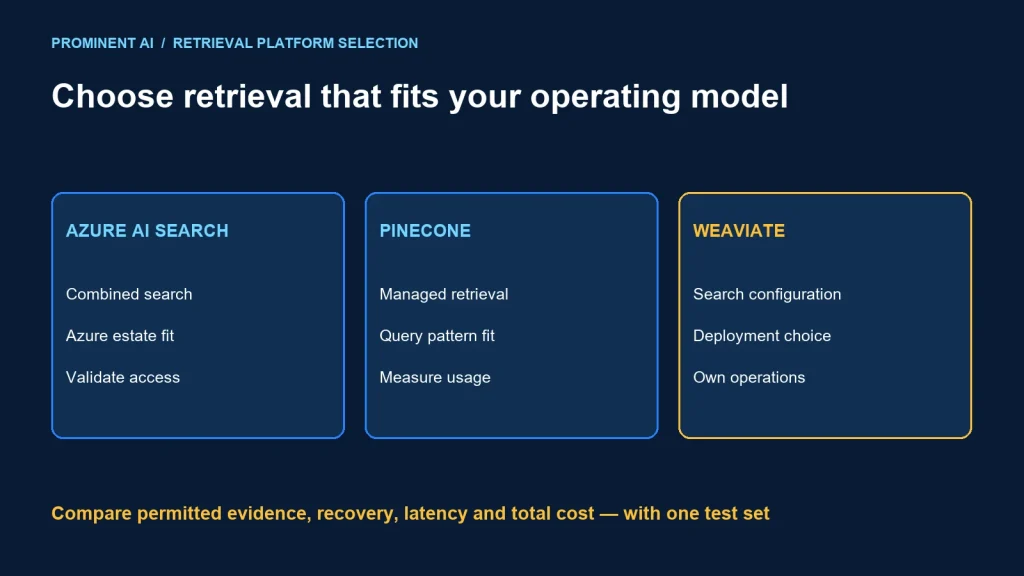
Choose Azure AI Search, Pinecone or Weaviate by testing your permitted enterprise queries and operating model, not by comparing vector similarity alone. Azure AI Search is a natural candidate for an Azure-centered search estate. Pinecone is worth evaluating when a managed retrieval service fits your application architecture. Weaviate deserves consideration when its collection model and hosted or self-managed deployment options match your requirements. These are starting hypotheses, not benchmark results.
The right choice must retrieve useful evidence, respect access boundaries, meet latency expectations and remain affordable to operate. This comparison provides a feature matrix, a cost worksheet and a repeatable selection process. No vendor performance test or quoted price is implied.
Azure AI Search vs Pinecone vs Weaviate: comparison matrix
A feature name is not an acceptance test. Confirm the current API, deployment, service tier and region for every capability that matters to your project. In particular, managed service identity does not automatically reproduce the source document’s permissions.
| Decision area | Azure AI Search | Pinecone | Weaviate | What to validate |
|---|---|---|---|---|
| Hybrid retrieval | Parallel full-text and vector queries merged with RRF | Keyword and dense retrieval combinations depend on API and selected pattern | Vector and BM25F results with configurable fusion and weighting | Exact IDs, paraphrases and multi-passage questions |
| Deployment decision | Azure-managed search service | Managed retrieval service; confirm the relevant deployment offering | Hosted Cloud or self-managed deployment | Approved location, network route and operating ownership |
| Application integration | Consider fit with the existing Azure search and identity estate | Consider fit with a service-based retrieval layer | Consider collection configuration and deployment control | Ingestion, updates, filters and application adapter effort |
| Access design | Separate service permissions from document authorization | Separate service access, tenant scope and record eligibility | Separate deployment access, tenant boundaries and object eligibility | Forbidden evidence never reaches model context |
| Operational responsibility | Manage schema, capacity, ingestion and application policy | Manage data layout, usage, ingestion and application policy | Hosted responsibility differs from self-managed infrastructure ownership | Restore, deletion, migration and incident procedures |
| Cost comparison | Model selected capacity and optional processing charges | Model the documented usage and deployment billing dimensions | Model hosted charges or full self-managed infrastructure and labor | Equivalent workload, resilience and support scope |
Microsoft documents Azure hybrid search as one request combining full-text and vector retrieval through reciprocal rank fusion. Pinecone documents multiple hybrid patterns, including filtering and rank fusion. Weaviate documents BM25F and vector fusion with configurable weighting. Those differences should shape the evaluation configuration rather than be reduced to three identical check marks.
Compare retrieval behavior before comparing scores
Enterprise questions mix exact strings and meaning. A product identifier needs precise matching; a paraphrased policy question may benefit from semantic retrieval. Some questions require several passages, including an exception that appears far from the main rule.
Build one labeled query set and preserve the same source snapshot across candidates. Hold parsing and chunking constant for the first comparison. Then permit documented, vendor-specific tuning in a second phase with a separate held-out set. Otherwise one platform may win because it received cleaner source material or more tuning time.
Do not compare raw similarity scores across engines. Their scoring, fusion and ranking stages differ. Compare whether the required permitted evidence appears at the agreed candidate depth, whether answers preserve qualifications, and whether the application meets its latency budget. Reranking is a separate configuration and cost decision.
Three query types that expose practical differences
- Exact lookup: an error code, contract reference or product SKU.
- Semantic question: a paraphrase that does not reuse the document’s terminology.
- Conditional answer: a rule plus an exception, date or approval requirement.
Include no-answer and conflicting-source cases. A confident response assembled from the wrong document version is not a retrieval success. See the RAG evaluation scorecard for separating recall, answer support and task correctness.
Security: service access is not document access
Authentication to a search endpoint proves which application may call it. It does not, by itself, establish which indexed documents the current employee or customer may read. Carry trusted caller and tenant context into a server-controlled retrieval policy.
For each candidate, test permission revocation, group changes, cross-tenant requests and cache reuse. Verify that an unauthorized result is excluded before context construction. Treat a client-supplied tenant ID or filter as untrusted unless the backend validates it against authenticated identity.
Microsoft distinguishes built-in service protections from controls the customer must configure. Apply that shared-responsibility thinking to every platform. Confirm networking, credential handling, administrative access and audit evidence against the exact deployment under review.
Ask where embeddings, source text, query logs and backups reside. Restrict sensitive payloads in telemetry. Neither a vector representation nor a hosted database is a reason to relax the source data’s handling rules. Validate contractual and organizational requirements with the appropriate owners rather than inferring compliance from a product label.
Operations and scale: test the workload you will actually run
Record document count, chunk count, vector dimensions, metadata size, update rate and query concurrency. A corpus with frequent deletions behaves differently from a static demonstration. Include indexing and permissions refresh while serving queries.
Weaviate supports hosted and self-managed deployments. The latter offers infrastructure control but also creates responsibility for capacity, patching, backups and recovery. A lower infrastructure invoice is not necessarily a lower operating cost.
For any managed option, establish who owns ingestion failures, schema changes, capacity alerts and application incidents. Test throttling and retry behavior without multiplying duplicate ingestion or queries. Measure end-to-end latency, including embedding and reranking, instead of reporting only database execution time.
Keep an exit path
Retain source records, stable document identifiers and a versioned ingestion configuration. Document embedding model and dimensionality. Export requirements should include metadata and permissions, not just vectors. Changing embedding models can require re-embedding; changing engines can require schema and query adapter work. An application retrieval interface helps contain that change, but does not make migration free.
A transparent total-cost worksheet
Use current quotations or official calculators for the selected region, plan and deployment. This worksheet deliberately uses variables rather than prices that may become outdated. Pinecone’s cost documentation is a starting point for identifying its applicable billing dimensions; record the relevant configuration beside any estimate.
| Input | Record for each candidate | Common omission |
|---|---|---|
| Corpus and storage | Source size, chunks, dimensions, metadata and replicas | Storing text and metadata as well as vectors |
| Query workload | Monthly requests, peak concurrency, candidate depth and filters | Retries, evaluation traffic and tenant skew |
| Updates | New, changed and deleted records per period | Re-indexing and permission refresh |
| Model processing | Embedding, reranking and generation usage | Re-embedding after model changes |
| Service and infrastructure | Capacity or usage charges, network, backups and support | Development and recovery environments |
| Engineering ownership | Setup, operations, security review and migration hours | Self-managed on-call effort |
Monthly operating estimate = retrieval service or infrastructure
                          + ingestion and embedding
                          + reranking and generation
                          + network, backup and monitoring
                          + allocated engineering operations

First-year estimate = 12 × monthly operating estimate
                    + implementation + migration + evaluation
The formula is an accounting framework, not a vendor quote. Avoid double-counting included features. Run low, expected and peak scenarios and identify which inputs are measured versus assumed. Compare candidates that satisfy the same quality, security and availability requirements.
A selection process your architecture team can review
- Define hard constraints: data location, access boundaries, recovery expectations and approved integration routes.
- Freeze a baseline: source snapshot, parser, chunks, embedding and labeled queries.
- Build thin adapters: ingestion, authorized retrieval, deletion and telemetry.
- Evaluate quality: recall, unsupported claims, relevance and boundary failures by query slice.
- Run operational tests: concurrent updates, throttling, outage handling and restoration.
- Estimate full cost: use measured usage where available and label assumptions.
- Record the decision: selected configuration, rejected alternatives, remaining risks and a review trigger.
Use mandatory gates before weighted scoring. A candidate that exposes forbidden content should not compensate through a high latency score. After passing the gates, weight quality, operations, integration and cost according to the application owner’s priorities. Keep the weights visible.
When each candidate belongs on the shortlist
Shortlist Azure AI Search when the existing Azure estate and combined search requirements make integration fit valuable. Shortlist Pinecone when a managed retrieval service and its supported query patterns fit the application. Shortlist Weaviate when its search configuration and deployment choices match the team’s control and ownership needs. Validate all three against evidence rather than choosing by ecosystem familiarity alone.
Common questions
Is Azure AI Search a vector database?
It supports vector search alongside full-text search in a managed search service. For an enterprise RAG decision, evaluate its complete retrieval and integration behavior rather than relying only on the database label.
Is Pinecone better than Weaviate for enterprise RAG?
There is no universal winner. Compare permitted retrieval quality, deployment requirements, operational ownership and total cost using the same source snapshot and held-out queries.
Do all three support hybrid search?
All document approaches that combine keyword and vector signals, but their APIs and fusion options differ. Confirm the supported pattern for the exact version and deployment you plan to use.
Which option is cheapest?
That depends on capacity, query traffic, update rates, model processing and engineering effort. Compare current quotes under equivalent workload and resilience assumptions; do not treat self-managed software as cost-free.
Will a vector database enforce all document permissions automatically?
Do not assume so. Design trusted identity propagation and document eligibility checks, then test revocation, tenant isolation and cache behavior before any retrieved text enters model context.
Turn the comparison into a retrieval architecture decision
For the surrounding application, read our enterprise RAG architecture guide and RAG, fine-tuning and prompt engineering comparison. To review your corpus, permissions and platform shortlist, request an enterprise RAG architecture review.