
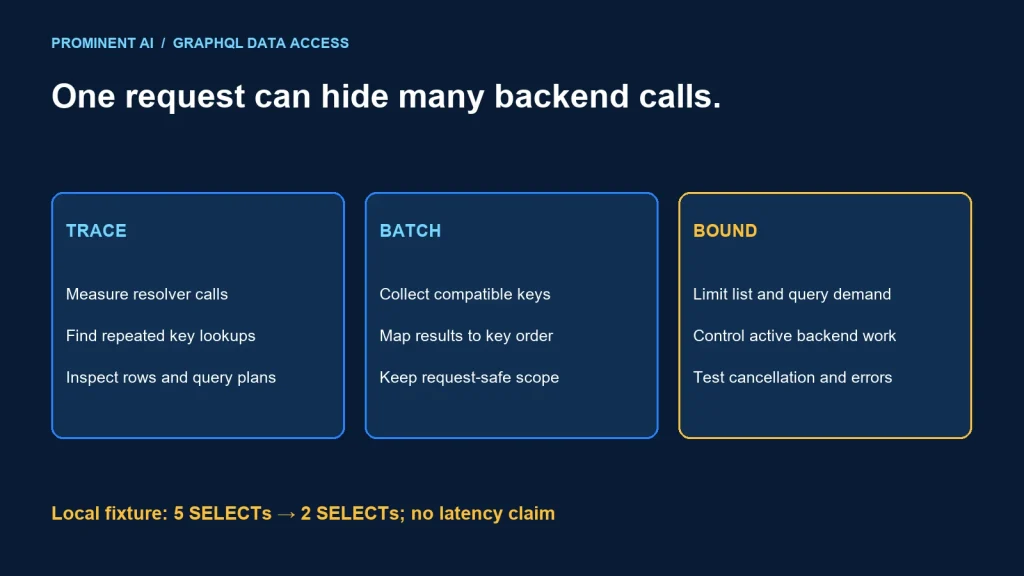
The GraphQL N+1 problem occurs when resolving a list causes an additional backend request for each item. Fix the data-access plan with batching, appropriate request-scoped loading and bounded query demand. One GraphQL HTTP request does not imply one database query.
Key takeaways
- Profile backend calls made by a complete operation.
- Batch compatible lookups and map results back to the requested key order.
- Keep loading state scoped to the authorized request context.
- Batching reduces repeated calls; it does not bound an arbitrarily large query.
How nested resolvers multiply backend requests
Imagine a fictional books query that returns a book ID and author name. A root resolver loads four books; each author resolver independently looks up its author. That is one list query plus four author queries, even when two books have the same author.
query {
  books {
    id
    author { name }
  }
}

Naive access: books → author 2 → author 1 → author 2 → missing author 99
Batched access: books → authors with keys [2, 1, 99] → map to each book
The GraphQL operation above is illustrative. Whether your actual server batches those lookups depends on resolver code, data sources and execution behavior. Inspect the backend trace before choosing a fix.
A join or projection can be a better solution when one datastore can efficiently return the required shape. Batching is especially useful when independent resolvers share key-based access, or related data comes from another service. Do not add a loader around an already efficient projection without measuring the tradeoff.
Run a local query-count demonstration
The following Python program uses standard-library SQLite. It models resolver-shaped access and records SQL SELECT statements. It is not a GraphQL server and does not implement the DataLoader library. This isolates the repeated-query mechanism so the result is easy to reproduce without network services or additional packages.
"""Resolver-shaped SQL profiling demo, not a GraphQL server or DataLoader library."""
import sqlite3
db=sqlite3.connect(':memory:')
db.executescript('''CREATE TABLE books(id INTEGER PRIMARY KEY, author_id INTEGER);
 CREATE TABLE authors(id INTEGER PRIMARY KEY, name TEXT);
 INSERT INTO books VALUES(1,2),(2,1),(3,2),(4,99);
 INSERT INTO authors VALUES(1,'Ada'),(2,'Grace');''')
trace=[]
db.set_trace_callback(lambda sql: trace.append(sql) if sql.lstrip().upper().startswith('SELECT') else None)
books=db.execute('SELECT id,author_id FROM books ORDER BY id').fetchall()
naive=[db.execute('SELECT name FROM authors WHERE id=?',(author,)).fetchone() for _,author in books]
naive_count=len(trace); naive_trace=trace.copy(); trace.clear()
books2=db.execute('SELECT id,author_id FROM books ORDER BY id').fetchall()
keys=list(dict.fromkeys(author for _,author in books2))
placeholders=','.join('?' for _ in keys)
rows=db.execute(f'SELECT id,name FROM authors WHERE id IN ({placeholders})',keys).fetchall() if keys else []
by_id={i:(name,) for i,name in rows}
batched=[by_id.get(author) for _,author in books2]
assert naive==batched
assert naive_count==5
assert len(trace)==2
assert batched[0]==batched[2]==('Grace',)
assert batched[-1] is None
assert [by_id.get(k) for k in [2,99,1]]==[('Grace',),None,('Ada',)]
print('Naive SELECT count:',naive_count)
print('Batched SELECT count:',len(trace))
print('Naive trace:',*naive_trace,sep='\n')
print('Batched trace:',*trace,sep='\n')
print('6 checks passed; fixture statement counts only, not a latency benchmark.')
Measured local result: the fixture executed five SELECT statements in the naive path and two in the batched path. Six checks passed: equivalent output, the two counts, repeated-author mapping, missing-author behavior and requested-key order.
Naive trace:
SELECT id,author_id FROM books ORDER BY id
SELECT name FROM authors WHERE id=2
SELECT name FROM authors WHERE id=1
SELECT name FROM authors WHERE id=2
SELECT name FROM authors WHERE id=99

Batched trace:
SELECT id,author_id FROM books ORDER BY id
SELECT id,name FROM authors WHERE id IN (2,1,99)
Run the file with Python to reproduce the checks. These are statement counts for a tiny local fixture, not latency measurements or a claim of production speedup. The program deliberately collects all keys before querying; a real asynchronous loader schedules compatible loads during request execution.
The SQL IN result is not assumed to arrive in request order. Mapping by ID and rebuilding the output preserves positions and missing values. Keep that property when adapting the example to a backend that returns results in a different order.
What DataLoader does—and what you still own
The official DataLoader documentation describes batching and memoization, with batch results aligned to input keys. Request-local caching is not a replacement for a shared application cache. Create loaders with the appropriate request and authorization scope.
In a real resolver integration, construct the loaders in the operation context and pass them to resolvers. Each resolver requests its key; the batch function calls the backend for compatible keys and returns one result or error position for each requested key. Follow the library’s scheduling and error contract.
Do not create one global loader holding user-visible records across unrelated requests. If the same ID can refer to different tenants or permission contexts, the key and scope must preserve that distinction. Authorization belongs in the backend access path, not merely in a top-level field.
After a mutation, decide whether a request-local cached value is still valid. Clear or refresh it through the loader’s supported API where needed. Otherwise later fields in the same operation may observe an outdated value.
Batch only operations with compatible semantics. Different filters, tenant scopes, projections or consistency requirements may need distinct loaders or composite keys. A broad batch that fetches unauthorized records and filters them later may violate the intended data-access boundary.
Set practical batch limits based on database parameter limits, payload sizes and downstream capacity. Splitting a very large key set into controlled chunks may produce more than two backend calls, which can be correct. The goal is supportable access, not a universal promise of one batch.
Avoid accidentally serializing independent loads. Awaiting each lookup inside a sequential loop can prevent useful coalescing. Validate the actual execution trace for your library and framework rather than assuming every use of a method named load produces a batch.
Batching does not solve query demand
GraphQL’s security guidance discusses controls such as pagination, depth, breadth, complexity and request limits. Use a combination suited to the schema. A shallow operation can still request a huge list, and many aliases can multiply work without deep nesting.
For a fictional customer dashboard, define page-size bounds for orders and order lines, a budget for expensive fields, and an overall execution deadline. Reject a request that exceeds the supported contract before it exhausts backend capacity.
Make cost estimation reflect list cardinality and expensive resolvers. Counting fields alone may rate a thousand-row export like a single lookup. Conversely, an overly conservative model can reject normal dashboards. Calibrate against observed workloads and document exceptions.
Do not trust a client-supplied page size just because the field is paginated. Validate its maximum and apply defaults deliberately. Include nested lists in the demand model, not only the root collection.
Use cancellation and bounded downstream concurrency. A timed-out request should not leave unlimited background queries running. Ensure logs can correlate the GraphQL operation with backend calls without storing sensitive query variables.
Trusted operations can help when a controlled client set is appropriate, but they still need access checks and resource budgets. A previously approved operation can become expensive as data volume grows.
Test cases before production
- Compare batched and naive results for repeated and missing keys.
- Return backend rows in a deliberately different order.
- Verify cross-tenant IDs cannot share an unauthorized result.
- Exercise partial backend errors and the resolver error contract.
- Test cache freshness after a mutation in the same operation.
- Inspect batch sizes and call counts for realistic nested queries.
- Reject excessive page sizes, alias breadth and costly operations.
- Cancel a slow request and verify downstream work stops appropriately.
The local example covers only the first mapping and count properties. The remaining cases require your real GraphQL runtime, authorization model and backend. Do not present the six fixture checks as evidence that a production GraphQL service is secure or load-tested.
Record query count, batch size, database time, rows read and total operation duration. A lower query count can still be slower if the batch query lacks indexes or retrieves far more data. Inspect query plans with representative parameter counts.
GraphQL performance troubleshooting
| Symptom | Investigate | Potential correction |
|---|---|---|
| One backend request per item | Resolver access and batch scheduling | Batch compatible keys or use a projection |
| Wrong author attached to an item | Batch output alignment | Map by key and preserve missing positions |
| Data leaks between tenants | Loader lifetime and authorization scope | Use request-safe context and enforce tenant access |
| Few queries but slow response | Rows read, indexes and oversized batches | Tune the data plan and bound demand |
| Batch count grows unexpectedly | Sequential awaits, distinct keys and execution phases | Trace the real scheduling path |
See the API architecture comparison for interface selection and the rate-limiting guide for capacity controls.
Common questions
How do you solve the GraphQL N+1 problem?
Profile backend access, batch compatible lookups or use an efficient projection, and verify output mapping and authorization. Add demand controls separately.
Does one GraphQL request mean one database query?
No. Nested resolvers can issue many backend calls. Measure the complete operation’s data-access trace.
Can DataLoader be a global cache?
Use it with the appropriate request and authorization scope. It is not a substitute for a deliberately designed shared cache.
Does batching always reduce the operation to two queries?
No. That result belongs to this tiny fixture. Real schemas, sources, execution phases and batch limits determine the count.
Is a depth limit enough to protect a GraphQL API?
No. Consider list sizes, breadth, expensive fields, total cost, concurrency and execution deadlines as well.
Make GraphQL access efficient and bounded
Bring the schema, resolver traces and expensive operations. Request an API integration architecture review to define loading, authorization and query budgets.