
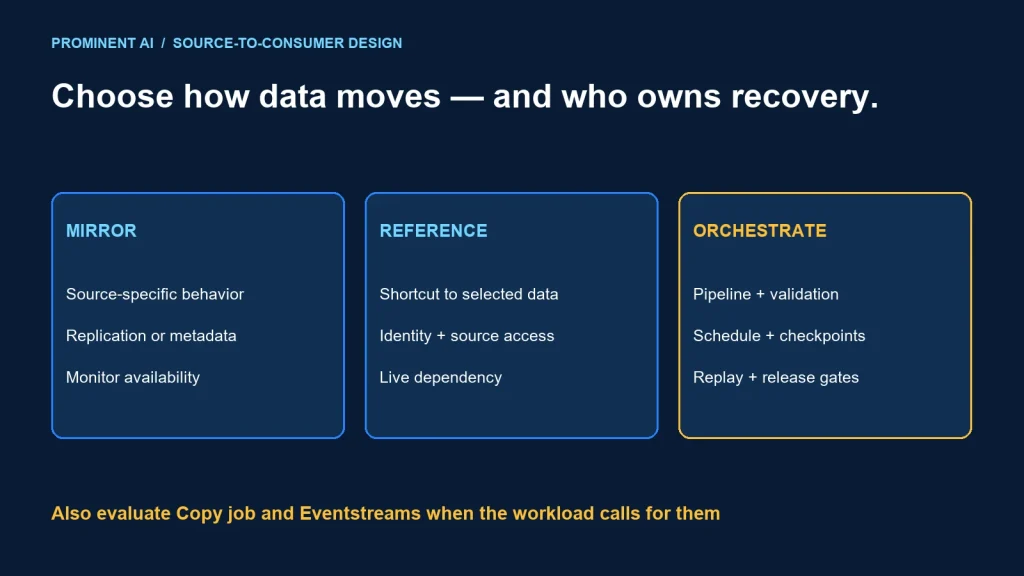
Use mirroring for a supported database or catalog integration, pipelines when you need explicit orchestration and processing control, and shortcuts when selected data should remain at its source. First identify whether your chosen mirroring source replicates data or exposes metadata and references. The word “mirroring” alone does not determine physical data movement.
Key takeaways
- Choose by source support, freshness contract and operating responsibility.
- Do not confuse replicated database mirroring with metadata mirroring.
- Include Copy job and Eventstreams when the workload needs a simpler copy or streaming path.
- Test recovery and downstream freshness, not only successful initial access.
Understand the patterns before selecting a tool
Microsoft’s mirroring overview describes database replication, metadata mirroring and open mirroring approaches. Database replication makes supported source data available in OneLake; metadata mirroring references source data through shortcuts. Open mirroring supports an integration path in which a producer supplies change data. Check the source-specific implementation before assigning ownership or estimating latency.
Shortcuts add references to selected data. They can complement a mirror rather than compete with it: a producer can make a dataset available once, while consumers reference it through governed paths. The OneLake unification guide describes that relationship. A producer’s failure can therefore affect multiple dependent references.
Pipelines are an orchestration choice. They can coordinate movement, transformation, validation and dependencies. Microsoft’s data movement decision guide also identifies Copy job for supported bulk, incremental and CDC-style movement, and Eventstreams for streaming workloads. Avoid building a complex pipeline when a simpler supported pattern meets the contract.
Two architecture patterns and their ownership boundaries
Architecture A: replicated source with shared analytical consumption
Operational database
  → supported replication / mirroring path
  → OneLake analytical data
  → owned validation and curation
  → governed semantic model or SQL consumption

Producer owns source changes and availability.
Platform owner monitors replication and recovery.
Data owner accepts freshness and correctness.The important boundary is the point at which the analytical copy is considered usable. A running replication process is not proof that a downstream report contains the latest complete business result. Monitor lag, source changes and the curation stage separately.
Architecture B: reference or orchestrate according to the data contract
Producer-owned supported data
  ├─ reference path: shortcut → authorized consumer
  │                  source remains a live dependency
  └─ controlled path: pipeline → validate → publish dataset
                     explicit schedule and replay ownership

Select the boundary from freshness, transformation,
source compatibility and recovery requirements.Neither diagram promises a particular latency or service level. Record source support, identity and failure handling for the actual deployment. Use the diagrams to identify who owns each boundary, not as a substitute for implementation validation.
Mirroring vs pipelines vs shortcuts: selection matrix
| Requirement | Candidate | Check before adoption |
|---|---|---|
| Supported database replication for analytics | Mirroring | Connector prerequisites, data types, schema changes and recovery |
| External catalog with supported in-place data | Metadata mirroring | What metadata is synchronized and how actual reads reach the source |
| Selected table, folder or file remains producer-owned | Shortcut | Format, identity, cache behavior and source availability |
| Multi-step orchestration with validation and dependencies | Pipeline | State, retries, transformations and schedule ownership |
| Straightforward supported copy without complex orchestration | Copy job | Available load mode, destination and incremental behavior |
| Event-driven stream processing | Eventstreams | Source, ordering, delivery and downstream requirements |
Start with the simplest candidate that satisfies the contract, then test its difficult cases. If two patterns are combined, state the reason. Mirroring plus shortcuts may separate producer and consumer ownership; a pipeline after replication may provide required business validation. Adding all tools by default usually creates avoidable operating work.
Workload comparisons
Operational database feeding analytics
A supported database source needs continuously updated analytical access. Assess mirroring prerequisites and source impact first. Test initial availability, ongoing changes, schema evolution and interruption recovery. Accept the design only when downstream freshness and correctness meet the business requirement.
Do not assume a replica is a transactionally synchronized copy of every related business process at every instant. Define how consumers handle incomplete or delayed updates and test the actual connector behavior.
Shared curated dataset across departments
A producer already publishes an approved dataset and consumers should avoid maintaining copies. A shortcut may be a suitable reference path. Record its effective identity and consumer permissions, and agree on source change notifications. The output is controlled reuse, not an independent backup.
Multiple sources with validation before release
A reporting dataset combines several sources and must pass reconciliation before publication. A pipeline can coordinate those steps and their dependencies. Define checkpoints, rejection handling and replay rules. A failed validation should prevent an incomplete release rather than merely create a warning beside it.
Simple incremental movement
If supported source and destination behavior meet the need, evaluate Copy job before building custom incremental orchestration. Confirm how updates, deletes and recovery are handled for that connector. Simplicity is useful only when it preserves the required semantics.
Operational constraints that decide the design
Write a freshness target from source acceptance to consumer visibility. Break it into source readiness, movement or reference access, transformation and serving. An ingestion dashboard alone cannot establish report freshness.
- Schema changes: test added, removed and changed fields and the downstream contract.
- Interruption: test source unavailability and how the target catches up.
- Replay: prove that recovery does not duplicate or omit required records.
- Permissions: test allowed, denied and revoked access through intended engines.
- Ownership: identify who investigates source, connection and consumer failures.
For shortcuts and metadata references, source reads remain part of the operating path. For replicated paths, monitor the copy’s state and lag. A design that hides these distinctions makes incidents harder to diagnose.
Use the OneLake shortcuts guide for identity and lifecycle detail, and the Data Factory comparison when assessing existing pipelines.
Compare total cost and roll out deliberately
Separate ingestion charges, storage, source compute, applicable transfer or request charges, Fabric serving consumption and operating effort. A feature described as free for one operation does not make the entire analytics system free. Use current source-specific terms and measured workload assumptions.
Run a bounded pilot with a manifest of source configuration, data selection, test cases and acceptance targets. Compare the candidate against the current process using equivalent correct outputs. Record failures rather than reporting only the successful steady state.
Roll out by an accountable dataset or domain. Avoid two independent writers or schedulers controlling the same destination unless coordination is explicitly designed. Preserve a recovery point and a tested route to restore service before retiring the old path.
Common questions
When should I use mirroring instead of pipelines?
When the supported source and mirroring behavior meet the analytics and freshness contract without requiring custom orchestration. Validate prerequisites, schema changes and recovery first.
Does all Fabric mirroring replicate data?
No. Metadata mirroring can reference source data through shortcuts. Inspect the selected source’s mirroring type before describing physical movement.
Can shortcuts replace every ingestion pipeline?
No. A reference does not automatically provide complex orchestration, business validation, snapshots or every transformation requirement.
Where does Copy job fit?
It is a candidate for supported movement scenarios that need less custom orchestration than a full pipeline. Verify the connector and load-mode behavior.
Which option has the lowest latency?
Measure the complete source-to-consumer path for the actual source and workload. Pattern names alone do not establish an end-to-end latency guarantee.
Choose the ingestion boundary you can operate
Use the capacity planning guide to validate concurrent demand. Plan your Microsoft Fabric implementation around source support, explicit ownership and tested recovery.