
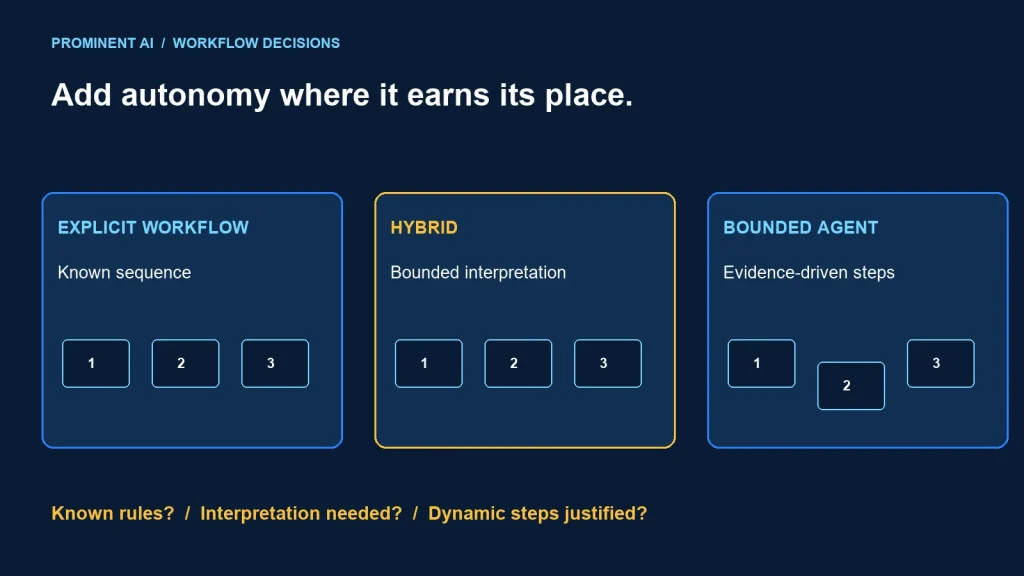
Use a deterministic workflow when the required sequence and decision rules are known. Use bounded agent autonomy when selecting the next useful step requires interpreting changing evidence. Many enterprise applications benefit from a hybrid: a controlled workflow owns identity, state, approvals and execution, while a model performs a limited interpretation or planning task.
“Deterministic” here describes the execution structure, not a promise that every dependency always returns the same result. A fixed workflow can include an AI extraction step whose output varies. An agent can also operate inside strict limits. The useful design question is where dynamic choice adds value and how the application contains its failure modes.
Start with the simplest decision path
- If the next operation is already known from validated inputs, implement an explicit rule or workflow.
- If language interpretation is needed but the business sequence is fixed, place a model inside that workflow.
- If the useful next step genuinely depends on intermediate findings, evaluate bounded agent planning.
- If required authority or evidence is missing, stop or escalate rather than expand autonomy.
Deterministic workflows and autonomous agents
An explicit workflow defines the states, operations and permitted transitions in application code or configuration. A model-driven agent can select steps or tools dynamically within its available environment. LangGraph’s workflows and agents guide describes this distinction and provides examples of common execution patterns.
For an enterprise architecture review, separate three questions: Who chooses the next step? Who decides whether it is permitted? Who owns recovery if it fails? A model can assist with the first question without becoming the authority for the other two.
What an explicit workflow does well
It makes the intended process reviewable. Teams can enumerate branches, test prerequisites and map failures to responsible owners. This is useful for predictable approvals, scheduled synchronization and known record transformations. It does not remove data-quality problems, upstream outages or the need for error handling.
Where bounded agent planning can help
Some investigations require choosing among sources, revising a search or asking a clarifying question after new evidence arrives. Enumerating every useful path may be impractical. A bounded agent can propose those steps while the application enforces source access, available tools, execution budgets and approval rules.
A decision matrix for workflow autonomy
| Requirement | Explicit workflow | Model step in a workflow | Bounded agent |
|---|---|---|---|
| Known sequence | Strong starting point | Useful when one step needs interpretation | Often unnecessary |
| Unstructured input | May need preprocessing | Extract or classify into a validated contract | Useful if interpretation also changes the investigation path |
| Changing evidence | Requires defined branches | Can interpret evidence within a known process | Can select further bounded steps |
| Auditability | Explicit transitions are inspectable | Record model and validation versions | Trace decisions, tools and evidence in addition to state |
| Cost predictability | Usually easier to estimate from the fixed path | Model usage remains a variable | Needs limits on requests, retries and planning |
| Consequential writes | Enforce approval and duplicate controls | Model can prepare a proposal | Autonomy does not remove approval requirements |
Three practical enterprise examples
1. Scheduled customer-record synchronization
A source record changes and a known set of fields must be mapped into a target system. If the mapping and exception rules are explicit, use an ordinary integration workflow. Validate identifiers, handle conflicts and preserve duplicate-safe processing. An agent deciding which field to update on every event adds discretion without a demonstrated need.
If free-text notes need classification, place that model task in a bounded step that outputs a reviewed schema. The surrounding process can remain explicit.
2. Invoice intake with review
The document format varies, but the business process is known: extract fields, validate them, match approved records and route exceptions. A hybrid workflow can use AI extraction while code checks required fields and business rules. The model does not approve payment merely because it recognizes an invoice.
Evaluate extraction and validation separately. A fluent summary is not proof that the amount, supplier or purchase-order reference was correctly recognized.
3. Support investigation across permitted sources
A specialist asks why an incident recurred. The useful next lookup depends on the first evidence retrieved. A bounded agent may choose a related incident, an approved knowledge search or a clarifying question. Give it read-only investigation capabilities and a stop condition for insufficient evidence.
If it proposes an operational change, transfer that proposal into an explicit review and execution path. The investigation’s flexibility should not silently become write authority. These scenarios are illustrative designs, not completed client projects.
A hybrid reference design
In the proposed design, the workflow owns the outer structure and the model owns a limited interpretation task. This separates flexibility from authority.
- Receive and authorize. Establish trusted caller context and allowed business scope.
- Prepare permitted evidence. Retrieve only approved sources and preserve references.
- Interpret or plan. Let the model classify, extract or select among bounded next steps.
- Validate the proposal. Check schema, prerequisites, permissions and execution budget.
- Review if needed. Route consequential changes to an eligible human reviewer.
- Execute and record. Use the supported business operation and retain its actual outcome.
The model should not be able to bypass the validation step by describing another route. A requested operation outside the contract becomes a defined rejection or escalation. For a detailed approval design, see human-in-the-loop AI agents.
Bound the search for a solution
Agree limits for active runtime, model requests, tool calls and clarification rounds. If the agent reaches a limit, return a clear incomplete result or escalate. Treat the limit as an operational decision to evaluate, not an arbitrary number copied from a demonstration.
Keep model-generated planning separate from the authoritative workflow state. A narrative saying “the change is approved” cannot replace the review record or the actual business-service result.
Evaluate usefulness, reliability and cost together
Build a representative set of tasks with expected outcomes and boundary cases. Compare a rules-based baseline, a bounded model step and an agent design on the same inputs. Include tasks that should be refused, clarified or escalated; measuring only completed answers can reward unsafe behavior.
- Correctness: was the result supported and appropriate for the user’s permitted task?
- Boundary correctness: were prohibited reads and writes blocked?
- Process reliability: did timeouts, restarts and malformed outputs reach defined outcomes?
- Cost: what was the total accounted cost per correct task, including retries and repair?
- Latency: what was the user-visible critical-path duration?
- Review burden: how much human intervention was needed and why?
No benchmark in this article claims one pattern universally outperforms another. An agent that finishes unusual investigations may justify added operational cost. A fixed process that handles the task correctly may be preferable even when an agent demonstration looks more sophisticated. For tracing and metric definitions, see AI agent observability.
Introduce autonomy incrementally
Begin with a read-only task and collect examples of where the explicit workflow struggles. Add model interpretation only at that boundary. Validate structured results and compare them with the existing process before allowing the model to select more steps.
When dynamic planning is justified, maintain a rollback to the simpler process. Version prompts, model settings, tools and evaluation cases together. Review any expansion of tool authority as an architecture change, not merely a prompt edit.
If multiple specialist agents become necessary, choose coordination based on the work rather than the number of roles in a diagram. Router, supervisor and hierarchical patterns address different assignment and recovery needs.
Common questions about workflow autonomy
When is workflow automation better than AI agents?
Can a deterministic workflow include generative AI?
Does autonomous mean unrestricted?
Which approach costs less?
How can a team move safely from a workflow to an agent?
Match autonomy to the actual process
Discuss an AI agent integration assessment with Prominent AI Services LLP. Bring the process, exceptions and acceptance criteria to decide where explicit automation or bounded AI adds value.
Technical reference reviewed 2 November 2026. The decision framework and scenarios are illustrative, without invented performance results.