
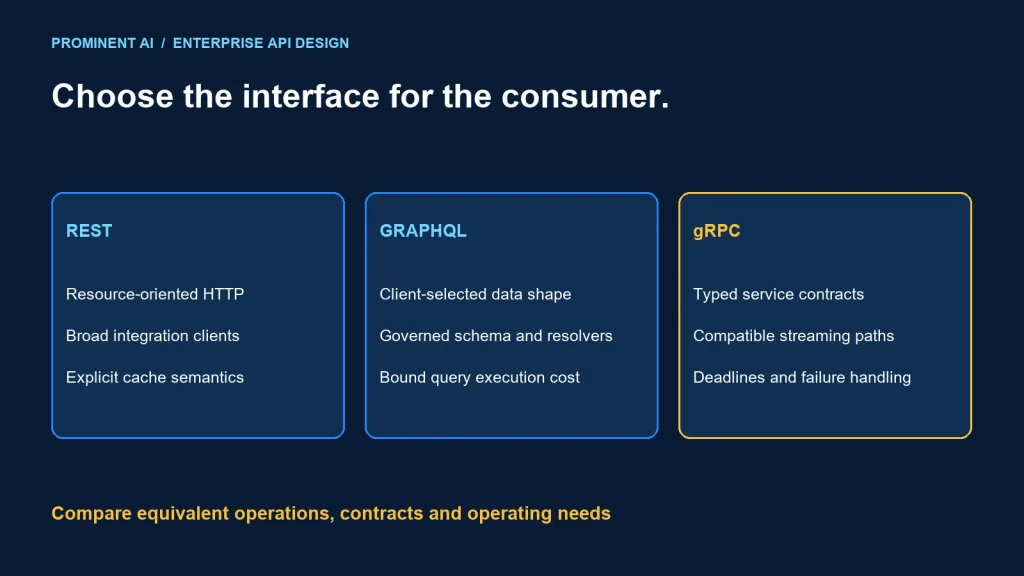
Use REST when resource-oriented HTTP interfaces and broad client compatibility fit the workload; consider GraphQL when clients need flexible, governed data selection; consider gRPC when typed service calls or supported streaming patterns fit controlled clients. The best enterprise API architecture may use more than one interface. Select from client needs, network behavior, authorization and operating responsibilities rather than a universal performance ranking.
Key takeaways
- REST, GraphQL and gRPC describe different interface models, not complete application architectures.
- Flexible queries need cost controls; generated contracts need evolution discipline.
- Caching and browser compatibility depend on the complete transport and client path.
- Compare equivalent business operations with security and failure behavior enabled.
REST vs GraphQL vs gRPC: compare the interface model
Microsoft’s REST API design guidance describes resource-oriented interfaces using HTTP semantics and representations. REST is an architectural style; JSON is a common representation choice rather than its definition.
GraphQL’s learning documentation introduces typed schemas, client-selected fields, queries and mutations. A schema gives clients a structured way to request data, while server-side execution and authorization still determine what can be returned.
gRPC’s core concepts describe service methods and typed messages, using Protocol Buffers by default. Unary and streaming call patterns support different interaction needs; client and infrastructure support must be checked for the selected mode.
None of these choices defines database ownership, business transactions or a microservice boundary. A single application can expose different adapters over the same authorized use cases. Keep business rules authoritative rather than duplicating them independently in every interface.
Two enterprise API architecture diagrams
Client-facing composition
Web / mobile / partner client
→ authenticated API boundary
├─ REST resource operations
└─ GraphQL schema and governed resolvers
→ application authorization and use cases
→ owned services and data

Cross-cutting controls: tenant scope, query limits, tracing and contracts
GraphQL can provide a composition boundary for a product experience, but a resolver must not become an unrestricted tunnel to every backend. REST can provide deliberately shaped resource representations instead of forcing clients to reconstruct internal tables.
Controlled internal service calls
Service client + identity + deadline
→ compatible routing and transport
→ gRPC method contract
→ authorized application operation
→ response or bounded stream

Failure controls: cancellation, resource limits, retries where safe,
contract compatibility and end-to-end telemetry
The internal path still crosses a trust boundary. A private network or generated stub does not establish permission. Define the identity and business operation before optimizing message encoding.
A workload and selection matrix
| Workload need | Candidate | Evidence to request |
|---|---|---|
| Broad partner ecosystem and familiar HTTP operations | REST | Documented resources, status semantics and client support |
| Several product clients need different data shapes | GraphQL | Schema design, resolver efficiency and query governance |
| Controlled typed service clients | gRPC | Language tooling, transport support and compatibility tests |
| Streaming interaction | Evaluate gRPC or an appropriate streaming interface | Actual client, proxy, flow-control and disconnect behavior |
| Cacheable public resource reads | REST is often a straightforward shortlist | Cache keys, authorization and invalidation design |
| Existing stable integration contracts | Retain unless a measured need justifies migration | Consumer impact and transition cost |
Use mandatory compatibility and security requirements as gates, then score remaining options. Record why network efficiency, client flexibility, operational familiarity or contract tooling matters for the workload. A score without evidence can disguise a team’s preference as an architecture conclusion.
Network behavior, caching and performance
Measure complete business operations. Comparing a small binary response with a JSON endpoint that returns unrelated data is not a fair protocol benchmark. Align data shape, authorization, compression, connection behavior and dependency work.
For GraphQL, inspect resolver fan-out and repeated reads. One client request can still produce many backend calls. Use the server implementation’s batching or caching facilities deliberately and keep tenant and authorization context in their scope.
For REST, avoid excessively chatty resource boundaries that make one screen require many sequential requests. An application-specific representation can be appropriate. Preserve useful HTTP semantics rather than treating every operation as an unrelated POST endpoint.
For gRPC, verify the deployed path supports the chosen transport and streaming requirements. Browser clients may need a compatible adaptation such as gRPC-Web; validate its supported modes rather than assuming native client behavior transfers unchanged.
Caching is an authorization and freshness decision as well as a speed feature. Resource URLs, GraphQL operation inputs, selected fields, tenant context and caller permissions can affect safe cache keys. Never share a response across users solely because the visible request text looks similar.
GraphQL response caching and normalized client caches can be useful, but they require deliberate identity and invalidation rules. A simple claim that GraphQL cannot cache, or that REST responses are always cacheable, misses the actual design choices.
Contracts and client developer experience
Publish the interface contract, examples and error behavior. For REST, describe representations and operations with suitable documentation such as OpenAPI. For GraphQL, maintain schema ownership and deprecation practices. For gRPC, version message and service definitions with generated clients and compatibility checks.
Code generation improves discoverability but does not remove business ambiguity. Clients still need to know whether an operation is idempotent, whether a failure means no work occurred and how long a result may take to become visible.
Test old consumers against new servers where the product requires coexistence. Avoid reusing identifiers or changing field meanings simply because a schema still parses. Compatibility includes semantics, not only serialization.
Define errors at the right layer. A successful network exchange can still contain a business rejection or partial data result. Ensure clients handle the protocol’s error model and the application’s business outcomes consistently.
Choose libraries after the contract and operating requirements are understood. No particular mediator, GraphQL server or gRPC hosting package is required to make the architecture valid. Review maintenance and licensing for the exact dependencies used.
Authorization, abuse controls and observability
Apply operation- and record-level authorization behind every adapter. A GraphQL field must not reveal data merely because the schema contains it. A REST identifier must not bypass tenant scope. A gRPC method must enforce its business permissions even when called by an internal service.
Bound request and response sizes, concurrency and execution cost. For flexible query interfaces, assess depth, breadth and expensive resolver combinations. Rate limiting based only on HTTP request count may not reflect actual server work.
Use deadlines and cancellation according to the business workflow. A client timeout does not prove a write was never committed. Safe retries need operation identity and a defined duplicate-handling contract, particularly for actions with external effects.
Trace request entry, use-case execution and downstream dependencies. Record operation identifiers safely without leaking tokens, sensitive arguments or entire query payloads unnecessarily. Keep enough context to distinguish transport failure from authorization denial and business rejection.
Review proxy and gateway behavior under failure. Connection draining, maximum durations, message limits and retry policies can change application behavior after deployment. Test through the actual ingress path instead of only calling a local development endpoint.
A pilot that compares equivalent operations
- Select a representative read and write journey.
- Define identical data scope and authorization requirements.
- Implement only viable interface candidates.
- Test normal, denied, malformed and oversized requests.
- Measure complete latency, throughput, errors and backend work.
- Exercise timeouts, retries, disconnects and old clients.
- Compare client effort, monitoring and maintenance responsibilities.
- Document the decision and migration boundary.
This is a proposed evaluation plan, not a claim of measured protocol superiority. A hybrid outcome can be appropriate: REST for partners, GraphQL for a governed product experience and gRPC for selected controlled service calls. Each additional interface must justify its maintenance and security surface.
Keep implementation boundaries aligned with the ASP.NET Core architecture comparison, and investigate real bottlenecks with the performance diagnostic runbook.
Common questions
When should developers choose GraphQL or gRPC over REST?
Consider GraphQL for governed client-selected data shapes and gRPC for compatible typed service calls or streaming needs. Validate the actual client and operating constraints.
Is gRPC always faster than REST?
No universal workload result applies. Compare equivalent operations through the real network path, including dependency work, encoding, security and connection behavior.
Does GraphQL remove backend overfetching automatically?
No. Clients select fields, but resolvers can still load excessive data or make repeated calls. Profile the server execution path.
Can an enterprise use all three approaches?
Yes, when different consumers justify different adapters and the team can maintain their contracts and controls. Keep business rules authoritative.
Does an internal API need authorization?
Yes. Internal routing and generated clients do not replace identity verification or operation- and record-level permissions.
Choose API contracts from consumer needs
Bring client requirements, integration constraints and current API pain points. Discuss your .NET modernization roadmap to compare interface models through a representative enterprise workload.