
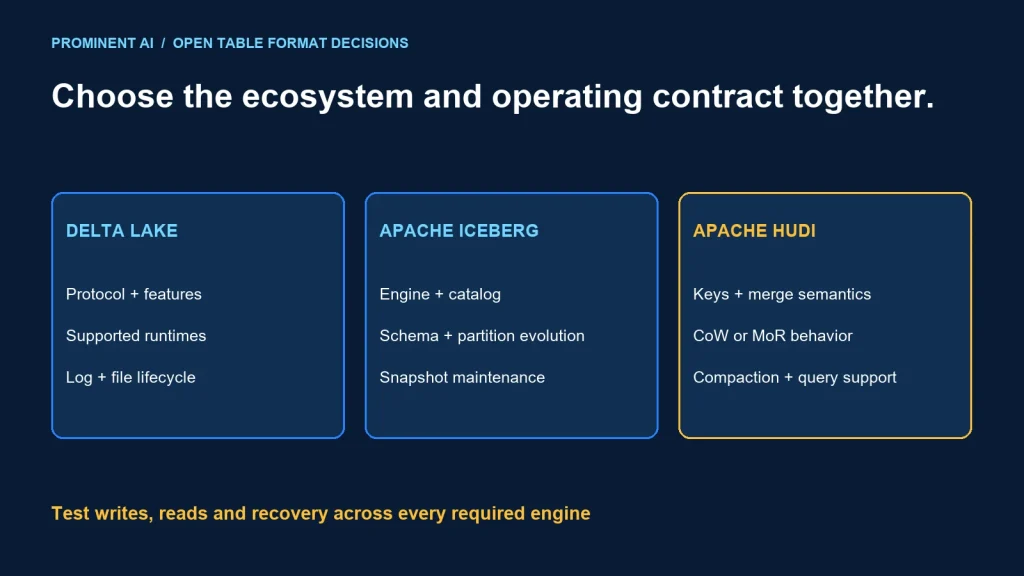
Choose Delta Lake, Apache Iceberg or Apache Hudi by the engines that must read and write your tables, the update workload and the maintenance model your team can operate. All three add table-level metadata and transaction behavior to data-lake storage. They are not interchangeable simply because a reader can open the underlying data files.
Key takeaways
- Test the exact reader, writer, catalog and table-feature combination.
- Include updates, deletes, concurrent writes and recovery in the pilot.
- Plan compaction, cleanup and retained-history policies.
- Measure workload behavior rather than ranking formats by brand recognition.
A table format is more than a folder of Parquet files
A file format describes how values are stored in an individual file. A table format adds metadata that identifies the valid table state and supports changes across files. Reading every file in a directory can produce an incorrect result if it ignores the table’s transaction metadata, delete information or snapshot rules.
Keep three layers separate: the storage objects, the table metadata and the catalog or service used to locate and coordinate tables. Interoperability requires support across the relevant layers, not just a statement that two products both understand Parquet.
How the three approaches affect decisions
Delta Lake: protocol and feature compatibility
Delta Lake’s compatibility guide describes table protocols and features that can require client upgrades. Enabling a feature can affect older readers or writers. Review every engine that touches a table before changing its feature set.
For a Delta-centered platform, evaluate the supported update, streaming and maintenance paths in the actual runtime. Do not assume a feature available in one managed platform is identical in every open-source or third-party client.
Apache Iceberg: schema and partition evolution
Iceberg’s evolution documentation describes schema, partition and sort-order evolution. These capabilities help separate logical table changes from a fixed directory convention. The practical value depends on reader and writer support and the catalog arrangement selected for the deployment.
Evaluate the catalog as an operational component: authentication, commit behavior, availability and recovery matter. A multi-engine strategy needs a tested write contract, not merely several successful SELECT statements.
Apache Hudi: table and query-type trade-offs
Hudi’s table-type guide distinguishes Copy-on-Write from Merge-on-Read. CoW rewrites base files for updates; MoR uses base and log data with compaction and appropriate query behavior. This exposes a trade-off between write work, read work and maintenance. Test the supported query type for each consuming engine.
Hudi can be a candidate for update-oriented ingestion, but its usefulness depends on keys, merge semantics and operational ownership. Do not select MoR solely because a demonstration writes quickly without measuring later reads and compaction.
Delta Lake vs Iceberg vs Hudi: selection matrix
| Decision | Delta Lake | Iceberg | Hudi |
|---|---|---|---|
| Compatibility review | Client versions and enabled table features | Engine, format version and catalog support | Engine, table version and query-type support |
| Changing data | Validate supported update and delete implementation | Validate engine-specific row-change support | Validate keys, merge rules and chosen table type |
| Metadata operations | Transaction-log and checkpoint lifecycle | Snapshots, manifests and catalog lifecycle | Timeline and table-service lifecycle |
| Maintenance | File layout and retained-history cleanup | File and snapshot maintenance | Compaction, cleaning and applicable table services |
| Best evidence | Representative supported-runtime pilot | Representative multi-engine pilot | Representative update/read/maintenance pilot |
The matrix identifies investigation priorities, not exclusive capabilities or benchmark winners. Each project evolves, and engine integrations can lag format capabilities. Record versions and enabled features with the test results.
Worked architecture example: changing customer data
Consider a fictional analytical platform receiving CDC updates for customer records. A transformation engine writes curated tables, two query engines read them and a reporting model serves business users. The requirement is to preserve the latest accepted record, apply deletions according to policy and recover from replay without duplicate effects.
CDC source events
  → validated keys and source ordering
  → one approved table-writing contract
  → versioned open-format table
  → supported query engine A / query engine B
  → reconciled business reporting

Owned services: catalog, maintenance, access,
history retention, reconciliation and recovery.- List engine constraints. Identify exact versions and supported table features for both readers and the writer.
- Test change semantics. Apply inserts, updates, deletes, repeated events and out-of-order arrivals.
- Test the maintenance cycle. Run supported compaction or cleanup and verify the same logical result.
- Test concurrent behavior. Confirm the supported commit and conflict-handling model.
- Choose from surviving candidates. Compare correct results, latency, cost and operating effort.
If one required engine cannot read a chosen table feature, either constrain that feature, change the integration or remove that candidate. Do not bypass the table layer by reading raw files to make the compatibility test appear successful.
Operational trade-offs architects should budget
| Choice | Benefit sought | Cost or risk to test |
|---|---|---|
| Frequent small commits | Lower visibility delay | Small files and metadata overhead |
| Long retained history | Investigation and recovery options | Storage and cleanup complexity |
| Multiple writers | Independent delivery | Commit conflicts and semantic inconsistency |
| Advanced table features | Specific performance or modeling capability | Reader and writer compatibility |
| Aggressive cleanup | Lower retained storage | Broken recovery or long-running-reader assumptions |
Choose history retention from actual recovery and consumer requirements. A table’s time-travel capability does not mean old data will remain available after the required files are cleaned up. Test supported recovery procedures and keep independent protection where the business requires it.
Schedule maintenance with an owner and failure alert. “Serverless” query access does not eliminate file layout, metadata growth or lifecycle responsibilities. Include the operator’s time when comparing cost.
A pilot that can support a decision
Use a declared dataset and workload mix. Measure append, update, delete, full scan, selective query and concurrent operation scenarios. Include cold and repeated reads and report failures. Keep equivalent logical results across candidates.
- Correctness after replay and deletes.
- Query behavior across every required engine.
- Schema changes and field interpretation.
- Commit conflict handling and restart behavior.
- Maintenance duration and logical-result checks.
- Storage growth and retained-history policy.
- Catalog and permission failure scenarios.
Publish the manifest with any benchmark: data sizes, change mix, engine versions, table settings, catalog, infrastructure and repetition count. A result from one configuration does not establish a universal ranking for all table formats.
Use the CDC architecture guide when change ordering and replay feed the table. Format selection cannot repair an incorrect upstream event contract by itself.
Common questions
Which lakehouse table format should architects choose?
Choose from candidates supported by the required readers, writers and catalog, then validate the actual update and query workload and maintenance process.
Are Parquet and Iceberg the same kind of format?
No. Parquet describes file storage; a table format manages table state and metadata across files. Compatible files alone do not establish table interoperability.
Can every engine read every table feature?
No. Verify exact engine and feature support. A protocol or table-feature upgrade can affect existing consumers.
Is Merge-on-Read always better for updates?
It shifts work between writing, reading and compaction. Measure the complete supported workload instead of judging only ingestion speed.
Does time travel replace backups?
Not automatically. Availability depends on retained metadata and data files, and recovery requirements may need separate protection.
Choose a table contract your engines can honor
Document the approved writers, consumers, features and maintenance owner. Request a data engineering pipeline assessment to compare table formats with workload and recovery evidence.