
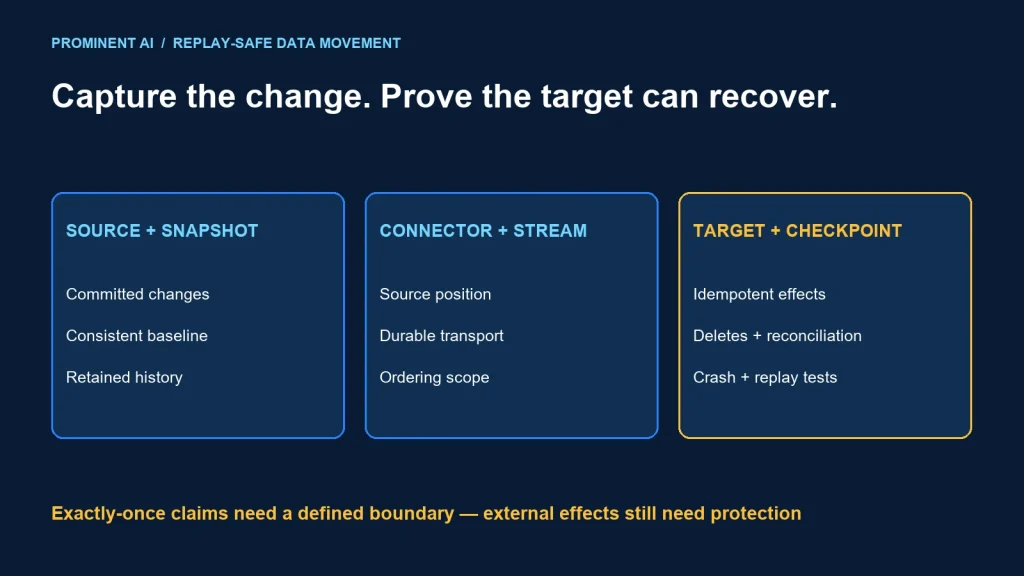
Change data capture, or CDC, identifies committed source changes so a consumer can update a downstream representation without repeatedly copying every row. Reliable CDC requires a consistent starting point, durable progress tracking, correct ordering assumptions and a sink that handles replay safely. Capturing an event is only the first part of maintaining a correct target.
Key takeaways
- Coordinate the initial snapshot with the subsequent change stream.
- Preserve source position and event identity through the pipeline.
- Design for replay and duplicates at the target.
- Monitor consumer lag against the source change-retention window.
SQL Server CDC and Debezium have different roles
SQL Server CDC uses transaction-log information to populate change tables for enabled source tables. Consumers can read captured changes over source-position ranges. Captured metadata helps interpret insertions, updates and deletions. The capture and cleanup processes must be operated so consumers can obtain the history they need.
The Debezium SQL Server connector uses SQL Server’s CDC capability and emits change events for consumers. Its snapshot and streaming configuration determines how the initial state and later changes are made available. Check documentation for the exact deployed connector version; the unversioned reference can describe a development release.
A CDC mechanism is not identical to an application-domain event. A changed order row says that database state changed; it may not establish that an order was approved or dispatched. Interpret business meaning through a documented contract rather than inferring it from arbitrary table updates.
Reference architecture with explicit checkpoints
Source transaction commits
  → SQL Server capture process and change tables
  → connector snapshot / change reading
  → durable transport with source metadata
  → consumer validation and key-based application
  → target state committed
  → consumer progress recorded safely

Monitor capture health, retention, lag, rejects,
target correctness and recovery checkpoints.Keep the source position distinct from event time and processing time. Timestamps can be useful for observability, but a timestamp alone may not uniquely order every change. Preserve the connector’s documented metadata instead of replacing it with the consumer’s local clock.
Assign owners for the source database, connector, transport and target. An end-to-end freshness incident can arise at any boundary, and each owner needs enough evidence to distinguish capture delay from consumer failure.
Initial snapshots and the stream handoff
An empty target needs a baseline before it can apply later changes. A snapshot establishes that baseline, while a coordinated source position determines how streaming continues. Without coordination, changes during the snapshot can be missed or applied twice.
Use the connector’s supported snapshot procedure rather than inventing a handoff based on wall-clock time. Record the selected mode, source impact, expected duration and restart behavior. Test updates and deletes that occur while the snapshot is in progress.
Re-snapshotting is a recovery decision
If required history has expired or a checkpoint cannot be trusted, continuing from the next available position can leave a silent gap. Stop the affected flow and choose a supported repair or re-snapshot procedure. Reconcile the target before resuming business consumption.
A large baseline can affect source load and downstream backlog. Measure the pilot using representative table sizes and concurrent source activity. Do not assume the fastest extraction settings are acceptable for the operational database.
Ordering, keys and idempotent application
Define the ordering scope you actually need. Source transaction order, per-table order and per-key transport order are different properties. Parallel consumers and partitions can change arrival order. A downstream multi-table view may temporarily observe related changes at different times unless the design coordinates them.
| Concern | Design decision | Test |
|---|---|---|
| Stable key | Identify the target row deterministically | Repeated update affects the intended row only |
| Duplicate event | Use a suitable event or source-position deduplication rule | Replay does not duplicate the effect |
| Out-of-order update | Apply a documented source-order comparison | Older state cannot overwrite newer state |
| Delete | Define hard delete, tombstone or retained-history semantics | Deleted source data is handled as intended |
| Checkpoint | Coordinate progress with durable target effects | Crash recovery neither loses nor double-applies work |
Idempotency means that repeating the same logical operation produces the intended final effect. It is not achieved merely by naming a pipeline “incremental.” Define the key and version rules and test them with replay.
An illustrative replay test
For a fictional customer record, apply version 10, replay version 10, then receive version 9 after version 11. The accepted target should retain version 11 under the declared ordering rule. This is a test design, not a universal implementation for every connector. Preserve composite positions and transaction metadata where the source requires them.
Why exactly-once claims need a boundary
A transport or processing framework can offer guarantees within a defined scope. That does not automatically guarantee exactly one external email, payment request or database side effect. A consumer can write to a target and crash before recording progress, causing a replay after restart.
Use a transaction that covers the required state and checkpoint where supported, or an appropriate idempotency design at the external boundary. Document the guarantee in concrete terms: which operations are atomic, which can repeat and which need reconciliation. Avoid describing the entire system as exactly-once without evidence for each boundary.
Do not discard duplicates blindly if distinct valid source operations happen to have identical business values. Event identity and source ordering metadata should distinguish replay from a legitimate repeated update.
Operational and recovery checklist
- CDC is enabled and configured for the intended source tables.
- Connector and source versions are supported together.
- Snapshot completion and streaming continuation are verified.
- Lag alerts account for available source-history retention.
- Deletes and schema changes have explicit handling.
- Rejected events are visible and owned.
- Target counts, keys and business aggregates reconcile.
- Crash and replay tests prove the checkpoint design.
- Source and target permissions use the required minimum scope.
Monitor more than the connector’s running status. Track the age of the latest applied source change, backlog, errors and target reconciliation. An apparently healthy worker can be processing the wrong table set or rejecting every changed record.
Review change-history retention against the longest plausible outage and recovery time. Longer retention also has resource costs, so agree on the trade-off with the source owner. If an outage exceeds the supported recovery window, use the documented gap-repair procedure.
Common questions
How does CDC replicate changes safely?
It needs a coordinated baseline and stream, durable source positions, correct sink semantics and tested recovery. Capture alone does not guarantee a correct replica.
Is CDC the same as polling a modified timestamp?
No. Timestamp polling is a different incremental pattern with its own update and delete limitations. Choose based on the source and required change semantics.
Why can CDC deliver duplicate effects?
Retries and crash recovery can replay work across non-atomic boundaries. Use appropriate idempotency or coordinated transactions and verify the behavior.
What happens if change history expires?
A consumer may be unable to recover a complete change sequence. Investigate the gap and use a supported repair or snapshot procedure instead of silently continuing.
Does CDC replace business-event design?
No. Database mutations and business events express different contracts. Define the business meaning and consumer behavior explicitly.
Design CDC around recoverable target state
For Fabric ingestion alternatives, review mirroring, pipelines and shortcuts. Request a data engineering pipeline assessment to review snapshot boundaries, replay and operational ownership.