

AI & Software Solutions for Medical Devices & MedTech
Connected device operations. Evidence your teams can follow.
Connect engineering, quality, product and service records across the device lifecycle. Build operational portals, integrations and reviewed AI with clear intended-use boundaries and accountable specialist review.
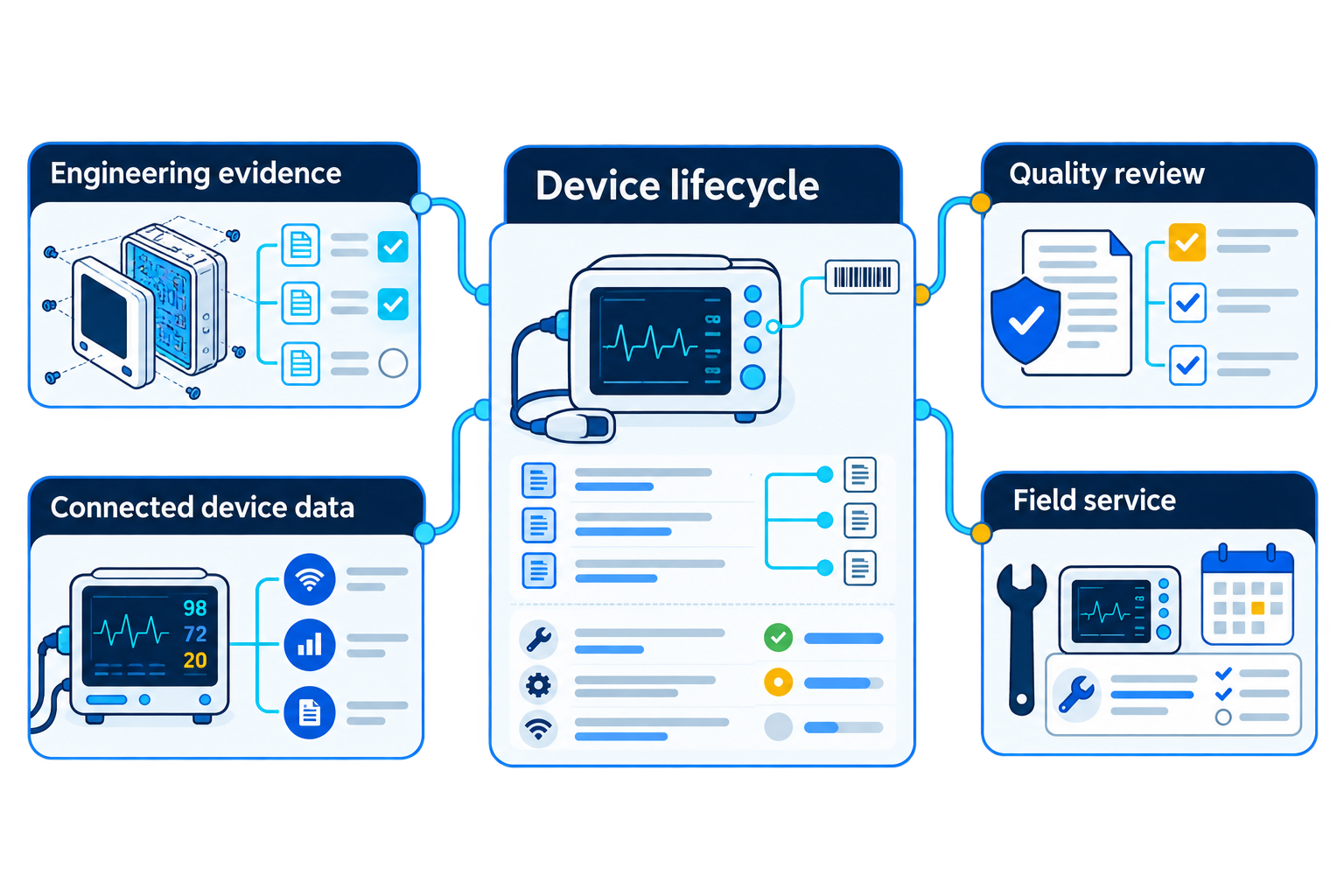
- Device lifecycle visibility
- Traceable product information
- Quality and service review
Industry ecosystem
Built for your part of the ecosystem
Choose the organization type that reflects your work.
Medical Device Manufacturers
Link engineering changes, production evidence and quality review.
Explore relevant applicationsConnected Health & MedTech Products
Connect permitted device events, product support and operational analytics.
Explore relevant applicationsDiagnostics & Laboratory Technology
Coordinate instrument data, quality exceptions and installation tasks.
Explore relevant applicationsDevice Distributors & Service Providers
Bring installed-base records, service work and complaint intake together.
Explore relevant applications
Business challenges
Turn disconnected work into traceable operations
Focus on the workflow, source records and people responsible for the result.
Device context is disconnected
Engineering, distribution and service records use different identifiers.
Review evidence is difficult to follow
Change and complaint records need linked sources and clear ownership.
Operational software needs a defined purpose
Teams must distinguish administrative support from regulated medical functions.
What we deliver
Practical solutions for medical devices & MedTech teams
Illustrative solution areas; scope, intended use and acceptance criteria are agreed during discovery.
Device data integration
Map permitted device events and product identifiers into operational systems.
Typical inputs: Interface specifications, event formats and intended-use boundaries.
WHAT YOU RECEIVEValidated field mappings and monitored ingestion interfaces.
Quality evidence workspaces
Connect change requests, inspection evidence and review responsibilities.
Typical inputs: Approved procedures, source records and role definitions.
WHAT YOU RECEIVEA review workspace with traceable evidence links.
Installed-base and service portals
Give authorized teams a shared view of device history and service requests.
Typical inputs: Installed-base records, service journeys and account permissions.
WHAT YOU RECEIVEA role-based portal with work and handover records.
Complaint intake coordination
Capture required information, flag missing identifiers and route cases to specialists.
Typical inputs: Approved intake fields, escalation rules and review owners.
WHAT YOU RECEIVEA traceable intake queue without automated reportability decisions.
Product operations analytics
Report agreed service, distribution and aggregate usage measures.
Typical inputs: Permitted records, metric definitions and refresh rules.
WHAT YOU RECEIVEOperational dashboards with restricted access and provenance.
Approved product knowledge search
Find current instructions and support content within product-version boundaries.
Typical inputs: Approved product documents, versions and access controls.
WHAT YOU RECEIVESource-linked retrieval with uncertainty escalation.
Practical applications
Medical Devices & MedTech applications by team and department
Explore a business problem, a three-step workflow and a practical output for each team.
Medical Device Manufacturers
Engineering
Design change evidence workspace
Change requests lack a consistent link to requirements and test evidence.
- 1Capture change request
- 2Link impact evidence
- 3Engineering team reviews
A traceable change package with review ownership.
Quality engineering
Nonconformance review queue
Quality issues and supporting inspection records are disconnected.
- 1Register issue
- 2Collect inspection evidence
- 3Quality team assesses
A controlled nonconformance queue with source references.
Production operations
Device serial and lot traceability
Production and distribution records need reconciliation across systems.
- 1Connect permitted identifiers
- 2Flag record gaps
- 3Operations verifies
A serial and lot traceability view with exception history.
Supply chain
Component availability reporting
Planning teams reconcile component and order data manually.
- 1Combine agreed records
- 2Highlight supply exceptions
- 3Planner reviews
A component dashboard with defined refresh and escalation rules.
Connected Health & MedTech Products
Product engineering
Device data integration
Device events and product records use different formats.
- 1Receive permitted events
- 2Validate data mapping
- 3Product team verifies
Documented ingestion interfaces with error handling and monitoring.
Customer support
Device support triage
Support teams lack product context for incoming requests.
- 1Capture support request
- 2Attach permitted device context
- 3Specialist reviews
A contextual support queue with clear escalation paths.
Product analytics
Connected product usage dashboards
Teams need aggregate product usage visibility across deployments.
- 1Collect permitted events
- 2Apply agreed measures
- 3Product team reviews
Aggregated operational reports without diagnostic or treatment recommendations.
Knowledge operations
Approved device knowledge assistant
Users struggle to find the right approved product instructions.
- 1Search current approved content
- 2Return source passages
- 3Escalate uncertainty
A source-linked support assistant with product-version boundaries.
Diagnostics & Laboratory Technology
Laboratory operations
Instrument result handover
Instrument outputs and laboratory systems require repeated manual transfer.
- 1Import permitted output
- 2Validate agreed fields
- 3Laboratory staff confirms
A reviewed data handover with source and reconciliation logs.
Technical services
Calibration task tracking
Calibration documents and service schedules sit in separate records.
- 1Register equipment schedule
- 2Route due tasks
- 3Authorized team verifies
An equipment service register with evidence links.
Quality control
QC exception workspace
Quality-control exceptions need supporting records and accountable review.
- 1Capture exception
- 2Attach reference evidence
- 3Qualified reviewer assesses
A QC investigation queue without automatic result release.
Customer onboarding
Laboratory installation coordination
Site prerequisites and training tasks are hard to coordinate.
- 1Capture site checklist
- 2Track readiness tasks
- 3Implementation lead approves
A laboratory onboarding plan with owners and completion evidence.
Device Distributors & Service Providers
Field service
Device maintenance coordination
Service teams need a shared view of installed devices and open work.
- 1Register service need
- 2Schedule qualified technician
- 3Verify completed work
A service workspace with device history and work records.
Complaint handling
Device complaint intake
Customer reports require consistent identification and follow-up.
- 1Capture report details
- 2Flag missing identifiers
- 3Specialist assesses
A complaint intake queue; reportability decisions stay with authorized specialists.
Distribution operations
Field action record coordination
Teams need current consignee and response information for agreed actions.
- 1Import approved action list
- 2Track communications
- 3Responsible team reconciles
An action tracking workspace without autonomous recall decisions.
Commercial operations
Device order and service portal
Orders, installed-base records and support requests are disconnected.
- 1Verify permitted account
- 2Link order and device records
- 3Account team reviews
A role-based customer portal with traceable request status.
Illustrative applications, not completed client projects. Examples describe possible project scope, not claims of deployed client results. Decisions remain with the designated responsible teams.
Designed for your environment
Designed around device context, evidence and intended use
Controls and deployment choices are scoped to your organization and intended use.
Access & permissions
Use role-based access and separate customer, device and person-linked records according to permitted purposes.
Traceability & review
Keep source links, product versions and review history. Clinical interpretation, safety assessment and regulatory decisions remain with qualified teams.
Deployment & integration
Agree software intended use, integration boundaries, testing, deployment, change control and support with engineering and quality owners.
These examples focus on operational workflows. Software intended for diagnosis, monitoring or treatment requires a separate intended-use and regulatory assessment. No device clearance, certification or regulatory compliance is implied.
Delivery approach
From a defined workflow to a working solution
Review concrete decisions and outputs at each stage.
- 01
Discover & scope
Map your workflow, permitted data, interfaces and responsible reviewers.
WHAT YOU RECEIVEAgreed scope and intended-use boundary - 02
Design & prototype
Test the key journey and review controls before wider implementation.
WHAT YOU RECEIVEPrototype and acceptance criteria - 03
Build & validate
Implement integrations and test the agreed requirements with your teams.
WHAT YOU RECEIVETested increment and acceptance evidence - 04
Launch & support
Deploy with handover, monitoring and change responsibilities.
WHAT YOU RECEIVEDeployment, documentation and support plan
Explore further
Related capabilities for medical devices & MedTech
Combine the capabilities this particular workflow needs.
Common questions
Medical Devices & MedTech software and AI FAQs
Practical answers about scope, integration, review and delivery.
What can medical device and MedTech software support?
Operational examples include design change evidence, serial and lot visibility, device support portals, laboratory data handovers and complaint intake coordination. Each application is scoped around its users, data and intended use.
Can you integrate device data with existing systems?
We assess permitted protocols, APIs, event formats and identifiers, then define the operational data flow and reconciliation. Connectivity depends on device and system interfaces, access and the intended-use boundary.
Is this software a medical device?
That depends on the software function, intended use and applicable jurisdiction. Administrative portals and operational reporting differ from functions intended for diagnosis or treatment. Your regulatory specialists should assess classification before scope and claims are agreed.
Can complaint reports be processed automatically?
Software can collect information, flag incomplete identifiers and route cases to the responsible team. Qualified specialists retain investigation, reportability, safety and field-action decisions. Automated regulatory submissions are not assumed.
How do you support quality and traceability needs?
The project can include source links, device identifiers, version history, role permissions and agreed testing evidence. Your quality team determines the applicable procedures and required acceptance evidence for the intended use.
Can we begin with a service portal or evidence workspace?
Yes. Start with a bounded operational workflow, identify the record owners and reviewers, and agree integration dependencies and acceptance criteria. The delivery plan, costs and ongoing support are defined after discovery.
Industry context: FDA: Device lifecycle and quality. These references inform the examples; they do not imply endorsement or certification.
Discuss your industry requirements →Connect your next device operations workflow.
Tell us about the task, your existing systems and who will review the result.
Prefer email? biz@prominent.tech · +91-96974 96976