
AI & Software Solutions for Pharmaceuticals & Biotechnology
Connected research and operations. Traceable work for specialist review.
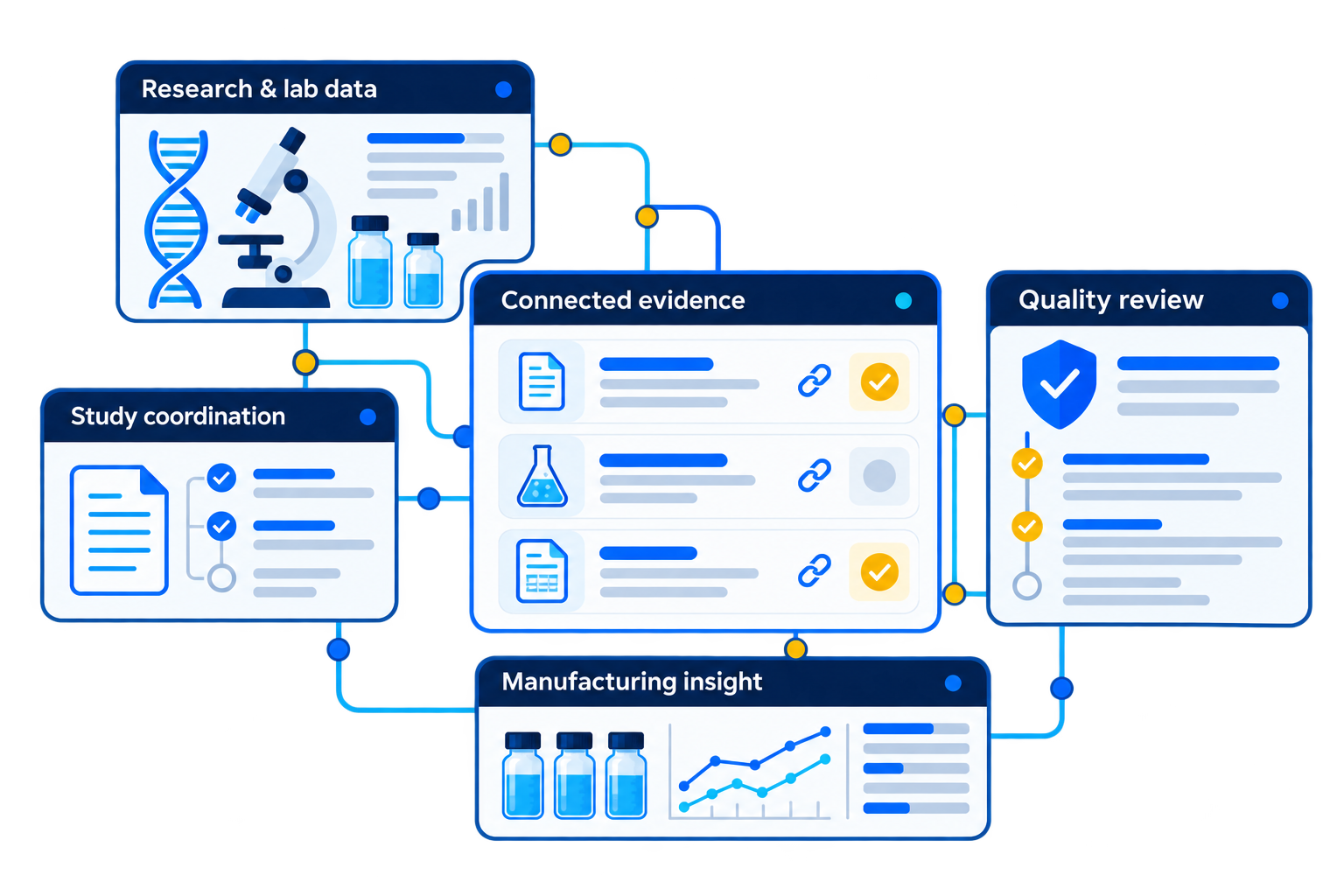
Bring research records, quality evidence and operational information into connected workspaces. Build software, integrations and reviewed AI around approved sources and the decisions your specialists own.
- Research and quality workflows
- Connected laboratory information
- Specialist-reviewed outputs
Industry ecosystem
Built for your part of the ecosystem
Choose the organization type that reflects your work.
Pharmaceutical Manufacturers
Connect manufacturing evidence, quality review and supply information.
Explore relevant applicationsBiotechnology R&D Companies
Organize research metadata, sample coordination and portfolio visibility.
Explore relevant applicationsClinical Research Organizations
Support study documents, site queries and agreed data reconciliation.
Explore relevant applicationsLife Sciences Services & Suppliers
Coordinate regulatory content, supplier evidence and information requests.
Explore relevant applications
Business challenges
Turn disconnected work into traceable operations
Focus on the workflow, source records and people responsible for the result.
Evidence is spread across systems
Research, laboratory and quality records are difficult to reconcile.
Document review loses context
Teams need current sources, review owners and a visible history.
Useful automation needs clear limits
Scientific conclusions and product decisions require specialist review.
What we deliver
Practical solutions for pharma & biotech teams
Illustrative solution areas; scope, intended use and acceptance criteria are agreed during discovery.
Research data workspaces
Organize experiment metadata and approved source references for research teams.
Typical inputs: Metadata dictionaries, research systems and permission rules.
WHAT YOU RECEIVEA searchable research workspace with provenance.
Quality evidence coordination
Bring deviations, supporting records and review responsibilities together.
Typical inputs: Agreed quality procedures, evidence sources and role definitions.
WHAT YOU RECEIVEA review workspace with traceable evidence and owners.
Laboratory and enterprise integration
Connect permitted LIMS, ERP and research interfaces with validation and exception handling.
Typical inputs: Interface specifications, field maps and data ownership.
WHAT YOU RECEIVEDocumented data pipelines with reconciliation logs.
Controlled knowledge retrieval
Retrieve current approved passages for scientific or operational staff to review.
Typical inputs: Approved documents, version rules and access boundaries.
WHAT YOU RECEIVESource-linked retrieval with review and escalation.
Operational analytics
Show agreed manufacturing, study and portfolio measures in defined operational views.
Typical inputs: Approved source records, metric definitions and refresh requirements.
WHAT YOU RECEIVETraceable dashboards for responsible teams.
Document and task workflows
Route missing evidence, document changes and supplier requests to designated reviewers.
Typical inputs: Document types, review routes and escalation rules.
WHAT YOU RECEIVEA controlled task queue with version and review history.
Practical applications
Pharmaceuticals & Biotechnology applications by team and department
Explore a business problem, a three-step workflow and a practical output for each team.
Pharmaceutical Manufacturers
Quality assurance
Deviation review workspace
Deviation records and investigation evidence are spread across systems.
- 1Capture deviation
- 2Link supporting evidence
- 3Quality team reviews
An investigation queue with owners and documented review status.
Manufacturing operations
Batch document completeness checks
Missing supporting records delay specialist batch review.
- 1Collect approved records
- 2Flag missing items
- 3Authorized reviewer assesses
A batch evidence checklist; release decisions remain with authorized staff.
Supply chain
Material status dashboards
ERP and warehouse records show inconsistent material status.
- 1Connect permitted records
- 2Reconcile status changes
- 3Planner reviews exceptions
A traceable inventory and material-exception dashboard.
Quality control
Laboratory result handover
Laboratory and quality teams re-enter result references.
- 1Import permitted results
- 2Validate mappings
- 3Analyst confirms handover
A reviewed result handover with source references and exception logs.
Biotechnology R&D Companies
Research informatics
Experiment metadata catalogue
Teams cannot consistently locate experiment context and approved records.
- 1Register experiment metadata
- 2Link source records
- 3Scientist verifies
A searchable research catalogue with access and provenance controls.
Research operations
Sample tracking coordination
Sample requests and handling milestones are recorded in disconnected tools.
- 1Record sample request
- 2Track agreed milestones
- 3Coordinator reconciles
A sample operations register with documented handovers.
Scientific knowledge
Research literature triage
Researchers repeatedly sort large sets of approved literature.
- 1Retrieve permitted references
- 2Group by research question
- 3Scientist reviews
A source-linked reading queue without unverified scientific conclusions.
Portfolio management
R&D milestone reporting
Project updates use different milestone definitions and formats.
- 1Collect project updates
- 2Normalize agreed milestones
- 3Portfolio lead reviews
A research portfolio dashboard with source-linked milestones.
Clinical Research Organizations
Clinical operations
Study document tracking
Study teams lose visibility of expected documents and review owners.
- 1Register required documents
- 2Flag incomplete records
- 3Study team verifies
A study document checklist with owners and review history.
Site coordination
Site query management
Operational queries are scattered across emails and shared files.
- 1Capture site query
- 2Route to responsible team
- 3Coordinator closes
A traceable operational query log without clinical decision automation.
Data management
Study data reconciliation queue
Transfers from approved systems contain inconsistent identifiers.
- 1Validate agreed fields
- 2Flag mismatches
- 3Data manager resolves
A reviewed reconciliation log with controlled source references.
Project finance
Study milestone invoicing support
Contract milestones and operational evidence are difficult to reconcile.
- 1Read agreed milestones
- 2Link completion evidence
- 3Finance reviews
An invoice preparation queue with supporting evidence.
Life Sciences Services & Suppliers
Regulatory operations
Submission content workspace
Teams struggle to locate current approved document versions.
- 1Register controlled sources
- 2Assemble document checklist
- 3Regulatory specialist reviews
A version-aware preparation workspace; no automatic regulatory submission.
Safety operations
Safety information intake routing
Incoming reports need prompt routing and completeness follow-up.
- 1Capture permitted report
- 2Flag missing fields
- 3Safety team assesses
A tracked intake queue; causality and reporting decisions stay with specialists.
Supplier quality
Supplier evidence tracking
Certificates and supplier review documents have different review dates.
- 1Register supplier evidence
- 2Notify review owner
- 3Quality reviewer approves
A supplier evidence register with review reminders.
Medical information
Approved content retrieval
Teams need current, approved responses with source references.
- 1Search approved materials
- 2Retrieve relevant passages
- 3Specialist reviews response
A permission-aware content assistant with version and source links.
Illustrative applications, not completed client projects. Examples describe possible project scope, not claims of deployed client results. Decisions remain with the designated responsible teams.
Designed for your environment
Designed around research, quality and controlled information
Controls and deployment choices are scoped to your organization and intended use.
Access & permissions
Separate research, study and commercial data according to permitted use and organizational access rules.
Traceability & review
Preserve source records, versions and review history. Scientific, safety, quality and release decisions remain with qualified teams.
Deployment & integration
Define integration boundaries, intended use, testing evidence, retention and operating responsibilities with your quality and IT teams.
These examples describe operational software and reviewed assistance, not autonomous clinical decisions or drug discovery claims. Validation, quality-system and regulatory requirements depend on the intended use and jurisdiction and must be assessed by your specialists.
Delivery approach
From a defined workflow to a working solution
Review concrete decisions and outputs at each stage.
- 01
Discover & scope
Map your workflow, permitted data, interfaces and responsible reviewers.
WHAT YOU RECEIVEAgreed scope and intended-use boundary - 02
Design & prototype
Test the key journey and review controls before wider implementation.
WHAT YOU RECEIVEPrototype and acceptance criteria - 03
Build & validate
Implement integrations and test the agreed requirements with your teams.
WHAT YOU RECEIVETested increment and acceptance evidence - 04
Launch & support
Deploy with handover, monitoring and change responsibilities.
WHAT YOU RECEIVEDeployment, documentation and support plan
Explore further
Related capabilities for pharma & biotech
Combine the capabilities this particular workflow needs.
Common questions
Pharmaceuticals & Biotechnology software and AI FAQs
Practical answers about scope, integration, review and delivery.
What software applications are relevant to pharma and biotech teams?
Examples include experiment metadata catalogues, study document tracking, laboratory data handovers, quality evidence queues and operational dashboards. The appropriate scope depends on the organization, intended use, approved data and accountable reviewers.
Can you connect LIMS, ERP and research systems?
We start with the interfaces your systems expose and the records your teams permit us to exchange. Field mapping, source ownership, reconciliation and controlled error handling are defined before integration is accepted.
Does this replace quality or regulatory review?
No. The applications organize records, flag missing information and assist preparation. Batch release, scientific interpretation, safety assessment and regulatory decisions remain with authorized specialists.
Can AI answer questions from controlled documents?
A retrieval-based assistant can search an approved document set and show source references. Version boundaries, permissions, evaluation questions and escalation are agreed with your team; generated text still requires appropriate review.
How is software validation handled?
Your quality and regulatory teams determine the intended use and applicable obligations. We agree requirements, test evidence, change controls and handover deliverables within the project scope. No blanket validation, certification or compliance claim is made.
Where should a pilot begin?
Choose a bounded workflow such as document completeness tracking or research metadata search. Use permitted data, name the reviewer and define acceptance criteria before agreeing the project plan and commercial scope.
Industry context: FDA: Pharmaceutical quality resources. These references inform the examples; they do not imply endorsement or certification.
Discuss your industry requirements →Start with one traceable pharma or biotech workflow.
Tell us about the task, your existing systems and who will review the result.
Prefer email? biz@prominent.tech · +91-96974 96976