

Prominent AI Services LLP
Manufacturing & Industry 4.0

AI & Software Solutions for Manufacturing & Industry 4.0

Connect production information to practical action.

Build tools for production reporting, inspection review, maintenance analysis and industrial document workflows.

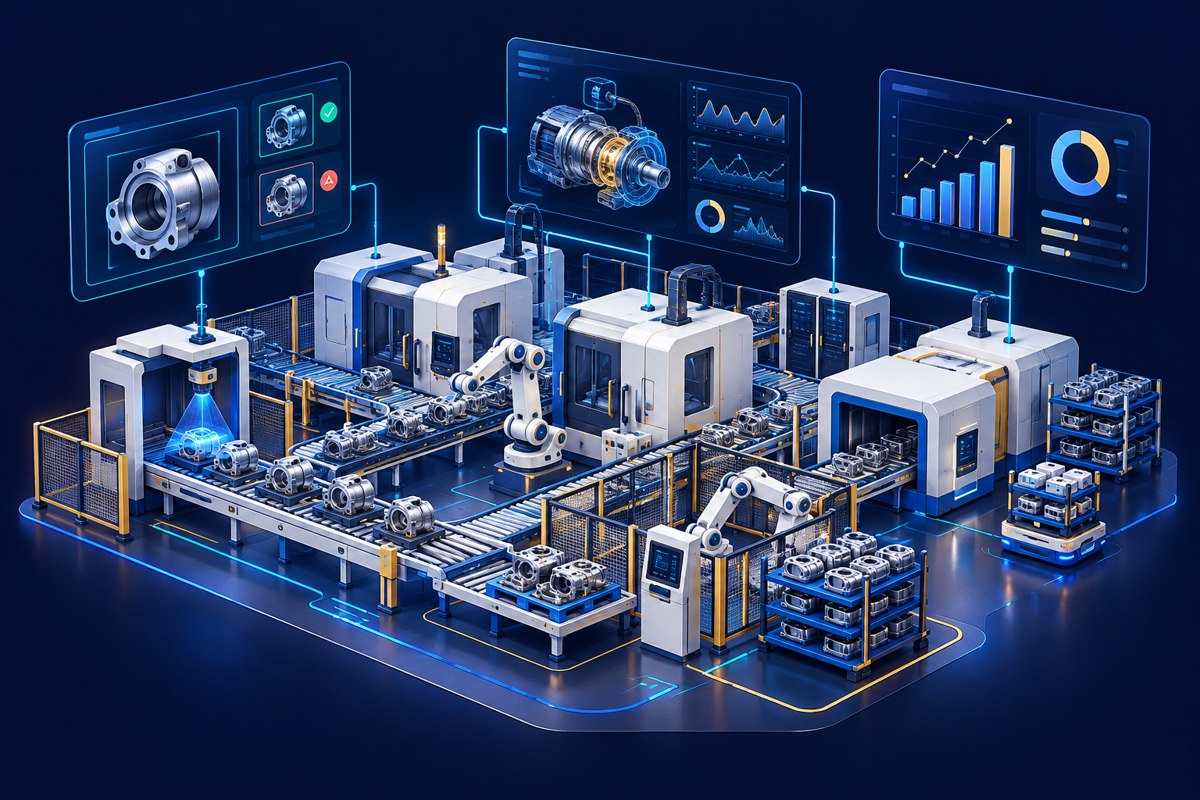
Illustrative manufacturing & industry 4.0 systems connected through data and software workflows.
Illustrative solution ecosystem, not a completed client project.
  • Workflow automation
  • Data integration
  • Human-reviewed AI

Built for your part of the ecosystem

Solutions for organizations and teams working across manufacturing & industry 4.0.

Start with the workflow that needs improving

  • Equipment and production information is difficult to combine consistently.
  • Quality evidence and maintenance records are spread across different tools.
  • Teams need usable reporting without introducing unvalidated control changes.

Practical solutions for complex workflows

Illustrative solution areas; scope, applicability and acceptance criteria are validated during discovery.

  • Quality-inspection support

    Use images and defined criteria to help reviewers identify inspection candidates.

    Typical inputs: Representative inspection images and qualified annotations.

    Practical output: A review tool with measured error rates and escalation.

  • Maintenance analytics

    Explore equipment trends and historical maintenance patterns.

    Typical inputs: Permitted sensor exports, service logs and operating context.

    Practical output: Condition reports and tested analytical indicators.

  • Production reporting

    Bring agreed throughput, downtime and process measures into one view.

    Typical inputs: Production records, event definitions and shift information.

    Practical output: Reconciled dashboards with source definitions.

  • Industrial document workflows

    Route work instructions, service documents and approvals to responsible teams.

    Typical inputs: Approved documents, versions and ownership rules.

    Practical output: Version-aware search and review queues.

  • Equipment-data integration

    Connect permitted equipment feeds to operational applications.

    Typical inputs: Available gateways, exports, APIs and connectivity constraints.

    Practical output: A monitored data interface and mapping specification.

  • Operations applications

    Build task, exception and handover tools for production teams.

    Typical inputs: Existing operational systems and workflow rules.

    Practical output: A usable application with role-based task tracking.

From disconnected information to connected workflows

Bring your systems, data and teams together with applications, useful AI assistance and clear human responsibility.

  1. Source systems

    Permitted equipment feeds
    Production & maintenance records
    Approved work documents

  2. Integration & data

    Approved connectivity
    Data mappings
    Source traceability

  3. Applications & AI assistance

    Work queues & portals
    Reporting & search
    Reviewable drafts

  4. Human review & action

    Authorized teams
    Specialist review
    Approvals & decisions

Access controls · Audit logging · Monitoring · Agreed retention

Example applications in your operating context

Illustrative workflows using synthetic information, not completed client projects.

Inspection review

An image is associated with a work item, flagged findings are reviewed and the qualified inspector records the outcome.

Discuss this workflow

Maintenance planning

Equipment trends and service history are combined in a report that supports a maintenance planning discussion.

Discuss this workflow

Designed around your data and operating requirements

Controls and deployment choices are scoped to your environment and intended use.

  • Access & permissions

    Read permissions and integration boundaries that respect operational environments.

  • Traceability & review

    Representative test conditions, qualified review and traceability of inspection results.

  • Deployment & integration

    Deployment, connectivity, monitoring and operational ownership agreed with plant teams.

These examples do not provide autonomous safety-critical control, machine-safety certification or guaranteed defect detection. Any safety-relevant use requires appropriate specialist assessment and validation.

A stack selected for your environment

Examples of technologies discussed for these workflows. Final selection depends on existing systems, access, licensing and evaluation.

Data & analytics

Technology marks identify products only; they do not imply partnerships, certifications or endorsement. Specialist industry standards and platforms are assessed individually rather than assumed compatible.

A clear path from discovery to deployment

A collaborative delivery approach with concrete outputs.

  1. Discover & scope

    Understand the workflow, users, systems, constraints and acceptance criteria.

    Output: Agreed project scope
  2. Design & prototype

    Define interfaces, permissions and a prototype for the key user journey.

    Output: Solution prototype
  3. Build & validate

    Implement, test and validate the agreed workflow with your team.

    Output: Tested working increment
  4. Launch & support

    Deploy with handover, monitoring and the agreed improvement plan.

    Output: Deployment & handover

Questions before you start?

Answers about starting a manufacturing software, data or AI project.

Will the software control production equipment?

The examples here focus on information, workflow and review tools. Equipment control is outside this page’s assumed scope. Safety-related requirements need separate engineering assessment, approval and validation.

How do you assess inspection feasibility?

We review the target conditions, representative images, annotations and the consequences of errors. A feasibility phase compares an approach with agreed baselines before operational adoption.

Can you work with existing equipment data?

We assess permitted gateways, exports and APIs together with network and vendor constraints. Integration is limited to interfaces and access agreed with your operational team.

Can we begin with one line or reporting problem?

Yes. A bounded reporting, document or inspection-review workflow can define the data and acceptance requirements before a wider rollout.

What handover and support are included?

The engagement defines testing, source-code ownership, documentation, training, monitoring and maintenance. Support scope follows the deployment environment and agreed operational responsibilities.

Let’s improve your manufacturing workflows.

Tell us about your users, systems and priorities.

Discuss Your Manufacturing Project